


1. Appeals against forfeiture of properties under SAFEMA for alleged illegal acquisition from smuggling proceeds. (Para 1 , 6 )

 Back
Back





APPELLATE TRIBUNAL FOR FORFEITED PROPERTY
Balesh Kumar, Member, Rajesh Malhotra, Member
Shri Ekramul Ansari Shri Tajamul Ansari – Appellant
Versus
The Competent Authority New Delhi – Respondent
FPA-146/DLI/2023
1. Appeals against forfeiture of properties under SAFEMA for alleged illegal acquisition from smuggling proceeds. (Para 1 , 6 )
2. Appellants claim properties from lawful sources; respondent argues properties acquired from illicit funds. (Para 2 , 3 , 4 , 5 )
3. Forfeiture of immovable properties upheld; forfeiture of bank account balances set aside. (Para 13 )
The person affected bears the burden to demonstrate that the property was acquired from lawful sources. (Para 8 , 9 )
Yes, if the properties are traceable to the convict or detenu and the relative fails to prove they are not illegally acquired. (Para 7 , 8 , 9 )
No, if no prejudice is caused and the properties are shown to belong to the appellant. (Para 11 )
No, if the amounts are too meagre to be correlated to unlawful earnings and no nexus is shown. (Para 10 , 12 )
FINAL ORDER
14.10.2025
This Order disposes of the Appeals Nos. FPA-146/DLI/2023 and FPA-147/DLI/2023 filed by Shri Ekramul Ansari and Shri Tajamul Ansari against the Order F. No. CA/DL/SAFEMA/02/2014-15/Vol-I dated 23.03.2023 (Impugned Order) passed by the Ld. Competent Authority and Administrator SAFEM (FOP) A, 1976 and NDPS Act, 1985, New Delhi. The Impugned Order under Section 7 (1) & (3) of the Smugglers and Foreign Exchange Manipulators (Forfeiture of Property)Act, 1976 (SAFEMA) forfeited the following properties: -
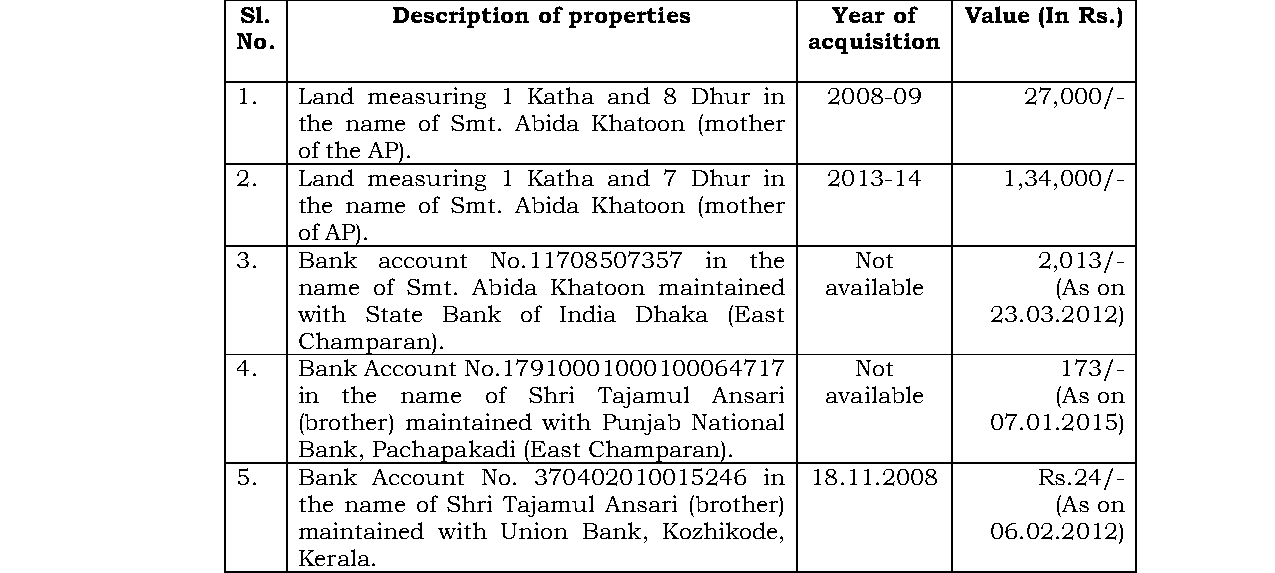
2. Ld. Counsel for the Appellant contended that there is no evidence on record to show any nexus between the properties forfeited and the alleged illegal earnings of the Appellants. He cited the Judgment of the Hon’ble High Court of Delhi in the matter of Kamal Kumar vs. Union Of India [2017 (345) ELT 104 (Del)]. Ld. Counsel also stated that the properties which have been forfeited are owned by Smt. Abida Khatoon and Shri Tajamul Ansari, mother and brother of the Appellant Shri Ekramul Ansari. Ld. Counsel further stated that Smt. Abida Khatoon expired on 21.08.2015 and drew attention to the death certificate which have been filed vide Application dated 22.10.2024. Ld. Counsel challenged the validity of the proceedings since the Show Cause Notice dated 02.07.2018 was issued to a dead person.
3. Ld. Counsel for the Appellant contended that the properties which have been forfeited had been acquired out of the own savings of the mother and the brother of the Appellant. The Appellant has claimed that the mother of the Appellant had customary jewelry and savings of her Late Husband. She had a Kisan Credit Card against which she obtained loan of Rs. 50,000/-, out of which Rs. 25,000/- was taken on 14.02.2011 and further Rs. 25,000/- was taken on 16.03.2011. In this regard, the copy of the Kisan Credit Card with the said endorsement was submitted to the Ld. Competent Authority. Further, copy of the Old Age Pension Scheme Book was also submitted which showed that Late Smt. Abida Khatoon had income therefrom as well. A copy of the State Bank of India Passbook of savings account No. 11708507357 was also submitted. Ld. Counsel stated that payment receipts made by the Appellant Shri Ekramul Ansari to his mother from February, 2013 to January, 2014 had also been submitted to the Ld. Competent Authority. Ld. Counsel further stated that the Appellant Shri Ekramul Ansari worked as Tailor in Mumbai between 1990 and June, 2006 for which he earned wages of Rs. 5,000/- to Rs. 10,000/- per month. The Appellant went to Dubai in July, 2006 and as Tailor in M/s First Choice Palace, Dubai, the Appellant was paid 800 Dirham per month till April 2014 when his salary became 2000 Dirham. Ld. Counsel contended that Late Smt. Abida Khatoon acquired the impugned properties through her own savings and lawful earnings remitted by the Appellant from abroad. Ld. Counsel for the Appellants further contended that the sum of Rs. 173 and Rs. 24 in the two accounts of the brother Shri Tajamul Ansari (Appellant in connected Appeal) are from his own earnings. He argued that the amounts are so petty and the fact that the Appellant Shri Tajamul Ansari worked independently and earning income of Rs. 15,000/- to Rs. 20,000/- per month, that by no stretch of imagination it can be said that this money in two accounts has nexus with alleged illegal income of his brother Shri Ekramul Ansari. Ld. Counsel therefore pleaded that the Forfeiture Order may be set aside and the Appeal may be allowed.
4. Ld. Counsel for the Respondent stated that the loan taken against Kisan Credit Card is in violation of the purpose for which the Card is issued. Such loan is granted for the purchase of agricultural inputs like seeds and fertilizers. Moreover, the loan was taken in 2011 and the two properties in the name of Late Smt. Abida Khatoon were acquired in the year 2008-09 and 2013-14 i.e. much before and much after the loan, as loan of Rs. 25,000/- each was taken on 14.02.2011 and



An indispensable Tool for Legal Professionals, Endorsed by Various High Court and Judicial Officers
Please visit our Training & Support
Center or Contact Us for assistance

Scan Me!
India’s Legal research and Law Firm App, Download now!


For Daily Legal Updates, Join us on :



 Back to top