Back
Back





2023 Supreme(Online)(BOM) 24878
HIGH COURT OF BOMBAY
K. R. SHRIRAM, RAJESH S. PATIL, JJ
Percept Finserve Private Limited – Appellant
Versus
Edelweiss Financial Services Limited – Respondent
Commercial Appeal (L) No. 284 of 2019 | Commercial Arbitration Petition No. 220 of 2014
For the Appellants/Petitioners: Mr. Aditya Pimple, Mr. Deepak Deshmukh, Ms. Nisha Kaba
For the Respondents: Mr. Karl Tamboly, Ms. Priyanka Shetty, Mr. Harshit Jaiswal, Mr. Aditya Singh Chauhan
Clauses in a Share Purchase Agreement providing an option to repurchase stocks are not illegal under SCRA unless associated with trading derivatives.
Headnote:(A) Arbitration and Conciliation Act, 1996 - Section 37 - Jurisdiction under Section 34 narrow - Appellants challenge legality of Award based on alleged breach of Share Purchase Agreement - Contract clauses deemed illegal for being forward contracts and options not traded on stock exchange under SCRA - Single Judge reverses finding stating clauses not illegal or unenforceable. (Paras 2, 11, 18)
(B) Illegal Contracts - Appellants failed to fulfill conditions of Share Purchase Agreement - Rights of Edelweiss to option for repurchase clearly defined and legal - Clarification given by the Apex Court assists interpretation of contract's enforceability. (Paras 10, 16)
(C) The court emphasized options do not constitute illegal contracts as defined under Section 18A of SCRA unless trading is involved. (Paras 20, 21)
Facts of the case:
The case revolves around a Share Purchase Agreement between Edelweiss and Percept, where Edelweiss claimed breach of contract leading to arbitration proceedings to enforce repurchase clauses.
Findings of Court:
The learned Single Judge held the clauses to be enforceable despite the Arbitrator’s reservations, clarifying legal definitions under SCRA.
Issues: Main issue pertains to legality of clauses in context of SCRA regulations.
Ratio Decidendi: The court affirmed that merely defining an option in a contract does not render it illegal unless it involves trading, as per SCRA stipulations, thus allowing the appeal.
Result: Appeal dismissed.
ORAL JUDGMENT (PER K.R. SHRIRAM, J.) :
1 Appellants have preferred this appeal under Section 37 of the Arbitration and Conciliation Act, 1996 (hereinafter referred to as “the said Act”) aggrieved by an order and judgment dated 27th March 2019 passed by the learned Single Judge of this Court under Section 34 of the said Act by which the learned Single Judge was pleased to allow the petition filed under Section 34 and set aside the impugned Award.
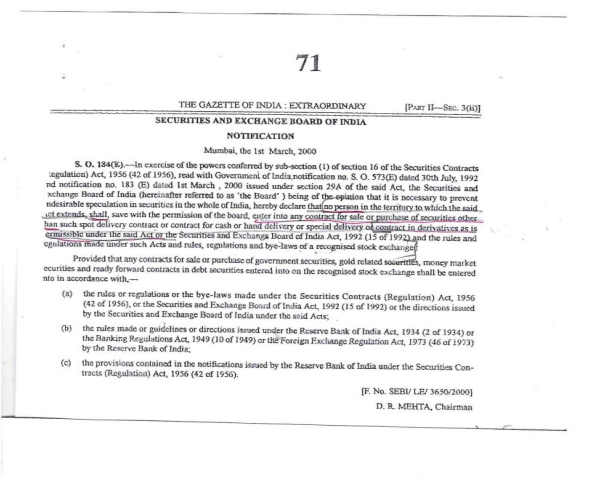
2 In the petition, respondent to this appeal, i.e., Edelweiss Financial Services Limited (hereinafter referred to as “Edelweiss”), had challenged an Award dated 6th June 2013 passed by the sole Arbitrator, whereby the sole Arbitrator concluded that two clauses, viz., clause 8.5 and clause 8.5.1 in the Share Purchase Agreement between Edelweiss and appellants herein Percept Finserve Private Limited and Percept Limited (hereinafter collectively referred to as “Percept”) are illegal because they were forward contracts contrary to the provisions of the circular issued by SEBI under Section 16 of the Securities Contracts (Regulation) Act, 1956 (hereinafter referred to as “ SCRA ”) and also because they are options and hence, contracts in derivatives not being traded on stock exchange and hit by Section 18A of SCRA . The Arbitral Tribunal held that clauses 8.5 and 8.5.1 are not enforceable.
3 Before we proceed further, it will be useful to remind us about the scope of an appeal under Section 37 of the said Act, its jurisdiction as an Appellate Court in examining an order, setting aside or refusing to set aside an Award. The Apex Court in UHL Power Company Limited V/s. State of Himachal Pradesh , (2022) 4 SCC 116, in paragraph 16 held as under :
16. As it is, the jurisdiction conferred on Courts under Section 34 of the Arbitration Act is fairly narrow, when it comes to the scope of an appeal under Section 37 of the Arbitration Act, the jurisdiction of an Appellate Court in examining an order, setting aside or refusing to set aside an award, is all the more circumscribed. In MMTC Limited v. Vedanta Limited , the reasons for vesting such a limited jurisdiction on the High Court in exercise of powers under Section 34 of the Arbitration Act has been explained in the following words :
“11. As far as Section 34 is concerned, the position is well- settled by now that the Court does not sit in appeal over the arbitral award and may interfere on merits on the limited ground provided under Section 34 (2)(b) (ii), i.e., if the award is against the public policy of India. As per the legal position clarified through decisions of this Court prior to the amendments to the 1996 Act in 2015, a violation of Indian public policy, in turn, includes a violation of the fundamental policy of Indian law, a violation of the interest of India, conflict with justice or morality, and the existence of patent illegality in the arbitral award. Additionally, the concept of the “fundamental policy of Indian law” would cover compliance with statutes and judicial precedents, adopting a judicial approach, compliance with the principles of natural justice, and Wednesbury reasonableness. Furthermore, “patent illegality” itself has been held to mean contravention of the substantive law of India, contravention of the 1996 Act, and contravention of the terms of the contract.”
4 Facts in brief are :
Edelweiss and Percept had entered into a Share Purchase Agreement dated 8th December 2007 (hereinafter referred to as “SPA”) as amended by a Deed of Rectification dated 21st April 2008 (hereinafter referred to as “Deed”) and an Amendment Agreement dated 23rd April 2008 (hereinafter referred to as “Amendment Agreement”). Under the SPA, Edelweiss purchased 2,28,374 shares of appellant no.2 - Percept Limited held by appellant no.1 - Percept Finserve Private Limited for a total consideration of Rs.20 Crores. The SPA had certain conditions subsequent set out therein, first of which required appellant no.1 as of appellant no.2 to accomplish