
 Back
Back





IN THE HIGH COURT OF JUDICATURE AT BOMBAY BENCH AT AURANGABAD
SHAILESH P. BRAHME, J.
Tukaram S/o Rekha (Rekhu) Rathod - Appellant
Vs.
Sham Balkrishanrao Selukar - Respondent
Second Appeal No. 1705 of 2005 With Civil Application No. 5021 of 2008 With Second Appeal No. 109 of 2014
Decided On : 17-10-2025
Case Details: Second Appeal No. 1705 of 2005 with Civil Application No. 5021 of 2008 and Second Appeal No. 109 of 2014, decided on 17-10-2025 by the High Court of Judicature at Bombay (Aurangabad Bench). (!) (!)
Parties: Appellant: Tukaram S/o Rekha (Rekhu) Rathod; Respondent: Sham Balkrishanrao Selukar. Plaintiffs (respondents 1-3) are sons of Balkrushna; defendants 6-7 are uncles; defendants 8-9 are step-brothers; defendants 1-5 are purchasers. (!) [3][4][5]
Subject Matter: Dispute over right of pre-emption under Section 22 of the Hindu Succession Act regarding undivided joint family properties (land gut Nos. 488, 490, 595) alienated via four sale deeds by defendants 6-9 to defendants 1-5. [4][6][7]
Substantial Questions of Law:
Entitlement of defendants 1-4 to Section 44 TPA protection. (!)
Trial Court Decree (30.03.1992): Declared sales void due to fraud, granted pre-emption right on deposit of sale consideration within 90 days (by 30.12.1992), restrained purchasers from disturbing possession. Suit proceeded ex-parte against some defendants. [9][11]
Lower Appellate Court (30.07.2005): Confirmed decree with modifications; no fraud found; 90 days for deposit; concurrent findings on joint family property, possession, and pre-emption right. [11][12][13] (!) (!) (!) (!) (!) (!) (!)
Family and Property Status: Undivided joint family of Keshav (propositus); no partition; ancestral properties; plaintiffs (sons of predeceased son Balkrushna) and defendants 6-9 in joint possession, confirmed by prior suit (RCS 908/1987). [4][17][18][19][20] (!)
Class I Heir Status and Pre-emption Right: Plaintiffs qualify as Class I heirs (sons of predeceased son) under Section 22 HSA vis-a-vis Keshav; preferential right to acquire undivided shares proposed for transfer; activates on timely deposit of consideration. (!) [21][22][23][24][25] (!) (!) (!) (!) (!) (!) (!) (!) (!)
No Estoppel or Waiver: No evidence plaintiffs were offered purchase opportunity pre-sale or refused; knowledge alone insufficient. [29] (!)
Deposit Timeline (Order XX Rule 14 CPC): 90 days fixed by trial court; stay during appeals suspended obligation; appellate court did not extend time, merely reset post-stay; non-payment leads to suit dismissal. [30][31] (!) (!) (!) (!) (!) (!)
No Section 44 TPA Protection: Purchasers of undivided shares must sue for partition; no such suit filed; strangers cannot claim against joint possession. [15][16][33] (!) (!)
No Need to Set Aside Sale Deeds: Pre-emption decree transfers title on deposit; possession already with plaintiffs; declaration unnecessary for undivided property. [7][34][35] (!) (!)
Fraud and Consideration: No fraud established; sale consideration reasonable, upheld. [13][36] (!)
Outcome: Both second appeals dismissed; decree confirmed with modification (deposit purchase price + 6% interest from 31.12.1992 within 90 days from judgment date). [36][37][38] (!) (!)
Ratio: Class I heirs in joint possession of undivided family property have enforceable pre-emption right under Section 22 HSA on timely deposit; no separate declaration to void sales needed. [summary paras 30,36,24,21,14,25,28,34,35]
JUDGMENT :
SHAILESH P. BRAHME, J.
. Taken up for final hearing with the consent of the parties.
2. Both appeals are admitted on the substantial questions emanating in order dated 15.02.2008, which can be summarized as follows :
(i) Whether the right of preemption is exercisable when defendant Nos. 6 and 7 are not Class I heirs of the deceased Balkrushna ?
(ii) Whether the property owned by the defendant Nos. 6 and 7 is liable to be transferred to the plaintiffs U/Sec. 22 of the Hindu SUCCESSION ACT ?
(iii) Whether plaintiffs can get title of the suit lands U/Sec. 22 of the Hindu SUCCESSION ACT without setting aside the sale deeds in question ?
(iv) Is it an error of law committed by Courts below by extending the time to deposit the sale amount, which is against Order XX Rule 14 of the C. P. C. ?
(v) Whether the extension of time granted by the lower Appellate Court is logical and palatable ?
(vi) Whether defendant Nos. 1 to 4 are not entitled to get benefit of Sec. 44 of the Transfer of Property Act ?
3. Both the second appeals are emanating from decision of the Trial Court in Spl. C. S. No. 25 of 1990 rendered on 30.03.1992 decreeing the suit. Being aggrieved R.C.A. No. 82 of 2001 was preferred by original plaintiffs and cross objection was preferred by the defendants – purchasers. By common judgment dated 30.07.2005 appeal as well as cross objection were dismissed, but judgment of the Trial Court was marginally modified. Against the judgment, Second Appeal No. 1705 of 2005 is preferred by the defendants – purchasers and Second Appeal No. 109 of 2014 is preferred by the original plaintiffs. I propose to refer the papers of Second Appeal No.1705 of 2005 and the parties therein as per their original status in the suit.
4. The matter pertains to joint family properties and right of preemption U/Sec. 22 of the Hindu SUCCESSION ACT (hereinafter referred as to the “Act” for the sake of brevity and inconvenience). It is apposite to understand the genealogy, which is as follows :
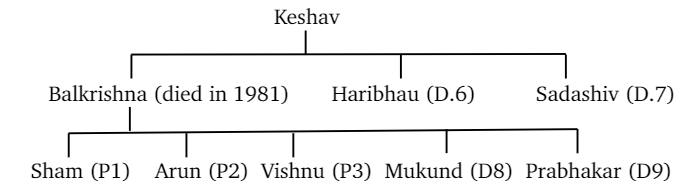
5. The respondent Nos. 1 to 3 are original plaintiffs, sons of Balkrushna. The respondent Nos. 6 and 7 are their real uncles. The respondent Nos. 8 and 9 are their step brothers. Appellants are the purchasers of the joint family property vide four distinct sale deeds.
6. Following are the details of the registered sale deeds of the joint family properties, which are questioned and for which the right of preemption U/Sec. 22 of the Act is claimed by the plaintiffs.
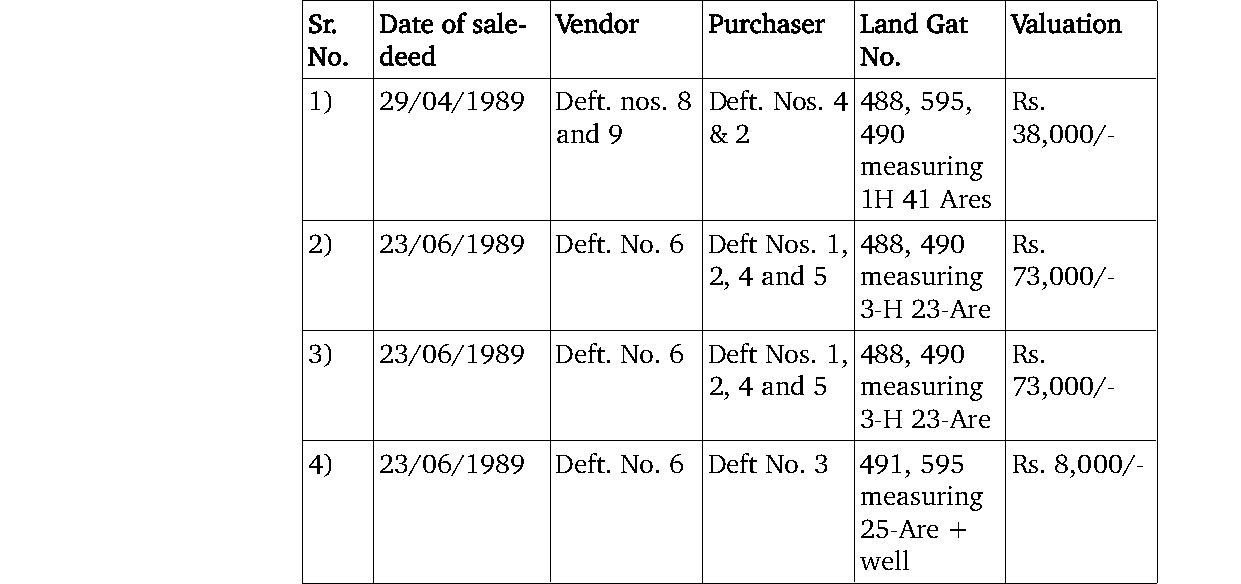
7. Plaintiffs had filed Spl. C. S. No. 25 of 1990 when they learnt about above referred alienations and thereafter when their peaceful possession was obstructed by the defendants - purchasers. It is contended by them that land gut Nos. 488, 490 and 595 are the undivided joint family properties. The defendant Nos. 6 to 9, who alienated part of the suit lands in different combinations to the purchasers had no authority to execute sale deeds bypassing claim of preemption of the plaintiffs. The plaintiffs and the defendant Nos. 6 to 9 are in joint possession and cultivation of the suit lands, which is evident from the orders passed in R.C.S. No. 908 of 1987. It is further contended that defendant Nos. 6 to 9 fraudulently alienated the suit lands to the defendant Nos. 1 to 5. The suit is filed seeking relief of declarations and perpetual injunction asserting right of preemption under Section 22 of the Act.
8. The defendant Nos. 2, 4 and 5 – purchasers, contested the suit by filing written statement challenging the status of the suit lands and the plaintiffs. Right of preemption U/Sec. 22 of the Act is denied by them. It is contended that they are tenants and in occupation of the suit lands even prior to execution of the sale deeds. The suit is stated to be barred by time.
9. The suit proceeded ex-parte as against defendant Nos. 1, 3 and 6 to 9. 10. Plaintiffs adduced evidence of plaintiff No. 1 – Shyam. Defendants adduced oral evidence of four witnesses including D.W. 1 Venkat, D.W. 2 Haribhau, D.W. 3 Jairam and
AI
The court affirmed that Class I heirs have a preferential right of preemption under Section 22 of the Hindu Succession Act regarding joint family properties, emphasizing the need to deposit the purch....

The right of pre-emption under Section 22 of the Hindu Succession Act applies even post-transfer if co-heirs were not notified, reinforcing the protection of joint family property.
The right of pre-emption under the Hindu Succession Act is contingent upon the property being that of a Hindu male who dies intestate, which was not applicable in this case.

The court clarified that a will's condition restraining alienation does not apply to the legal representatives of the testator and that a right of preemption under the Hindu Succession Act is only ap....
Pre-emption rights under Section 22 of the Hindu Succession Act cannot be invoked by non-Class I heirs after property partition and are valid until declared otherwise by a competent court.

Point of law: condition restraining from alienating his share cannot be imposed and such a condition is void. However, as above pointed out, the preemption clause available to the plaintiff by virtue....

A plaint must disclose a clear cause of action; clever drafting that creates an illusion of a cause of action is insufficient for maintaining a suit.



An indispensable Tool for Legal Professionals, Endorsed by Various High Court and Judicial Officers
Please visit our Training & Support
Center or Contact Us for assistance

Scan Me!
India’s Legal research and Law Firm App, Download now!


For Daily Legal Updates, Join us on :



 Back to top


