
 Back
Back





IN THE HIGH COURT OF JUDICATURE AT BOMBAY CRIMINAL APPELLATE JURISDICTION
Manish Pitale, Manjusha Deshpande, JJ
Shrabani Deodhar – Appellant
Versus
The State of Maharashtra & Ors. – Respondent
WRIT PETITION NO. 4546 OF 2013 | WRIT PETITION NO. 4547 OF 2013
The legal analysis of the case indicates that the key issue revolves around whether the petitioners can be held liable for the offences under the relevant laws, specifically the Atrocities Act, IPC, and PCR Act, based on the circumstances of the airing of the Marathi serial.
The court found that the essential element of intent to humiliate a member of a Scheduled Caste or Scheduled Tribe was not established against the petitioners. It was noted that the petitioners, including the Programming Head and the Executive Producer, did not create or directly involve themselves in the script content that contained the objectionable words. The actual utterance was by an actor, spontaneously, and there was no evidence to suggest that the petitioners intentionally included or endorsed the derogatory language or intended to insult or humiliate the complainant or other members of the Scheduled Castes or Tribes (!) (!) (!) .
Furthermore, the court emphasized that merely broadcasting content that contains potentially offensive language does not automatically constitute an offence unless there is clear evidence of an intentional act to insult or humiliate, which was absent in this case. The petitioners' role was limited to broadcasting, and disclaimers were issued to clarify that they did not endorse the content. The absence of specific allegations linking the petitioners to the act of uttering the objectionable words or to an intent to insult was significant (!) (!) (!) .
The court also considered the procedural aspect, noting that the FIR was registered based on a court order and that the allegations did not prima facie demonstrate the essential ingredients of the offences. The statements of witnesses, which were identical and based on feelings of insult and humiliation upon viewing the episode, were not sufficient to establish the required mens rea or intent for criminal liability at this stage (!) (!) .
In conclusion, the court held that the basic ingredients of the offences under the relevant laws were not satisfied against the petitioners. The absence of evidence of intentional wrongdoing, the spontaneous nature of the utterance, and the limited role of the petitioners in the content production process led to the decision to quash the FIR against them. The court exercised its jurisdiction to prevent abuse of process, considering that the allegations did not constitute a prima facie case for proceeding with criminal prosecution (!) (!) .
The FIR was thus quashed, and the petitions were allowed, emphasizing that this decision was specific to the petitioners involved and did not affect any other potential proceedings against individual actors or content creators involved in the serial (!) (!) .
JUDGMENT
(Per Manish Pitale, J.) :
By these petitions, the petitioners have prayed for quashing of FIR No. 232 of 2023 registered at Wada Police Station, Dist.
Thane, for offences under Section 295A of the Indian Penal Code, 1860 (hereinafter referred to as ‘IPC’ for short), Section 7(g) of the Protection of Civil Rights Act, 1955 (hereinafter referred to as ‘PCR Act’ for short) and Section 3 of the Scheduled Castes and the Scheduled Tribes (Prevention of Atrocities) Act, 1989 (hereinafter referred to as ‘Atrocities Act’ for short).
2. The petitioner in Writ Petition No. 4546 of 2013 was the Programming Head for a Marathi Channel, ‘Star Pravah’ owned by the Star Entertainment Media Private Limited (hereinafter referred to as ‘SEMPL’ for short). The petitioners in Writ Petition No. 4547 of 2013 are the SEMPL and the Executive Producer of the aforesaid SEMPL. The petitioners are aggrieved on being shown as accused in the aforesaid FIR, on a report lodged by the first informant-Rahul Gaikwad.
3. The other accused persons are the Director, Scribe and Actor concerned with a Marathi language serial Laxmi versus Saraswati (hereinafter referred to as ‘Marathi serial’ for short), which was produced by Reliance Broadcast Network Limited (hereinafter referred to as ‘RBNL’ for short).
4. The allegation in the report, leading to registration of the FIR, is that the said accused persons were responsible for airing of a particular episode on 22.08.2012 of the said Marathi serial, in which the words 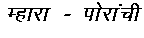 (mhara-poranchi) were used in a dialogue by one the character. This was in the context of warding off evil eye, as regards the leading character in the said Marathi serial. According to the first informant, the said words were intentionally used in order to humiliate him and others, who saw the episode and this constituted offence under the provisions of the Atrocities Act, apart from the aforesaid offences under IPC and PCR Act.
5. The petitioners submit that even if the allegations made in the present FIR, are to be accepted for the sake of arguments, the basic ingredients of the offences are not made out. It was submitted that the petitioners before this Court in these petitions neither uttered objectionable words nor were they content creators of the said Marathi serial.
6. On 10.09.2014, when these petitions came up for consideration, this Court granted Rule and interim relief was granted in terms of prayer clause (b), as a consequence of which, further investigation remained stayed as against the petitioners only.
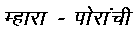
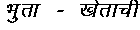
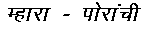
7. The petitions were taken up for hearing and disposal when Mr. Satish Mane-Shinde, learned senior counsel appearing for the petitioner in Writ Petition No. 4546 of 2013 and Mr. Sanjog Parab, learned senior counsel appearing for the petitioners in Writ Petition No. 4547 of 2013, submitted that the thrust in the present case on behalf of the investigating authority as well as the first informant appeared to be in respect of offences under the provisions of the Atrocities Act. Since the alleged incident took place prior to the amendment of the year 2016 in the Atrocities Act, attention of this Court was invited to Section 3 of the Atrocities Act, as it stood prior to the amendment. It was submitted that in the light of the allegations made by the first informant, only Section 3(1)(x) of the Atrocities Act appears to have been invoked. In fact, Ms. Sharmila Kaushik, learned APP as well as Mr. Milind Ingole, learned counsel appearing for the respondent No.3-first informant, submitted that Section 3(1)(x) of the Atrocities Act was indeed invoked. It is relevant to note that the equivalent provision post amendment is Section 3(1)(r) of the Atrocities Act. By referring to the said provision, it was submitted that the basic ingredients of the offence are not made out in the present case. There is no assertion that the petitioners are not members of a scheduled caste or scheduled tribe, knowledge or intention of using the objectionable words cannot



An indispensable Tool for Legal Professionals, Endorsed by Various High Court and Judicial Officers
Please visit our Training & Support
Center or Contact Us for assistance

Scan Me!
India’s Legal research and Law Firm App, Download now!


For Daily Legal Updates, Join us on :



 Back to top


