
 Back
Back





CENTRAL ADMINISTRATIVE TRIBUNAL
M. Swaminathan, J, Sangam Narain Srivastava, A
T.A. Tamilmani, G. Ramaraj, S. Gajendran, K. Radha Krishnan, T.S. Parthiban, A. Thulasirangan, V. Pugazhendi, K. Madhavachari, B. Thangamani, S.R. Ravechandiren, D. Gopalakrishan, S. Sivasubramanian, C. Padmanabhan, K. Radhakrishnan – Appellant
Versus
Union of India – Respondent
OA
| Table of Content |
|---|
| 1. overview of applicants' claims for macp benefits. (Para 1 , 2) |
| 2. arguments supporting entitlement to upgraded pay. (Para 3 , 4 , 5) |
| 3. judicial observations on relevant laws and previous rulings. (Para 6 , 7 , 8 , 9) |
| 4. ratio decidendi establishing the basis for decisions. (Para 10 , 11) |
| 5. conclusive ruling granting the macp benefits. (Para 12 , 13) |
ORDER
(Pronounced by Hon'ble Mr. M. Swaminathan, Judicial Member)
This OA have been filed by the applicants seeking the following relief:
“To declare that the applicants are entitled to 3 MACP benefit in PB2 (Rs.9300 – 34800) with Grade Pay of Rs.4600/- and consequently set aside order No.707, dated 24.12.2015 and Order th No.25122, dated 08.02.2016, issued by the 4 rd respondent in so far as it grants 3 MACP benefit in PB2 with grade Pay of Rs.4200 and consequently rd direct the respondents to grant the applicants, 3rd MACP Benefit in PB2 (Rs.9300 – 34800) with Grade Pay of Rs.4600/- with effect from the respective due dates with all consequential benefits, including monetary benefits flowing therefrom and pass such further or other orders as may be deemed fit and proper”.
2. Brief facts of the case, as submitted by the applicants are as follows:
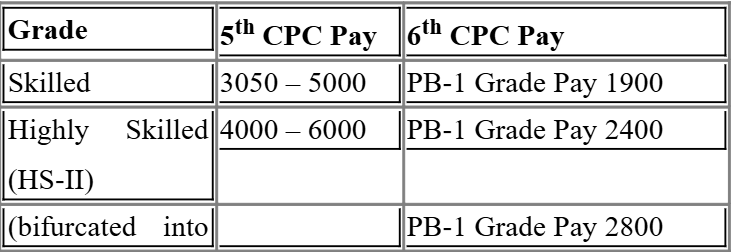
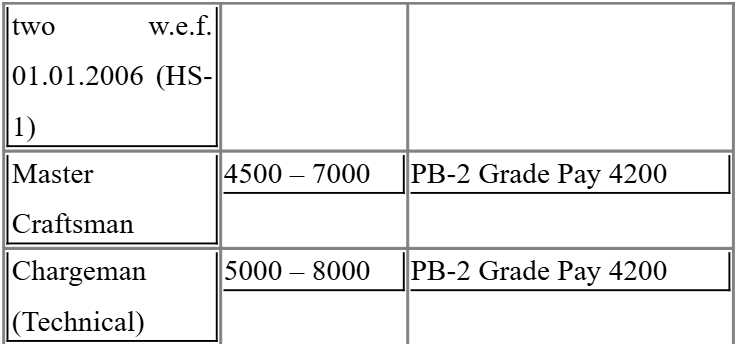
The applicants are industrial employees working at the 4th respondent's factory. They were initially appointed in the Semi-Skilled Grade, later moved to the Skilled Grade, promoted to the Highly Skilled (HS) Grade, and eventually placed as Master Craftsmen. The transition from Highly Skilled (Rs. 4000-6000) to Master Craftsman (Rs. 4500-7000) occurred in 2005, at a time when the Master Craftsman position was not considered part of the hierarchical structure. In effect, the post was regarded as a dead-end position, and movement into it was viewed as a placement, not a promotion. At the time, the next promotional post from the Highly Skilled Grade was the Chargeman (Rs. 5000-8000). Following the recommendations of the 6th CPC, Master Craftsmen were granted a replacement scale of PB2 with a Grade Pay (GP) of Rs. 4200. The Chargeman post was also placed in PB2 with a GP of Rs. 4200. In 2010, the 1st respondent restructured the industrial cadre with retrospective effect from 01.01.2006. Under the revised structure, the Master Craftsman position was integrated into the promotional hierarchy and considered a promotional post from the Highly Skilled Grade. The applicants were placed as Master Craftsmen in 2005, before the revised cadre structure was implemented. Under the Modified Assured Career Progression (MACP) Scheme, employees are entitled to financial upgradation to the next available Grade Pay in the hierarchy after stagnating in a particular Grade Pay for ten years. Accordingly, the applicants, having served for ten years in PB2 with a GP of Rs. 4200, were entitled to be placed in PB2 with a GP of Rs. 4600. However, the applicants were granted the 3rd MACP under the impugned orders dated 24.12.2015 and 08.02.2016, which kept them in the same Pay Band (PB2) with a Grade Pay of Rs. 4200, along with a 3% increment benefit. Upon inquiry, the applicants were informed that the respondents' position was that, since the Chargeman's Pay Band and Grade Pay (Rs. 4200) were the same as those of the Master Craftsman, the applicants were not eligible for a higher Grade Pay of Rs. 4600. This has led to the present Original Application.
3. The learned counsel for the applicants argued that the MACP Scheme clearly provides that, upon completing the required number of years, an employee is entitled to financial upgradation to the next available grade pay within the hierarchy of Pay Bands. The scheme imposes no restriction on granting the next available Grade Pay, even if it exceeds the Grade Pay attached to the promotional post within the hierarchy.
4. He further emphasized that the MACP Scheme is based on the hierarchy of Pay Bands, unlike the ACP Scheme, which was based on the hierarchy of posts. Therefore, when implementing the benefits under t



An indispensable Tool for Legal Professionals, Endorsed by Various High Court and Judicial Officers
Please visit our Training & Support
Center or Contact Us for assistance

Scan Me!
India’s Legal research and Law Firm App, Download now!


For Daily Legal Updates, Join us on :



 Back to top


