
 Back
Back





CUSTOMS EXCISE & SERVICE TAX APPELLATE TRIBUNAL
ASHOK JINDAL, Judicial Member, K. ANPAZHAKAN, Technical Member
Neo Metaliks Limited – Appellant
Versus
Commissioner of Central Goods and Service Tax – Respondent
FINAL ORDER NO. 75496 / 2026
| Table of Content |
|---|
| 1. facts of alleged clandestine excise duty demand from return discrepancies. (Para 2 , 3 , 4) |
| 2. appellant argues no evidence for clandestine removal; ca reconciliation. (Para 5) |
| 3. revenue defends order; court frames issues. (Para 6 , 7) |
| 4. ca certificate explains differences via trading; must be considered. (Para 8 , 9) |
| 5. clandestine allegation unsustainable without concrete evidence. (Para 10) |
| 6. extended limitation not invocable post-audit. (Para 11 , 12) |
| 7. demand set aside; appeal allowed. (Para 13 , 14) |
ORDER: [PER SHRI ASHOK JINDAL]
The appellant is in appeal against the impugned order wherein the demand of central excise duty amounting to Rs.16,54,91,669/- (inclusive of cess), along with interest and penalty thereon under Section 11AC of the Central Excise Act, 1944, has been confirmed against them.
2. The facts of the case are that M/s. Neo Metaliks Limited (hereinafter referred to as “the appellant”) is a public limited company, inter alia engaged in the manufacture of Pig Iron, Pig Iron Chips, Pig Iron Skull, MS Scrap, Granulated Slag and Sinter at its factory located at Bamunara Industrial Area, P.O. Gopalpur, Durgapur, District – Burdwan, West Bengal and registered with the Central Excise authorities under Registration No. AABCN8514GXM001.
3. During the course of scrutiny of records of the appellant in 2014, the Department compared the sales value declared in VAT returns for the financial year 2012-13 with the value of clearances reported in ER-1 returns and assumed the differential value to be the value of goods clandestinely removed without payment of excise duty. The observations of the Department were communicated to the appellant vide spot audit memo dated 13.03.2014, to which the appellant furnished its reply on 02.04.2014.
3.1. The Department carried out similar comparisons for the Financial Years 2013-14, 2014-15 and 2015- 16 as well.
4. Subsequently, a Show Cause Notice dated 09.05.2017 was served upon the appellant by invoking the extended period of limitation, demanding excise duty to the tune of Rs. 16,54,91,669/-, along with interest and equivalent penalty, on the allegation of clandestine production and clearance. The appellant filed their reply to the above Notice vide letter dated 10.01.2018 reconciling the said differences along with a Chartered Accountant’s certificate and other documentary evidences in support of their contention.
4.1. The matter was adjudicated by way of the impugned order wherein the demand of central excise duty, along with interest and penalty, as proposed in the Notice, has been confirmed against the appellant. The details of the demand of central excise duty under dispute in this appeal are given below: -
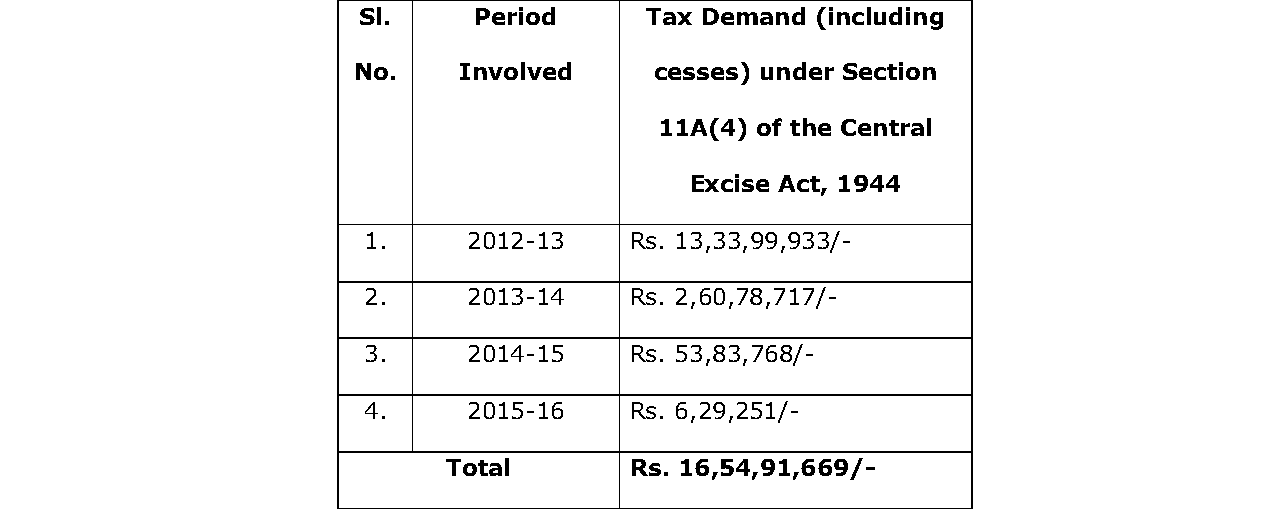
4.2. Against the said order, the appellant is before us.
5. During the course of hearing, the Ld. Counsel appearing on behalf of the appellant has made various submissions in support of his contentions, which are summarized hereinbelow: -
A. The Revenue has failed to prove the allegation of clandestine manufacture and clearance by way of positive/affirmative/tangible evidence and hence such a charge cannot be sustained merely on the basis of comparison of statutory returns, in the absence of any concrete and corroborative material evidence:
(i) It is a settled law that allegation of clandestine manufacture is a very serious charge. The burden of proving such allegation squarely lies upon the Department, which must discharge the same by adducing some affirmative, positive, and cogent evidence. Such a charge cannot be sustained merely on the basis of comparison of statutory returns, in the absence of any concrete and corroborative material evidence.
(ii) The appellant submits that it is a settled principle of law that the charge of clandestine clearance is a serious charge, which is required to be established with positive/affirmative/tangible evidence and the burden of establishing the said charge lies heavily upon the Revenue. It has been consistently held by Hon’ble Cou



An indispensable Tool for Legal Professionals, Endorsed by Various High Court and Judicial Officers
Please visit our Training & Support
Center or Contact Us for assistance

Scan Me!
India’s Legal research and Law Firm App, Download now!


For Daily Legal Updates, Join us on :



 Back to top


