


 Back
Back





2026 Supreme(Online)(Chh) 5578
IN THE HIGH COURT OF CHHATTISGARH AT BILASPUR
Narendra Kumar Vyas, J
Chhattisgarh Public Service Commission – Appellant
Versus
Chhattisgarh State Information Commission – Respondent
WPC No. 2759 of 2025 | WPC No. 2761 of 2025
Disclosure of personal information under RTI requires explicit consent from the candidate, balancing public interest and privacy provisions.
Headnote:(A) Right to Information Act, 2005 - Sections 8(1)(j) and 11 - Information sought by a waiting list candidate regarding personal information of selected candidate - Public Service Commission denied disclosure citing privacy concerns - State Information Commission's direction to provide information quashed on grounds of not having candidate's consent and misapplying public interest standards. (Para 18)
(B) Public Service Commission - Role as selection body clarified, emphasizing confidentiality of candidates' personal information and necessity of consent for sharing. (Para 13)
(C) Public Interest - Definition and its implications in Right to Information cases highlighted, where privacy concerns and confidentiality weigh heavily against unwarranted disclosures. (Para 14)
Facts of the case:
The Chhattisgarh Public Service Commission, having conducted an examination for Assistant Registrar, denied personal information of selected candidates to a waiting list candidate citing privacy. The candidate argued for information transparency as the selected applicant was a public servant.
Findings of Court:
The Court concluded that the PSC's decision to withhold information was justified given the lack of consent and legal provisions underscoring confidentiality.
Issues: The main issues were whether personal information of candidates can be disclosed under RTI when they have not consented, and the extent of a Public Service Commission's liability to disclose information about candidates.
Ratio Decidendi: The court emphasized the need for explicit consent for disclosing candidates’ personal information under RTI provisions, stressing confidentiality and distinguishing the facts from other judgments where disclosure was mandated.
Result: Writ petitions allowed.
Understood. Please provide the legal document content (inside
| Table of Content |
|---|
| 1. common questions of law and fact in writ petitions. (Para 1 , 2) |
| 2. information sought was personal regarding the selected candidate. (Para 4 , 5 , 6) |
| 3. points of determination regarding rti applicability. (Para 10 , 11) |
| 4. court emphasizes on privacy and consent under rti. (Para 14 , 15 , 18) |
C A V Order
1. Since common question of law and facts are involved in both writ petitions, they are heard together and are being disposed of by this common order.
Writ Petition No. 2759 of 2025
2. Chhattisgarh Public Service Commission has filed this petition against the order dated 16.01.2025 passed by Chhattisgarh State Information Commission (hereinafter referred to Commission) by which S.A. bearing No. A/4396/2024/ Raigarh filed by the respondent No. 2 has been allowed and the Commission has directed the petitioner to provide information relating to the selected candidate Shailesh Kumar Patel regarding his 15 years of teaching or academic experience with grade pay of Rs. 7,000 or 8 years of experience of teaching or academic experience with grade pay of Rs. 8,000/-. The petitioner has also sought certified copy of the Ph.D degree of Shailendra Kumar Patel.
Writ Petition No. 2761 of 2025
3. Chhattisgarh Public Service Commission has filed this petition against the order dated 27.01.2025 passed by Chhattisgarh State Information Commission (hereinafter referred to Commission) by which S.A. bearing No. A/3830/2023/ Raigarh filed by the respondent No. 2 has been allowed and the Commission has directed the petitioner to provide information relating to the selected candidate Shailesh Kumar Patel regarding his 15 years of teaching or academic experience with grade pay of Rs. 7,000 or 8 years of experience of teaching or academic experience with grade pay of Rs. 8,000/-. The petitioner has also sought certified copy of the Ph.D degree of Shailendra Kumar Patel.
4. Brief facts as reflected from the records of both the writ petitions in brief, are that (a) Public Service Commission (hereinafter referred to PSC) has initiated selection process for appointment of Assistant Registrar in the University wherein Dr. Shailendra Patel was selected on the aforesaid post and the respondent No. 2 was wait list candidate. The PSC after finalizing the examination has forwarded the list of selected candidate to the appointing authority/ Secretary Higher Education Department for appointment. Thereafter, respondent No.2 moved an application on 19.04.2023 wherein he has sought following information which reads as under:-
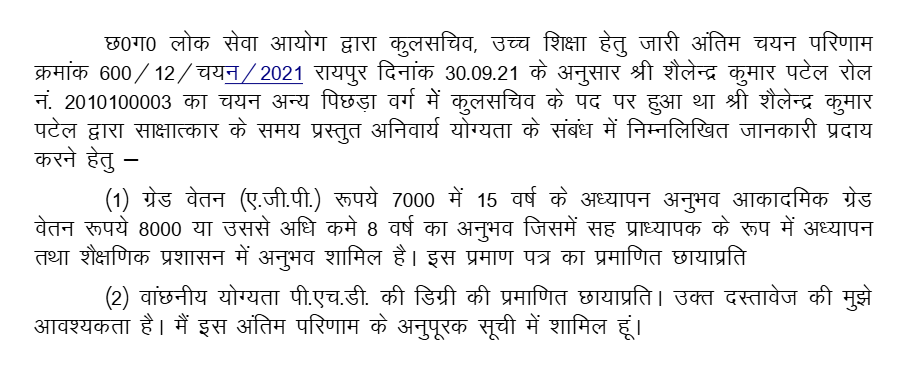
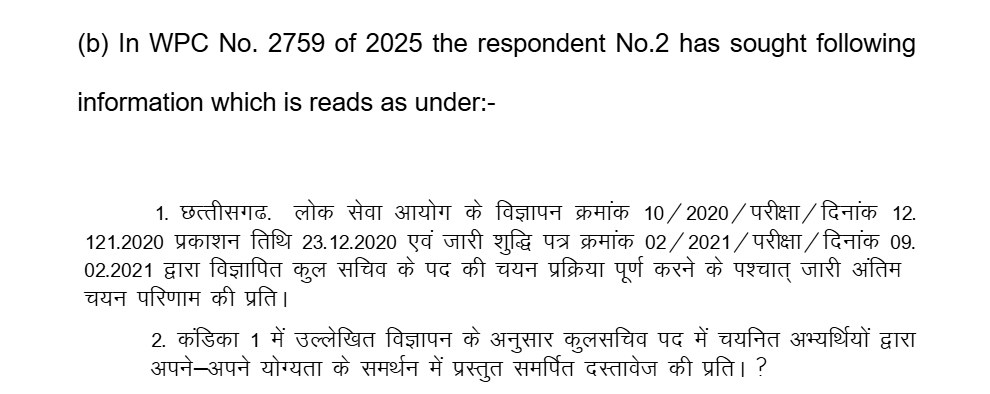
(c) The Information Officer, Chhattisgarh Public Service Commission vide memo dated 19.04.2023 and 29.04.2024 has declined to provide information to the information seekers on the account that these information are personal information relating to third person, therefore, as per Section 8 (1) (J) of Right to Information Act, 2005 (hereinafter referred to Act, 2005) same cannot be furnished to him as he has not granted the consent to provide the information to respondent No.2. Being aggrieved with these orders, both the respondents have preferred First Appeal before the Appellate Authority under RTI, office of the Public Service Commission, Raipur. The Appellate Authority vide its order dated 23.05.2023 in appeal No. 7-A/2023 in appeal No. 33/2024 decided on 31.05.2024 has rejected the same.
(d) Being aggrieved with these orders, respondent No. 2 (in both the cases) has preferred the appeal before the State Information Commission mainly contending that the First Appellate Court malafidely has wrongly interpreted Section 8 (1) (J) of the Act, 2005 and has declined to supply information to the petitioner, as such impugned order passed by the Information Officer and First Appellate Authority are illegal and liable to be quashed.
5. It is further contended that since the information sought by the respondent No. 2 is not personal information and it does not interfere in the privacy of a person, therefore, the information should have been pro












