
 Back
Back





CENTRAL INFORMATION COMMISSION
Vinod Kumar Tiwari, Information Commissioner
Vinod Vashisht – Appellant
Versus
CPIO, Office of the Director of Income Tax – Respondent
CIC/CCITB/A/2023/148598
| Table of Content |
|---|
| 1. information sought by the appellant (Para 4) |
| 2. arguments regarding disclosure under rti (Para 5 , 6) |
Information sought:
The Appellant filed an (offline) RTI application dated 17.08.2023 seeking the following information:
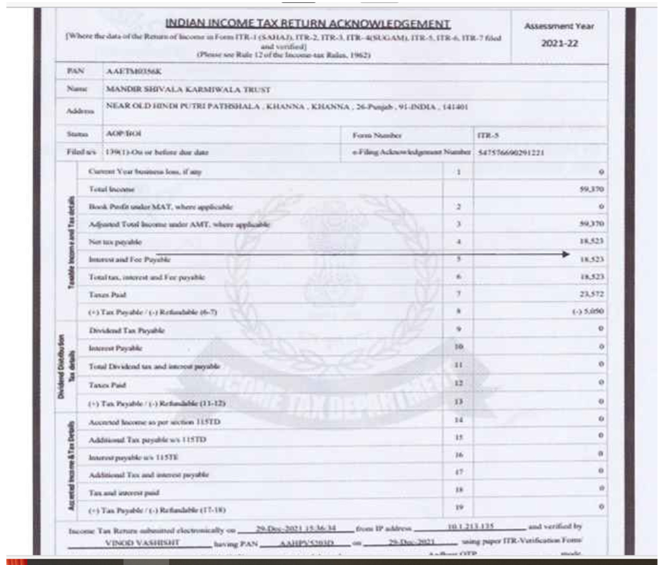
“The applicant is president of Mandi Shvala Karmiwala Trust, Old Hind Putri Pathshala Khanna District Ludhiana having PAN NO. AAETM0356K. The income tax return (ITR-5) for the assessment year 2021-22 was filed with total assessable income as Rs. 59370.00. No any member of Society (Registered under Society Registration Act) was getting any share from the income. This information (0 share) was duly shown in ITR (AUDIT INFORMATION Col SL(E). Against total income of Rs. 59370.00 the system wrongly assessed income tax Rs. 18573.00. Vide demand reference No. 2022202137075564530T Assessent was made as under:-
1. Total income 59370
2. Tax 17811 Surcharge 6590 Cess 976 25377
3. TDS 23572
4. Net Demand 1805 (r/off 1810) Vide Transaction ID No. FOS002871052650 dated 26.7.2023 the assessee objected to calculation of tax which is still pending for processing. Please inform the following information:-
1. Please inform the section of Income Tax Act under which tax of Rs. 17811 was levied against total assessable income of only Rs. 59370.00
2. Name and designation of the officer who had assessed the tax Rs. 17811.00
3. Please inform the status of Transaction ID No. FOS002871052650”
The CPIO furnished a reply to the Appellant on 27.10.2023 stating as under:
“3.1. It is observed that the applicant is seeking information related to the income tax details of the Trust-Mandir Shivala Karmiwala Trust (AAETM0356K) for A.Y.2021-22. The information sought for pertains to Third Party.
3.2. It may be mentioned here that the information provided in the return of income filed is held by the Centralized Processing Centre, Bengaluru, in its fiduciary capacity and treated as confidential. Kind attention is invited to Section 8(1)(e) of the RTI Act which reads as follows:
Notwithstanding anything contained in this Act, there shall be no obligation to give any citizen information available to a person in his fiduciary relationship, unless the competent authority is satisfied that the larger public interest warrants the disclosure of such information.
3.3. The Honble Supreme Court of India, in the matter of Girish Ramachandra Deshpande (SLP No.27734 of 2012) has held that the information relating to Income tax matters of an assessee is personal information which stands exempt from disclosure under the RTI Act. In the application, nothing is found to establish the larger public interest by seeking this information. In view of the above, the request of the applicant for information in respect of M/s. Mandir Shivala Karmiwala Trust for the A.Y. 2021-22 is liable to be rejected, invoking the provisions of Section 8(1)(j) of the RTI Act, 2005 .
4. Eligibility to Seek Information under the RTI Act: It is mentioned that the applicant has filed an application under RTI as President of the Trust, seeking income tax return details of the Trust, i.e. on behalf of the Trust. This makes it evident that it is the Trust, which is actually seeking information, through the applicant. In this context, it is relevant to note that Section 3 of the RTI Act confers the Right to Information to all Citizens of India, subject to the provisions of the Act. Further Section 6(1) of the RTI Act provides that a person who desires to obtain information under the Act, shall make a request in writing. The Legislature in its wisdom has used the word person to denote an applicant, appellant or complainant in various Sections viz., 5(1), 6(1), 6(2), 7(1), 7(3), 7(4), 7(5), 7(6), 7(8), 8(3), 18(1), 19(1) and 26(2) of the RTI Act. A conjunctive reading of all these Sections, especially Section 3 with 6(1), would make it clear that a person, who is a citizen can seek information under the RTI Act. Therefore, the Trust is not a Citizen as a natural person and hence, not eligib



An indispensable Tool for Legal Professionals, Endorsed by Various High Court and Judicial Officers
Please visit our Training & Support
Center or Contact Us for assistance

Scan Me!
India’s Legal research and Law Firm App, Download now!


For Daily Legal Updates, Join us on :



 Back to top


