
 Back
Back





HIGH COURT OF DELHI
Rekha Palli, NAVIN CHAWLA, Saurabh Banerjee, JJ
PRAGATI CONSTRUCTION CONSULTANTS – Appellant
Versus
UNION OF INDIA – Respondent
FAO(OS) (COMM)-70/2024
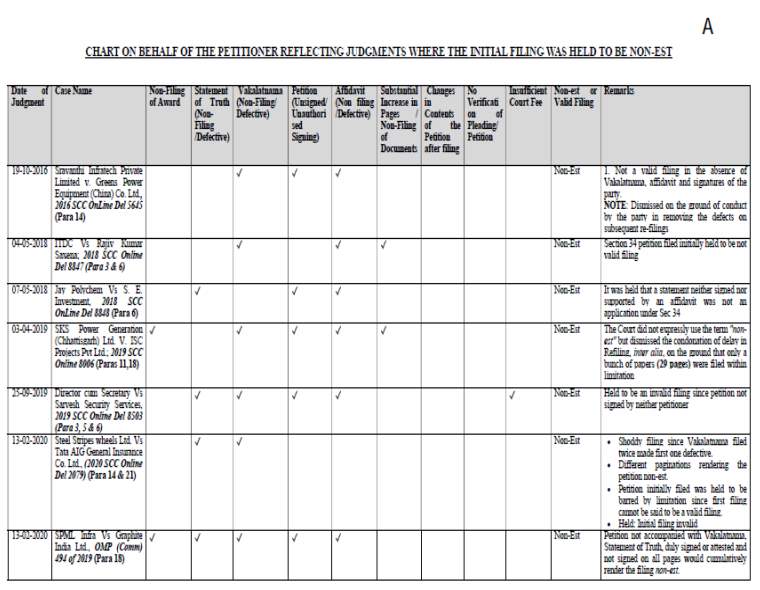
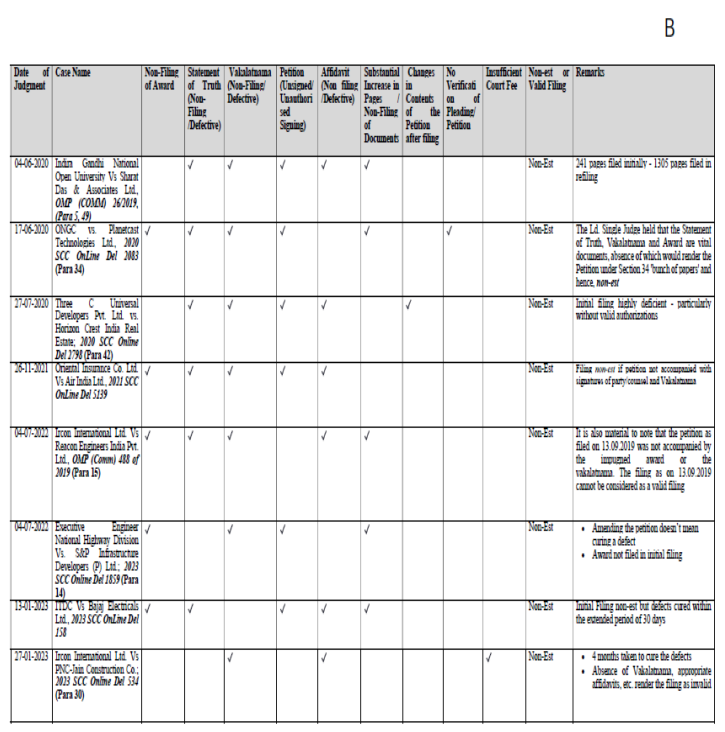
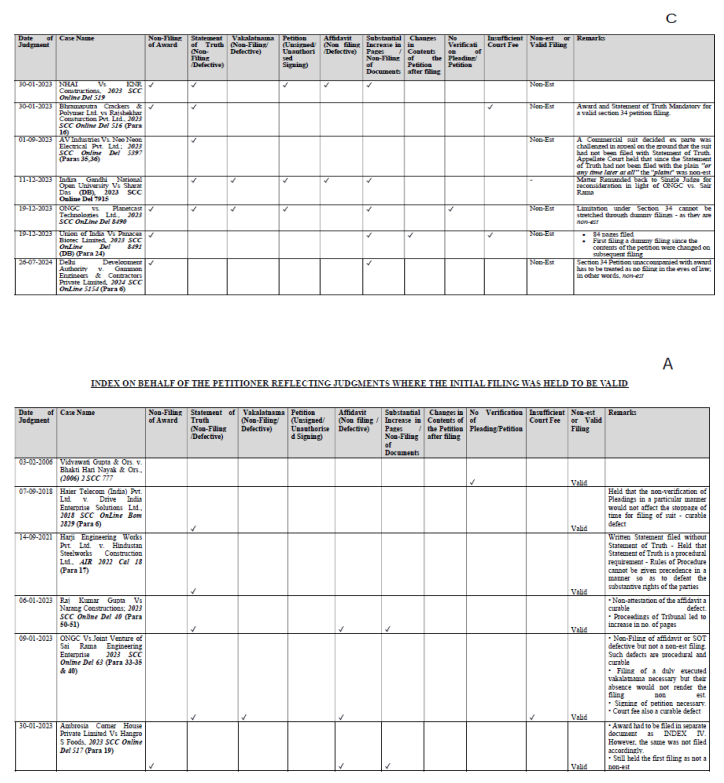
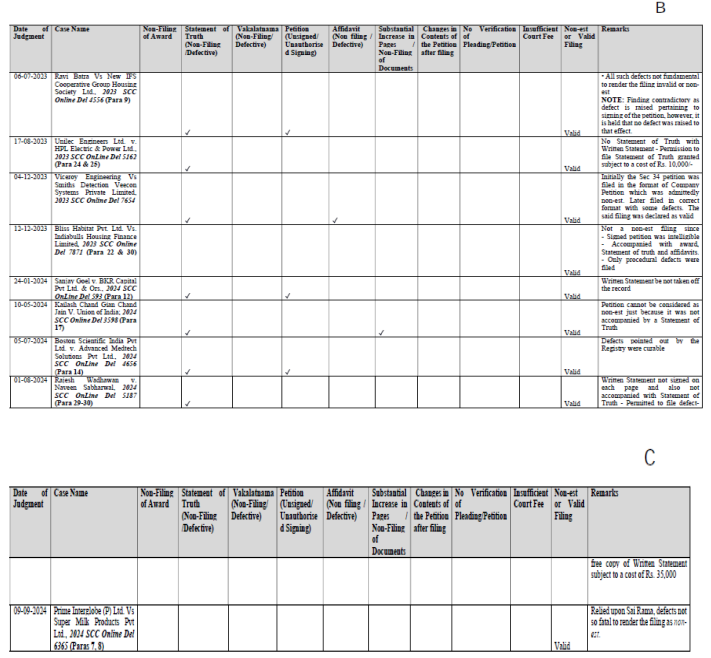
(A) Arbitration and Conciliation Act, 1996 - Section 34(3) - Commercial Courts Act, 2015 - Order VI Rule 15A - Requirement of Statement of Truth and filing of Arbitral Award - Non-filing of the Arbitral Award renders the application non-est, while non-filing of the Statement of Truth is a curable defect - The court emphasized that procedural defects should not defeat substantive rights. (Paras 46-98)
(B) Limitation - The court reiterated that the limitation period for filing an application under Section 34 is strict and cannot be extended beyond the prescribed period unless sufficient cause is shown. (Paras 47-48)
(C) Judicial Interpretation - The court clarified that the absence of essential documents like the Arbitral Award or Statement of Truth could lead to an application being declared non-est, but such declarations depend on the cumulative nature of defects. (Paras 59-66)
JUDGMENT :
NAVIN CHAWLA, J.
PREFACE
1. This Full Bench has been constituted to answer the reference made by the learned Single Judge of this Court vide his Order dated 21.03.2024 (hereinafter referred to as „Order of the Reference‟) passed in OMP(COMM) 20/2024 titled Bharat Broadband Network Limited v. Sterlite Technologies Limited.
2. The relevant extracts from the Order of the Reference, which would also indicate the question of law to be determined by this Full Bench, is as under:
"4. As far as the Statement of Truth is concerned, it is undisputed that the Statement of Truth was not filed on 27.10.2023, when the petition was first filed. However, learned counsel for the parties have drawn my attention to two Division Benches judgments, which come to different conclusions as to whether the lack of Statement of Truth constitutes a fatal defect in the original filing.
5. The first of these decisions is ONGC v. Sai Rama Engineering Enterprises, [2023 SCC OnLine Del 63]. Mr. Jayant Mehta, learned Senior Counsel for the petitioner has drawn my attention to paragraph Nos. 30 to 35 which read as follows:
"30. We concur with the learned Single Judge that certain defects are curable and do not render the application as non est. However, the nature of certain defects is such that it would not be apposite to consider the defective application as an application under Section 34 of the A&C Act, to set aside an arbitral award. Undisputedly, every improper filling is not non est.
31. We are unable to concur with the view that the minimum threshold requirement for an application to be considered as an application under Section 34 of the A&C Act is that, each page of the application should be signed by the party, as well as the advocate: the vakalatnama should be signed by the party and the advocate; and it must be accompanied by a statement of truth. And, in the absence of any of these requirements, the filing must be considered as non est. It is essential to understand that for an application to be considered as non est, the Court must come to the conclusion that it cannot be considered as an application for setting aside the arbitral award.
32. It is material to note that Section 34 of the A&C Act does not specify any particular procedure for filing an application to set aside the arbitral award. However, it does set out the grounds on which such an application can be made. Thus, the first and foremost requirement for an application under Section 34 of the A&C Act is that it should set out the grounds on which the applicant seeks setting aside of the arbitral award. It is also necessary that the application be accompanied by a copy of the award as without a copy of the award, which is challenged, it would be impossible to appreciate the grounds to set aside the award. In addition to the above, the application must state the name of the parties and the bare facts in the context of which the applicants seek setting aside of the arbitral award.
33. It is also necessary that the application be signed by the party or its authorised representative. The affixing of signatures signify that the applicant is making the application. In the absence of such signatures, it would be difficult to accept that the application is moved by the applicant.
34. In addition to the above, other material requirements are such as, the application is to be supported by an affidavit and a statement of truth by virtue of Order XI, Section I of the Commercial Courts Act, 2015. It is also necessary that the filing be accompanied by a duly executed vakalatnama. This would be necessary for an advocate to move the application before the court. Although these requirements are material and necessary, we are unable to accept that in absence of these requirements, the application is required to be treated as non est. The application to set aside an award does not cease to be an application merely because the applicant has not complied with certain procedural requirements
35. It is well se



An indispensable Tool for Legal Professionals, Endorsed by Various High Court and Judicial Officers
Please visit our Training & Support
Center or Contact Us for assistance

Scan Me!
India’s Legal research and Law Firm App, Download now!


For Daily Legal Updates, Join us on :



 Back to top


