Back
Back





2021 Supreme(Online)(DEL) 690
$~16 * IN THE HIGH COURT OF DELHI AT NEW DELHI Date of Decision: 07.01.2021 + W.P.(C) 121/2021 RCI INDUSTRIES AND TECHNOLOGIES LTD THROUGH ITS DIRECTOR RAJEEV GUPTA .…Petitioner Through: Mr. Ashok K. Babbar, Mr. Bharat Kumar Tripathi and Mr. Surendra Kumar, Advocate.
versus COMMISSIONER DGST DELHI & ORS. .… Respondents Through: Mr. Ramesh Singh, Standing Counsel with Mr. Gautam Narayan, Additional Standing Counsel for GNCTD, Ms. Bhawna Kataria and Mr. Adithya Nair, Advocates for R-1.
Mr. Harpreet Singh, Senior Standing Counsel.
CORAM:
HON’BLE MR. JUSTICE RAJIV SAHAI ENDLAW HON’BLE MR. JUSTICE SANJEEV NARULA
JUDGMENT
SANJEEV NARULA, J. (Oral)
CM APPL. 375/2021
1. Exemption allowed, subject to just exceptions.
2. The application is disposed of.
3. The present writ petition under Article 226 of the Constitution of India, 1950 impugns the action of search carried out at the Petitioner’s business premises on 30th September, 2020, under Section 67 of the Delhi Goods and Services Tax Act, 2017 (hereinafter referred to as ‘DGST Act’) read with Rule 139 of the DGST Rules, 2017.
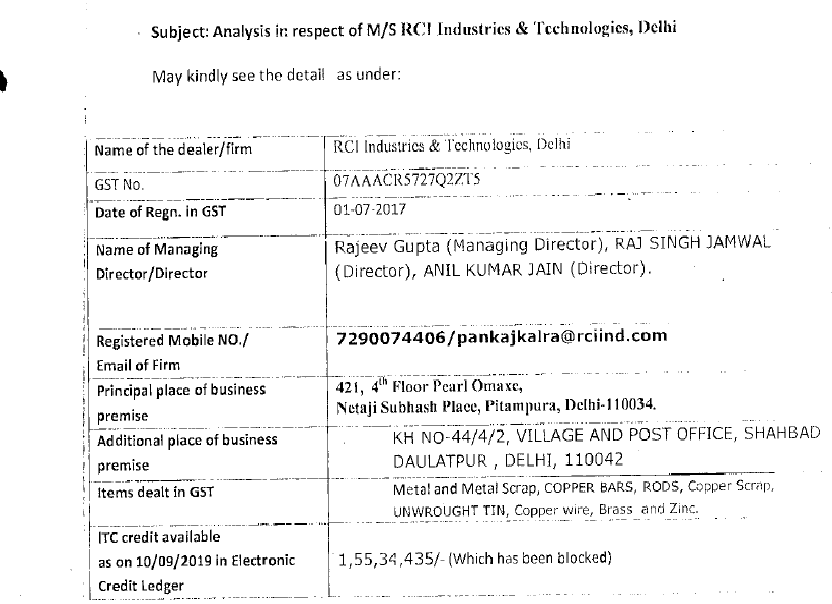
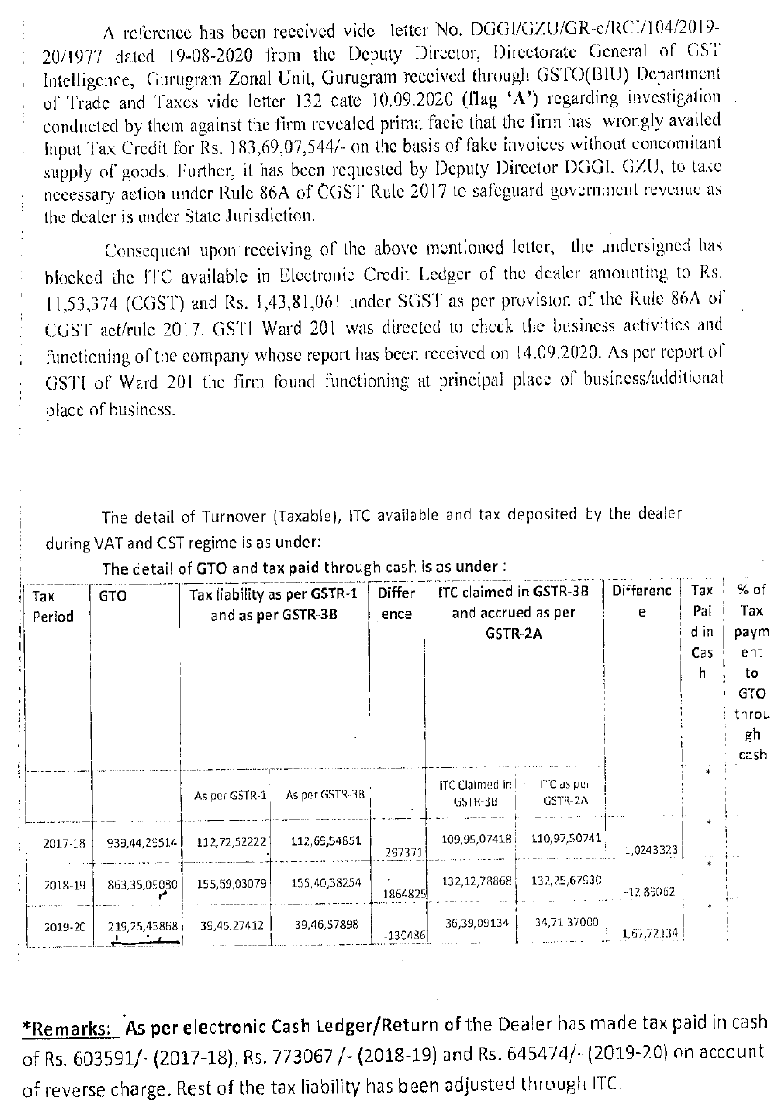
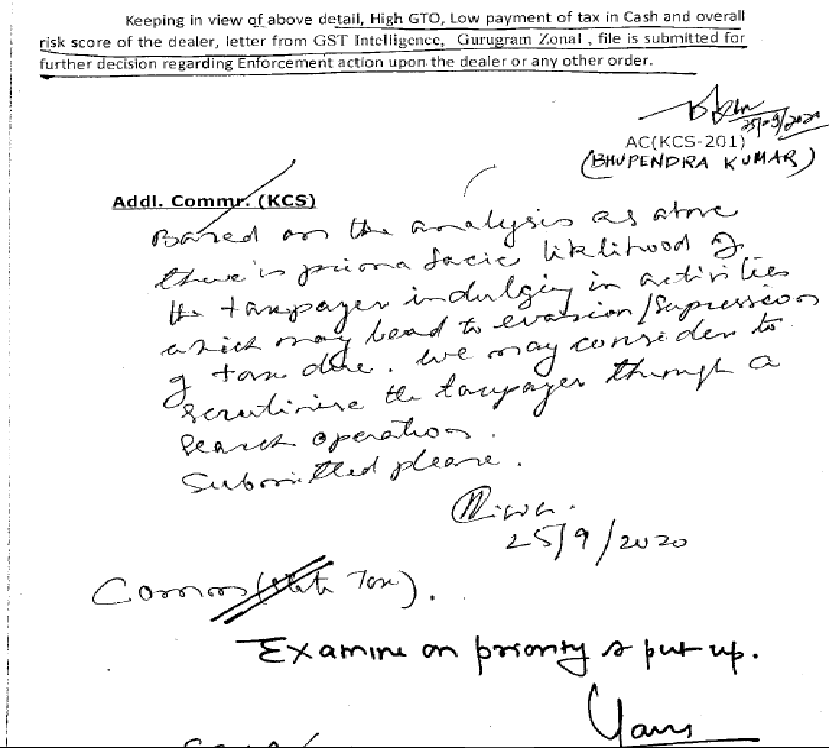
4. The factual matrix giving rise to the present writ petition is as follows: The Petitioner company, duly registered under the CGST/ DGST Act, functions from its unit at Pitampura, North-West Delhi and has its godown/warehouse at Shahbad, Daulatpur, Delhi. It also has units in other states for which separate registration under the CGST Act exists at Rajasthan and Himachal Pradesh. On 30th September, 2020 at 3:30 PM, the Respondent No. 2 (Assistant Commissioner/VATO, Delhi) entered the Petitioner’s place of business and godown, for the purpose of conducting a search. Petitioner was handed over a notice by Respondent No. 2 under Rule 56(18) of DGST Rules, 2017, inter-alia asking to produce books of accounts for the period 2017-18, 2018-19, 2019-20, and 2020-2021. Besides, Respondent No. 2 also provided: (i) a copy of authorisation in Form GST INS-01 dated 30th September, 2020, (ii) Deployment Order No. 119 dated 30th September, 2020 under Section 60 of the Delhi Value Added Tax Act, 2004, as well as (ii) Grant of Authority dated 30.09.2020 in Form DVAT-50 under Rule 65 of DVAT Rules, 2004. It is contended that at the end of search , forced statement of the Managing Director was recorded and Petitioner was pressurized to make payment of tax and interest under Form DRC-03.
5. Mr. A. K. Babbar, learned counsel for the Petitioner complains that Petitioner has been subjected to harassment at the hands of CGST Authorities i.e. DGGI Gurugram who have searched them numerous times.
He submits that in fact Petitioner has responded to the summons issued in this regard, pursuant whereto statement of Petitioner company’s director was also recorded. The last search was conducted by the CGST authorities on 7th March, 2020 at the director’s residence. This search action was challenged by the petitioner in W.P.(C) No. 7145/2020 before the Punjab and Haryana High Court. The said challenge was successful and consequently the search action and the panchnama dated 7th March, 2020 were quashed. The Petitioner’s grievance is that now the State GST Authority i.e DGST has subjected the Petitioner to yet another search action in relation to the same period, despite the Petitioner being earlier subjected to search action at the hands of the Central Authorities, which was impugned before the Punjab and Haryana High Court. It is argued that the action of the State authorities under the DGST Act is illegal and unlawful and contrary to the provisions of the CGST/DGST Act.
6. Mr Babbar urges that no parallel enquiries on the same issues by the two authorities (i.e. R-1 & R-2 under the State GST, and R-4 & R-5 under the Central GST) can take place under Sections 5 and 6 of DGST Act, 2017. In support of this submission, he refers to the foresaid provisions which read as under:
“Section 5: Powers of Officers –
(1) Subject to such conditions and limitations as the Commissioner may impose, an officer of State tax may exercise the powers and discharge the duties conferred or imposed on him under this Act.
(2) An officer of State tax may exercise the powers and discharge the duties conferred or imposed under this Act on any other officer of State tax who is subordinate to him.
(3) The Commissioner may, subject to such conditions and limitations as may be specified in this behalf by him, delegate his powers to any other officer who is subordinate to him.
(4) Notwithstanding anything contained in this section, an Appellate Authority shall not exercise the powers and discharge the duties conferred or imposed on any other