


 Back





2024 Supreme(Online)(DEL) 30937
HIGH COURT OF DELHI
HON'BLE MR. JUSTICE MANOJ KUMAR OHR, J
RAJSHREE VERMA – Appellant
Versus
THE STATE (GNCT OF DELHI) AND ANR. – Respondent
CRL.M.C. 1877/2023
Important Points
Subject
Criminal Law - Bail
Act Referred
Headnote
(B) Bail Cancellation - Grounds for cancellation of bail include interference with justice, evasion of justice, abuse of concession, absconding, misuse of bail, and tampering with evidence. (Paras 9)
Facts of the case:
The petitioner sought to challenge the bail granted to the respondent in a sexual assault case, alleging improper hearing and lack of judicial reasoning. The FIR involved allegations of financial transactions and personal relations between the parties. The complainant was 50 years old at the time of the FIR. (Paras 1-5)
Findings of Court:
The court found no cogent reasons to interfere with the bail orders, emphasizing the need for supervening circumstances for cancellation. (Paras 6-9)
Issues: The main issues were whether the petitioner was given a fair opportunity to be heard and whether the bail order reflected proper judicial reasoning. (Paras 1-2)
Ratio Decidendi: The court ruled that bail should not be cancelled without substantial reasons and that the principles established in prior judgments regarding bail cancellation must be adhered to. (Paras 9)
Result: Petition dismissed.
RUPAL LUTHRA
ORDER
% 23.09.2024
1. By way of present petition, the petitioner seeks setting aside of the order dated 22.04.2022 as well as the order dated 17.08.2022 passed by learned Trial Court vide which the respondent no.2 was admitted to regular bail in FIR No.361/2021 registered under Section 376 IPC at PS Daryaganj, Delhi.
2. Learned counsel for the petitioner/applicant has assailed the impugned orders on two grounds- firstly, that he was not given proper opportunity of being heard and secondly, that the reading of the impugned order would show that there was no application of judicial mind. In support of the aforesaid contentions, he submits that there were certain WhatsApp messages exchanged between the parties and reading of the same would show that there were certain indirect threats. He further submits that while it was a regular bail application, the impugned orders record grant of anticipatory bail. Learned counsel for respondent No.2 on the other hand has defended the impugned order by contending that the bail application was listed on multiple dates and even on the date of the passing of the impugned order, the petitioner/complainant was present along with her counsel. He further states that the impugned order was passed after hearing both the parties.
3. Learned APP for the State upon instructions states that the State has not challenged the impugned order. He, on instructions, submits that during the course of investigation, though the petitioner/complainant did not handover any mobile phone, the mobile phone from the respondent no.2 was seized and has been sent to FSL. Further, it is stated that a fraction of the WhatsApp chats/conversations form part of the charge-sheet and the bail was granted after filing of the charge-sheet.
4. I have heard learned counsel for the parties and perused the material available on record.
5. The petitioner/complainant has filed the complaint with the allegations that she got to know respondent No.2 through a friend request received on the Facebook and that their mothers were already known to each other being classmates at their school time. The complainant was also aware of the marital status of the respondent No.2. As per the impugned order, both the complainant and respondent No.2 had already obtained divorce from their respective partners. The FIR also contained the allegations of financial transactions between them. On the date of the registration of the FIR, the petitioner/complainant concededly was of 50 years of age. The impugned order records that the relations were maintained on the pretext of marriage, however since respondent No.2 did not keep his promise, the present FIR came to be lodged.
6. Considering the age of the parties and the nature of allegations, the Trial Court passed the impugned order.
7. During the course of hearing, learned counsel for the petitioner/complainant has referred to certain WhatsApp chats dated 24.03.2022 to contend that the same indicates indirect threat. The said WhatsApp chats are reproduced hereunder:
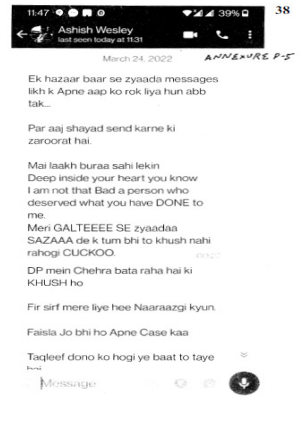
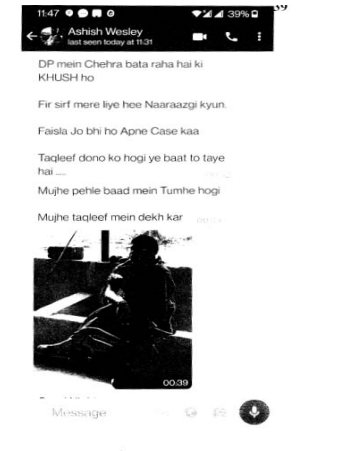
8. A prima facie reading of the aforesaid chats would not show any threat. Learned APP for the State upon instructions, states that the IO never received any complaint of threat from the petitioner/complainant and even the charge-sheet was filed without any arrest.
9. Moreover, in regard to the Court’s power in assessing the correctness of an order granting bail and the Court’s power while considering an application for cancellation of bail, the Supreme Court has observed in Deepak Yadav v. State of Uttar Pradesh reported as (2022) 8 SCC 559 wherein in was observed as under:
“…31. This Court has reiterated in several instances that bail once granted, should not be cancelled in a mechanical manner without considering whether any supervening circumstances have rendered it no longer conducive to a fair trial to allow the accused to retain his freedom by enjoying the concession of bail during trial. Having said that, in case of cancellation of bail, very cogen














