


 Back
Back





2024 Supreme(Online)(DEL) 32964
HIGH COURT OF DELHI
Purushaindra Kumar Kaurav, J
PUNEET KUMAR ANAND – Appellant
Versus
PISHORI LAL (DECEASED) THR LRS – Respondent
RSA-101/2019
Ms. Shoba Ramamoorthy, Ms.Vincy George and Mr. Gokulakrisnan and Mr. Ajay Subhas, Advs.
A testator can impose limitations on property bequeathed, and subsequent clauses cannot override the initial intent unless explicitly stated.
Headnote:(A) Indian Succession Act, 1985 - Section 95 - Partition suit - Interpretation of a Will - The appellant-defendant challenged the decree affirming that the Will executed by the mother conferred only a life estate to the father, with the property to devolve equally upon the sons after his death. The courts found that the intention of the testatrix was clear in limiting the father's rights, thus precluding him from alienating the property. (Paras 6, 30, 32)
(B) Legal principles - Testamentary disposition - A testator can impose limitations on property bequeathed, and subsequent clauses cannot override the initial intent unless explicitly stated. (Paras 22, 30)
(C) Estoppel - Conduct of parties in prior proceedings cannot negate rights conferred by a legal document. (Paras 24, 34)
Facts of the case:
The dispute arose from a partition suit concerning a residential property, with conflicting interpretations of a Will executed by the mother regarding the father's rights over the property. The appellant-defendant claimed absolute ownership based on the Will, while the respondent-plaintiff argued for a life estate only.
Findings of Court:
The courts concluded that the Will conferred a life estate to the father, with the property to vest equally in the sons upon his death.
Issues: The main issues were the interpretation of the Will and the extent of the father's rights over the property.
Ratio Decidendi: The court ruled that the Will's language indicated a life estate for the father, with the sons as ultimate beneficiaries, and that the father's subsequent actions could not alter this intent.
Result: Appeal dismissed.
JUDGMENT
The present Second Appeal has been filed by the legal heirs of the original defendant, challenging the judgment and decree dated 12.12.2018 passed by the learned Additional District Judge in RCA No. 60769/2016, titled Puneet Kumar Anand v. Pishori Lal [deceased] through his legal representatives. By the impugned judgment and decree, the first Appellate Court dismissed the appeal and affirmed the judgment and decree dated 28.02.2015, passed by the learned Civil Judge in Suit No. 293/12, whereby, the suit for partition instituted by the respondent-plaintiff was decreed against the appellant-defendant.
2. The facts, as discerned from the record, indicate that the present dispute arises out of a suit for partition concerning the subject property, a residential house bearing Door No. 34-E/3, situated in East Patel Nagar, New Delhi. The property stands on a plot measuring 200 square yards [equivalent to approximately 1800 square feet or 167 square meters] and comprises a ground floor, a first floor, and a terrace.
3. The respondent-plaintiff and the appellant-defendant are the sons of late Mr. Boota Mal Anand and late Mrs. Lakshmi Devi. The respondent- plaintiff is the elder brother of the appellant-defendant. The familial relationship and direct lineage between the relevant parties is outlined in the following genealogy table:-
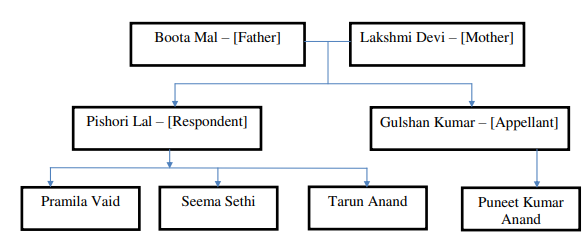
4. The dispute essentially centers on the interpretation of a Will executed by late Mrs. Lakshmi Devi, the mother of the parties. The appellant- defendant asserts that this Will conferred an absolute and unfettered interest in the subject property upon their father, late Mr. Boota Mal Anand, thereby empowering him to execute a subsequent Will, through which he bequeathed the property exclusively to the appellant-defendant.
5. Conversely, the respondent-plaintiff contends that the Will executed by their mother only granted their father a life estate, thereby restricting his authority to alienate, transfer, or further bequeath the property. This conflicting interpretation of the testamentary disposition forms the crux of the dispute.
6. The Courts below, upon examining of the testamentary document and the surrounding circumstances, concluded that the intention of the testatrix, Late Mrs. Lakshmi Devi, was to confer only a life estate upon the father, late Mr. Boota Mal Anand, thereby precluding him from alienating or further bequeathing the property to the exclusion of either son. The Courts found that, upon the demise of the father, absolute ownership of the property was intended to vest equally between the two sons.
7. Consequently, the Trial Court decreed the suit for partition, declaring that the father lacked the authority to unilaterally alienate or bequeath the property. This determination of the Trial Court was subsequently affirmed by the first Appellate Court.
8. The appellant-defendants, however, vehemently contend that the interpretation adopted by the Courts below is flawed and contrary to the language of the testament. They assert that Clause 5 of the Will explicitly conferred an absolute right of ownership upon the father, Late Mr. Boota Mal Anand, thereby granting him unfettered authority to deal with the property, including the right to alienate or bequeath it as he deemed fit.
9. It is further argued that once an absolute estate is unequivocally vested in an individual by way of testamentary disposition, any subsequent clause in the same instrument seeking to impose restrictions on such absolute ownership, or to reassign the property to other beneficiaries, would be legally untenable. According to the appellants, the Will must be read harmoniously, and the intention to grant full ownership to the father must prevail over any purported limitations.
Submissions on behalf of the appellant-defendant:-
10. Ms. Shobha Ramamoorthy, learned counsel appearing on behalf of the appellant-defendant, argues that late Mrs. Lakshmi Devi, the mother of the parties, executed a registered Will dated 11.12.1968












