


 Back
Back





2024 Supreme(Online)(DEL) 30751
HIGH COURT OF DELHI
Amit Mahajan, J
SATBIR – Appellant
Versus
STATE GNCTD – Respondent
CRL.REV.P.-197/2023
The ossification test's findings are credible, and the margin of error cannot be applied to classify the petitioner as a juvenile when he was over 18 years at the time of the incident.
Headnote:(A) Juvenile Justice (Care and Protection of Children) Act, 2000 - Section 7-A - Indian Evidence Act, 1872 - Section 45 - Determination of age - The petitioner sought to be declared a juvenile based on an ossification test report indicating an age of 21-22 years, which, when related back to the date of the incident, suggested he was over 18 years old - The trial court dismissed the application, emphasizing the ossification test's reliability when multiple joints are assessed and the absence of supporting documents from the petitioner. (Paras 1, 8, 16, 32)
(B) Margin of Error - The court ruled that the margin of error in age determination is not absolute and can be reduced when multiple joints are tested, as per medical jurisprudence principles. (Paras 24, 28)
(C) Benefit of Doubt - The court reiterated that the benefit of doubt should favor the accused, but the evidence must substantiate claims of juvenility. (Paras 10, 31)
Facts of the case:
The petitioner challenged the trial court's dismissal of his application to be declared a juvenile based on an ossification test conducted in 2017, which indicated he was 21-22 years old at that time, relating back to an age of over 18 years at the time of the alleged incident in October 2015.
Findings of Court:
The trial court's dismissal of the petitioner's application was upheld, confirming that the ossification test's findings were reliable and that the margin of error could not be applied to reduce the age below 18 years.
Issues: The primary issue was whether the petitioner should be declared a juvenile based on the ossification test report.
Ratio Decidendi: The court concluded that the ossification test's findings were credible, and the margin of error could not be applied to classify the petitioner as a juvenile, as he was over 18 years at the time of the incident.
Result: Petition dismissed.
JUDGMENT
1. The present revision petition is filed inter alia challenging the order dated 02.08.2022 (hereafter ‘the impugned order’), passed by the learned Special Judge, East District, Karkardooma Courts, Delhi, in SC No. 2032/2016 arising out of FIR No. 981/2015, registered at Police Station Mandawali. The petitioner also seeks that the petitioner be declared to be a Juvenile on the date of the alleged incident on the basis of the findings in the Ossification test report.
2. The learned Trial Court, by the impugned order, dismissed the application filed by the petitioner to declare him as a Juvenile.
3. The present FIR was lodged at the instance of the maternal uncle of the prosecutrix on 24.10.2015 on the apprehension that the prosecutrix had been kidnapped. The prosecutrix was thereafter recovered. The alleged date of the incident, as per the prosecution, is 20.10.2015/21.10.2015.
4. The petitioner moved an application under Section 45 of the Indian Evidence Act, 1872 for his ossification test through his mother as he had no related documents to prove his age. The said application was allowed and the ossification test of the petitioner was conducted at LBS Hospital on 28.11.2017.
5. In the Ossification Test Report dated 29.11.2017, the age of the petitioner is adjudged to be between 21 to 22 years. There is an apparent discrepancy in the report wherein while the range of the petitioner’s age is written to be between 21 to 22 years in numericals, however, in words, the age is stated to be between twenty to twenty two years. The relevant portion of the report is reproduced hereunder:
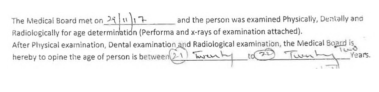
6. The Ossification Test Report was duly exhibited and the doctors who had examined the petitioner and issued the report were examined on 19.04.2022 (CW1) and 02.05.2022 (CW2) respectively. CW1 deposed that the age of the petitioner was opined to be between 21-22 years. He admitted in the cross examination that the age range was mentioned as 20-22 years in the forwarding letter. On a question by the learned Additional Public Prosecutor for the State, he clarified that the word ‘one’ was inadvertently not typed after the word ‘twenty’. CW2 was not cross-examined.
7. On 11.05.2022, the petitioner filed an application for deciding his juvenility on the basis of the Ossification Test Report and relied upon the judgment passed by the Hon’ble Apex Court in the case of Darga Ram v. State of Rajasthan : (2015) 2 SCC 775.
8. The learned Trial Court in the impugned order observed that the ossification test of the petitioner was done in respect of multiple joints and therefore the margin of error was significantly on the lower side. In this regard, the learned Trial Court relied upon the judgment of a Coordinate Bench of this Court in Mohd. Wasim v. State : 2012 SCC OnLine Del 2862. The relevant portion of the impugned order reads as under:
“10. In the present case, medical board opined that in the ossification test, the epiphysis of shoulder, elbow, wrist, hip , knee and ankle joints as well as iliac crest and ischiel tuberosity have appeared and fused . The medial ends of clavicle were not found. In the dental examination, all teeth were found and on the general appearance of the accused, the medical board came to the conclusion that age of the accused is between 21-22 years.
xxx
13. It is, therefore, apparent that test is done in respect of the multiple joints and therefore the margin of error is significantly on the lower side and thus medical board came to an acceptable and reasonable conclusion in respect of the age of the accused.
14. The ossification test was conducted on 28.11.2017 and the alleged incident is stated to have occurred on 20/21.10.2015.
15. Taking into consideration age of the accused was opined to be 21-22 years on 28.11.2017 and if the same is relate back to the date of offence i.e. 20/21.10.2015, the accused would be about 19 years of age i.e. more than 18 years.
16. In view of the above-mentioned discussion and considering the totality of t












