
 Back
Back





2026 DHC 3759
IN THE HIGH COURT OF DELHI AT NEW DELHI
ANIL KSHETARPAL, AMIT MAHAJAN, J.
Matsya Fincap Pvt Ltd. - Appellant
Versus
Govind Lal - Respondent
EFA(COMM) 8 OF 2024
Decided On : 05-05-2026
Advocates Appeared :
For the Appellant : Mr. Bhupendra Kumar Gupta, AR.
For the Respondent : Mr. Pramod Kumar and Mr. Gaurav, Advs.
| Table of Content |
|---|
| 1. establishing the factual matrix and jurisdictional dispute regarding the absence of a signed arbitration agreement. (Para 1 , 2 , 3 , 4 , 5 , 6 , 7 , 8 , 9 , 10) |
| 2. parties' contentions regarding the validity of the arbitration agreement and the scope of section 47 cpc. (Para 11 , 12 , 13 , 14) |
| 3. defining requirements of section 7 of the a&c act regarding written arbitration agreements and mutual consent. (Para 15 , 16 , 17 , 18 , 19 , 20 , 21) |
| 4. requirement of consensus ad idem for a valid arbitration agreement and consequences of its absence. (Para 22 , 23 , 24 , 25 , 26) |
| 5. executing court's authority under section 47 cpc to declare an award a nullity for inherent jurisdictional defects. (Para 27 , 28 , 29 , 30 , 31 , 38) |
| 6. scrutiny of the bona fides of the arbitration initiation and the implications of unilateral documentation. (Para 32 , 33 , 34 , 35 , 36 , 37) |
| 7. limitations on party autonomy where unilateral appointment of an arbitrator compromises independence and fairness. (Para 39 , 40 , 41 , 42 , 43 , 44 , 45 , 46) |
| 8. final confirmation that an non-existent arbitration agreement renders an arbitral award legally unenforceable. (Para 47 , 48) |
JUDGMENT :
ANIL KSHETARPAL, J.
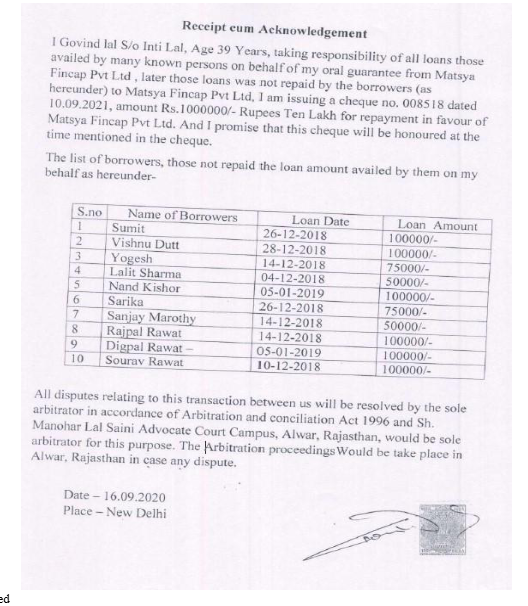
1. Through the present Appeal, the Appellant (Decree Holder) assails the correctness of the order dated 01.04.2024 [hereinafter referred to as 'Impugned Order'], passed in EX. (COMM.) No.287/2023, whereby the learned District Judge declined to enforce the ex-parte arbitral award dated 22.10.2022 [hereinafter referred to as 'the Award'] primarily on the ground that the receipt-cum acknowledgement dated 16.09.2020 [hereinafter referred to as 'acknowledgement letter'] containing the arbitration clause was not signed by the Appellant.
2. The learned District Judge has held that since the acknowledgement, though signed by the Respondent (Judgment Debtor) and handed over to the Appellant, did not bear the Appellant's signature, it did not constitute a valid arbitration agreement within the meaning of Section 7 of the Arbitration and Conciliation Act, 199 A&C Act.
3. Therefore, the issue that arises for consideration before this Court is whether an acknowledgment letter issued by the Respondent to the Appellant, containing an arbitration clause but signed by only one of the parties, constitutes a valid arbitration agreement within the meaning of Section 7 of the A&C Act, and consequently, whether the initiation of the arbitral proceedings pursuant thereto was legally sustainable in the facts of the present case.
FACTUAL MATRIX:
4. In order to appreciate the controversy, it is necessary to briefly advert to the relevant facts.
5. The Appellant is a company registered under the Companies Act, 2013, acting through its Authorised Representative ('AR'), Mr. Bhupendra Kumar Gupta. The Appellant filed the Execution Petition bearing Ex. (Comm.) No. 287/2023 seeking enforcement of the ex parte Award passed by the learned Sole Arbitrator, whereby a sum of Rs.10,00,000/- along with interest was awarded against the Respondent.
6. Upon service of notice, the Respondent entered appearance and filed objections to the maintainability of the Execution Petition. The principal objection raised was that there existed no valid arbitration agreement between the parties and, therefore, the learned Sole Arbitrator lacked jurisdiction to initiate arbitral proceedings and render the Award.
7. The acknowledgment letter, relied upon by the Appellant as containing the arbitration clause, inter alia, recorded that in the event of disputes arising between the parties, the same would be referred to arbitration and adjudicated by a sole arbitrator appointed in terms thereof. The arbitration clause contained therein provided that disputes or differences between the parties would be settled through arbitration in accordance with the provisions of the A&C Act. The said document, however, admittedly bore the signature of the Respondent and did not bear the signature of the Appellant. Th
AI



An indispensable Tool for Legal Professionals, Endorsed by Various High Court and Judicial Officers
Please visit our Training & Support
Center or Contact Us for assistance

Scan Me!
India’s Legal research and Law Firm App, Download now!


For Daily Legal Updates, Join us on :



 Back to top


