


 Back
Back





2026 Supreme(Del) 737
IN THE HIGH COURT OF DELHI AT NEW DELHI
MANOJ KUMAR OHRI, J.
Gyan Anand - Appellant
Versus
State of N.C.T. of Delhi & Ors. - Respondents
FAO No. 348 of 2008
Decided On : 26-05-2026
For the Appellant : Mr. Ashutosh Dubey, Ms. Rajshri Ashutosh Dubey, Mr. Abhishek Chauhan, Mr. Amit P. Shahi, and Mr. Rishabh Bhardwaj.
For the Respondent: Mr. Sarojanand Jha, Mr. Suraj Malik, Ms. Rajreeta Ghosh, Mr. Rahul Kumar, and Ms. Muskan Saxena.
A Will must be attested by at least two witnesses who witness the testator signing or receive their personal acknowledgment. Failure to produce a witness who confirms these statutory formalities renders the Will invalid, especially when suspicious circumstances shroud its execution.
Headnote:(A) Indian Succession Act, 1925 - Section 63 - Indian Evidence Act, 1872 - Sections 68 and 71 - Probate petition - Validity of Will - Requirement of execution and attestation - Mandatory to prove due execution by at least one attesting witness - Attesting witness must bear witness to the act of signing and the testator must acknowledge the signature in their presence - Where a witness fails to satisfy the requirement of testifying to the signing in the presence of the testator, the document remains unproved as per law. (Paras 10, 11, 16, 17)
(B) Appeal - Scope - Appellate court concurs with findings of the trial court regarding the failure of a propounder to discharge the burden of proving that the document was executed under free will and in accordance with statutory formalities - Where there are suspicious circumstances, the burden is higher and not discharged by weak testimony. (Paras 17, 19, 20)
Facts of the case:
The appeal arose from the dismissal of a petition seeking the probate of a document claimed to be the final testamentary disposition. The trial court found the document suspicious and unsubstantiated due to inconsistent testimony regarding its execution and the failure to prove valid attestation by two witnesses as required by law.
Findings of Court:
The testimony of the witness failed to establish that the document was signed in their presence or that the second signatory acted with the necessary intent to witness the execution. The court held that simply signing a document alongside a medical certification does not equate to the legal requirement for attestation under the specified statutory provisions.
Issues: The primary issues were whether the document complied with the mandatory requirements for attestation under the Succession Act and whether the burden of proof regarding the validity of the testamentary disposition had been discharged.
Ratio Decidendi: The legal requirement for valid attestation under Section 63(c) mandates that witnesses must have seen the testator sign or received a personal acknowledgment of the signature. Since the examined witness was not present during the actual execution and the second signatory did not act as an attesting witness, the proof of execution is fundamentally deficient.
Result: Appeal dismissed.
| Table of Content |
|---|
| 1. factual foundation regarding the disputed will and family lineage. (Para 1 , 2 , 3 , 4 , 5) |
| 2. contention regarding the validity of will execution and valid attestation. (Para 6 , 7 , 8 , 9) |
| 3. statutory requirements for proof of will execution under isa and evidence act. (Para 10 , 11) |
| 4. evaluation of evidence and witness testimony regarding attestation formalities. (Para 12 , 13 , 14 , 15 , 16) |
| 5. failure to prove animus attestandi and valid attestation warrants dismissal. (Para 17 , 18 , 19 , 20) |
JUDGMENT :
1. The issue involved in the present appeal is the validity of the Will dated 10/20.09.2004 (hereinafter referred to as the “Will”) stated to be executed by the late Ved Ram Anand. The appellant propounded the said Will by filing the underlying petition under Section 276 of the Indian Succession Act, 1925 (hereinafter referred to as “ISA”), claiming himself to be the beneficiary. Vide the impugned judgment, however, the Trial Court dismissed the said petition by observing that the said Will was shrouded by suspicious circumstances and that the petitioner had failed to prove that it was duly executed as the last and final Will of the testator.
2. Before proceeding further and for the sake of convenience, the genealogical table of the testator is extracted hereunder:
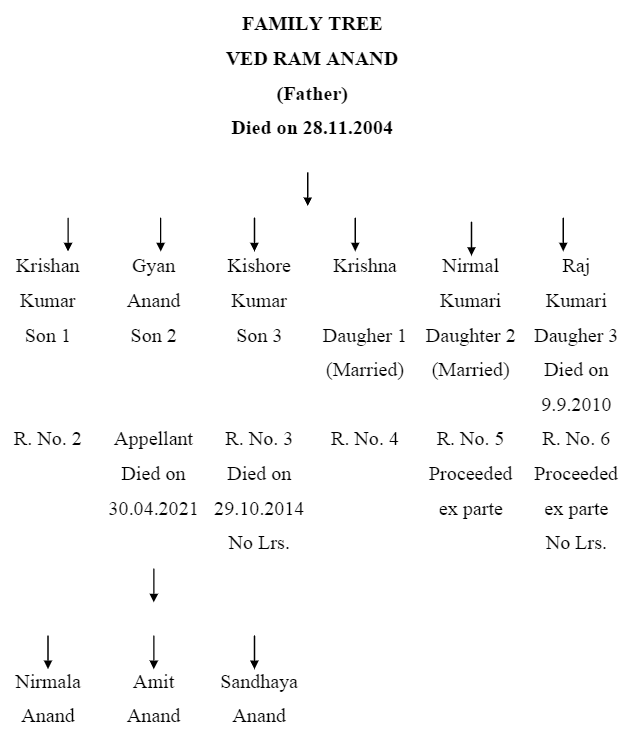

3. Vide the Will, the testator bequeathed his sole property, i.e., property bearing no. 109, Gagan Vihar, Delhi – 110051, in favour of the appellant, with a right of residence to the testator’s other son, i.e., Kishore Kumar @ Raju, in half portion of the ground floor of the said property. It was stated that Kishore Kumar @ Raju would be entitled to use the same for residential purposes and would not be entitled to sell or rent out the same. The testator’s moveable properties in the form of cash, bank account balance, receivables, paintings, works of art, books, were also bequeathed to the appellant. It was directed that the expenses to be incurred on the marriages of the testator’s two daughters, namely Nirmal Kumari and Raj Kumari, were to be met from the funds realised from the sale of the terrace rights of the aforementioned property. There is no mention of the testator’s other children in the Will other than the direction that his daughters and sons-in-law will not have any right in any of his assets and the aforesaid property.
4. Pertinently, the Will was preceded by another Will dated 12.07.1993, wherein the testator’s sole property was bequeathed to the appellant and Kishore Kumar @ Raju in equal shares. The testator had specifically excluded his eldest son, i.e., Krishan Kumar, and eldest daughter, Krishna Kumari, from his estate.
5. Respondent nos. 2 and 4, i.e., Krishan Kumar and Krishna Kumari, are the only contesting respondents, the others having not filed any objection either before the Trial Court or in the present appeal.
6. The impugned judgment is contested by the appellant, who contends that the Trial Court failed to appreciate that the Will was the testator’s last and final testament and was attested by two witnesses, i.e., Mahendra Pal Rastogi and Dr. K.K. Rathi. The former of the two also appeared and testified to its execution.
7. As per the case of the appellant, the testator, after executing the first Will whereby respondent nos. 2 and 4 were excluded from his estate, took further steps towards expressing his intent by disowning respondent no. 2 vide a declaration executed on 05.07.1993. Another declaration was made on 20.04.2004 whereby the testator, in fact, reiterated his desire to disown respondent no. 2 on account of misbehaviour and the ill-treatment meted out to him. In fact, a public notice dated 17.07.2004 was also published in the newspaper, namely Rashtriya Sahara, disowning respondent no. 2 as well as his wife and two children from all of the testator’s moveable and immoveable assets. On being excluded from the bequeathment, respondent no. 2 filed a suit for partition bearing CS No. 480 of 2004, wherein a prelimina












