


 Back
Back





2026 Supreme(Guj) 1045
IN THE HIGH COURT OF GUJARAT AT AHMEDABAD
GITA GOPI, J.
Sharad Kishanchand Bihani Prop. of Sharad Fabrics - Applicant
Versus
Harishbhai Ramkishan Narang Prop. of Durga Finance & Anr. - Respondents
Criminal Revision Application (Modification of Condition/Order) No. 1163 of 2026 With R/Criminal Revision Application No. 1164 of 2026 With R/Criminal Revision Application No. 1165 of 2026 With R/Criminal Revision Application No. 1166 of 2026 With R/Criminal Revision Application No. 1167 of 2026 With R/Criminal Revision Application No. 1168 of 2026 With R/Criminal Revision Application No. 1170 of 2026
Decided On : 23-04-2026
For the Applicant : Mr. Manan Shah for Mr. C.R. Buddhadev and Mr. Harmeet M. Desai.
For the Respondent: Mr. Pranav Dhagat, APP.
ORDER :
1. Common grievance has been raised in all the matters by learned advocate Mr. Manan Shah that the learned Appellate Court, Surat had passed an order laying down condition on the very same day i.e. 18.3.2026 in all the appeals preferred, on suspending the sentence passed by the learned Magistrate, Surat, while releasing the applicant – accused on bail of paying 80% of compensation money to the complainant and 20% to be deposited to the Government in four matters, while had also ordered to pay total compensation amount to the complainant in other three cases.
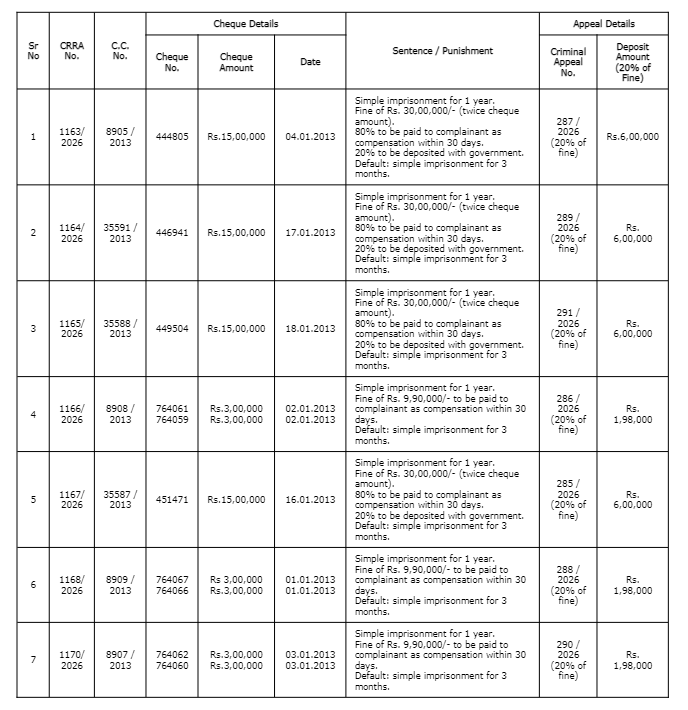
2. The crux of the sentence with the conditions, in terms of the case, with the details of cheque and the cheque amount was summarised in the tabular form referred by Mr. Shah.
3. Advocate Mr. Shah, relying upon the judgment in the case of Jamboo Bhandari v. Madhya Pradesh State Industrial Development Corporation Limited & Ors. reported in (2023) 10 SCC 446, has submitted that the learned Appellate Court while considering the provision under Section 148 of the Negotiable Instruments Act, 1881 (hereinafter referred to as “the NI Act”) was required to consider the observations in the case of Surinder Singh Deswal @ Colonel S.S. Deswal & Ors. v. Virender Gandhi, (2019) 11 SC 341, where the Hon'ble Apex Court has explained the meaning of expression “may” under sub-section (1) of Section 148 of the NI Act and thus, submitted that the Appellate Court was required to examine the facts of the case for the satisfaction of the Court to consider whether imposing such condition of the compensation/fine amount would be unjust or imposition of that condition would have deprived the right of the appeal of the appellant, as the order ultimately would become very onerous and the appellant – accused’s right to proceed with the appeal would get frustrated as his financial capacity would not permit him to deposit such a huge amount in one go, as ordered by the learned Appellate Court.
4. Having heard the learned advocate Mr. Shah, the law laid down in regard to the provision of Section 148 NI Act would be required to be appreciated by referring to the case laws.
5. In the case of Surinder Singh Deswal (supra), the amended provision of Section 148 of NI Act was dealt with in following terms:-
“8. Now so far as the submission on behalf of the appellants that even considering the language used in Section 148 of the NI Act as amended, the appellate court “may” order the appellant to deposit such sum which shall be a minimum of 20% of the fine or compensation awarded by the trial court and the word used is not “shall” and therefore the discretion is vested with the first appellate court has construed it as mandatory, which according to the learned Senior Advocate for the appellants would be contrary to the provisions of Section 148 of the NI Act as amended is concerned, considering the amended Section 148 of the NI Act as a whole to be read with the Statement of Objects and Reasons of the amending Section 148 of the NI Act, the word used is “may”, it is generally to be construed as a “rule” or “shall” and not to direct to deposit by the appellate court is an exception for which special reasons are to be assigned.
Therefore amended Section 148 of the NI Act confers power upon the appellate court to pass an order pending appeal to direct the appellant-accused to deposit the sum which shall not be less than 20% of the fine or compensation either on an application filed by the original complainant or even on the application file by the appellant-accused under Section 389 CrPC to suspend the sentence. The aforesaid is required to be construed considering the fact that as per the amended Section 148 of the NI Act, a minimum of 20% of the fine or compensation awarded by the trial court is directed to be deposited and that such amount is to be deposited within a period of 60 days from the date of the order, or within such further period not exceeding 30 days as may be directed by the appellate court for












