


 Back
Back





2025 Supreme(Online)(ITAT) 2871
INCOME TAX APPELLATE TRIBUNAL (HYDERABAD BENCH)
Shri Vijay Pal Rao, Shri Manjunatha, G., JJ
HARSCO INDIA PRIVATE LIMITED HYDERABAD – Appellant
Versus
DCIT. CIRCLE 2(1) HYDERABAD – Respondent
ITA 1041/HYD/2024
Interest rates for international transactions must reflect the market conditions of the currency in which the loan is to be repaid, favoring LIBOR or EURIBOR over domestic rates.
Headnote:(A) Income Tax Act, 1961 - Sections 143(3), 144C(5), and 144C(13) - Assessment year 2021-22 - Appeal against assessment order regarding arm's length pricing for interest on outstanding receivables from associated enterprises (AEs) - Tribunal upheld TPO's adjustment using SBI short-term deposit rate as ALP, rejecting the assessee's plea for LIBOR rate - Judicial indiscipline noted for not following prior decisions in the assessee's case - The court emphasized that interest rates should be determined based on the currency of the loan repayment, not domestic rates. (Paras 5, 6, 10)
(B) Transfer Pricing - Arm's Length Principle - The principle requires that the interest rate for international transactions should reflect the market conditions of the currency in which the loan is to be repaid, thus LIBOR or EURIBOR rates should be applied instead of domestic rates. (Paras 7, 8, 10)
Facts of the case:
The appeal arises from an assessment order where the TPO adjusted the interest on outstanding receivables from AEs, using SBI short-term deposit rates as the benchmark, despite prior rulings favoring the assessee.
Findings of Court:
The Tribunal found that the TPO's use of SBI rates was justified but noted the importance of applying LIBOR or EURIBOR for international transactions.
Issues: The main issues were whether the interest rate for benchmarking should be based on domestic rates or international rates and the implications of not following prior Tribunal decisions.
Ratio Decidendi: The court ruled that the interest rate applicable to international transactions should be determined by the market rate of the currency involved, rejecting the use of domestic rates.
Result: Appeal allowed for statistical purposes.
| Table of Content |
|---|
| 1. assessee's objection to tpo's adjustment (Para 3) |
| 2. dr's submission on tpo's decision (Para 4) |
| 3. consideration of prior tribunal decisions (Para 5) |
| 4. judicial indiscipline noted (Para 6 , 7 , 8 , 9) |
| 5. direction to adopt libor (Para 10) |
| 6. recompute interest u/s 234c (Para 11) |
| 7. appeal allowed for statistical purposes (Para 12) |
Per Vijay Pal Rao, Vice President
This appeal by the assessee is directed against the assessment order dated, 06/09/2024, passed u/s 143(3) r.w.s. 144C(13) of the I.T. Act, 1961, in pursuant to the directions of the DRP, dated 19/08/2024 passed u/s 144C(5) of the Act for the A.Y.2021-22.
2. The assessee has raised the following grounds of appeal:
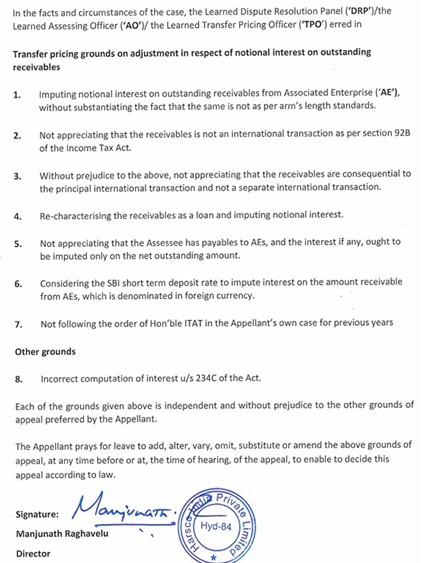
3. At the time of hearing, the learned AR of the assessee has submitted that the TPO has made adjustment by imputing the notional interest on the outstanding receivables from AEs by considering the SBI short term deposits as Arms’ Length Price. He has further submitted that the DRP has rejected the objections of the assessee on this issue despite the fact that for the preceding years i.e. A.Ys 2016-17 & 2017-18, this Tribunal has decided this issue in favour of the assessee.,
4. On the other hand, the learned DR has submitted that, there are judgments of this Tribunal wherein the short term deposits rate has been considered as comparable price in respect of interest on outstanding receivables from AEs. The TPO as well as the DRP has followed the decisions of this Tribunal on this issue. Accordingly, the short-term rate for 45 days is considered as ALP for benchmarking the transaction of interest on outstanding receivables from AEs. He has relied upon the order of the TPO as well as the DRP.
5. We have considered the rival submissions as well as relevant material available on record. At the outset, we note that for the A.Ys 2016-17 & 2017-18, this Tribunal has decided this issue in favour of the assessee. However, the DRP has upheld the order of the TPO in making adjustment by adopting the SBI deposit rate in para 2.1.17 to 2.1.19 as under:
“2.1.17 As regards adoption of ALP interest rate, in the facts of the case. we consider that, it is pertinent to look into the opportunity costs i.e.. the income that the assessee would have earned, had the assessee received the amounts in time. This has to be determined taking into account the Indian market conditions, the assessee being taken as the tested party. Factoring these aspects, we are of the view, that the SBI short term fixed deposit interest rate may be the appropriate ALP rate to measure the interest compensation in these types of transactions. In this regard, we place reliance on the principle held by the Honourable Bangalore ITAT in the Case of Logix Microsystems Ltd (TA No 423/Bang/2019 dated 07.l0.2010) (2010-1 50-ITAT Bang-TP), under similar factual circumstances, wherein it was observed, "While adopting the Indian rate, it is not proper to rely on PLR of the State Bank of India. This is because if the funds were brought in time and those funds were properly deployed, the assessee company may earn an income at the maximum rate applicable to deposits and not at the rate applicable to loans. We find it appropriate to adopt reasonable rate that would be available to the assessee on short-term deposits". Accordingly, the action of TPO of adopting the SBI short term deposit interest rate for the subject year as the ALP interest rate is justified. As the SBI short term deposit rate is an index rate adopted under Indian conditions to charge interest it is not an ad hoc rate as contended by the assessee. Therefore, we reject the plea of the assessee to adopt LIBOR rate at the purpose of computing interest on outstanding receivables.
2.1.18 On the plea regarding the decision of Hon'ble TAT in assessee's own case, it is held that the general rule that is being applied over many years is that the doctrine of res judicata is not applicable in tax matters. This is because each year's assessment is final only












