Back
Back





2025 Supreme(Online)(ITAT) 3002
INCOME TAX APPELLATE TRIBUNAL (INDORE BENCH)
Sh. Bhagirath Mal Biyani, ACJ, Sh. Udayan Dasgupta, J
PIYUSH JAIN INDORE – Appellant
Versus
INCOME TAX OFFICER-4(4) INDORE ITO INDORE – Respondent
ITA 368/IND/2024
Sh. Gagan Tiwari & Ms. Priyal Jain, ARs; Sh. Ashish Porwal, Sr. D. R.
Cash generated from sales recorded in books cannot be treated as unexplained cash credit under Section 68 of the Income Tax Act.
Headnote:
(A) Income Tax Act, 1961 - Sections 68 and 145(3) - Appeal against addition of Rs. 70,00,000/- for cash deposited during demonetization - Assessee's explanation regarding cash sales and deposits was found credible, with regular books maintained and no defects pointed out by the Assessing Officer - Court held that cash generated from sales cannot be treated as unexplained cash credit under Section 68 when adequately recorded. (Paras 3, 11, 17)
(B) Burden of proof - The burden lies with the Department to prove that cash deposits are income from undisclosed sources when the trading results have been accepted as genuine. (Paras 8, 14)
Facts of the case:
The appellant, a wholesale dealer in gold and silver, had a return assessed at Rs. 74,78,900/- with an addition of Rs. 70,00,000/- for cash deposits during the demonetization period. The appellant maintained regular books of accounts and provided explanations for cash deposits as sales proceeds.
Findings of Court:
The court found the appellant's explanations credible, stating that the cash deposits were part of recorded sales and that the Assessing Officer's rejection of the cash book was unjustified.
Issues: The key issues were whether the cash deposits during demonetization could be classified as unexplained cash credits and if the rejection of the cash book by the AO was justified.
Ratio Decidendi: The court ruled that cash generated from sales recorded in the books cannot be treated as unexplained cash credit under Section 68, emphasizing the need for valid reasons to reject the books of account.
Result: Appeal allowed.
ORDER
Per Udayan Dasgupta, J.M.:
This appeal is filed by the assessee against the order of the ld. CIT(A) National Faceless Appeal Centre NFAC (Delhi), passed u/s 250 of the Income Tax Act, 1961 dated 21.03.2024 which has emanated from the order of the ITO, Ward 4(4), Indore passed u/s 143(3) of the I.T. Act, 1961 dated 26.12.2019.
2. The grounds of appeal taken by the assessee in Form 36 are as follows:
“1. That addition of Rs. 70,00,000/- u/s 68 on account of SNB notes deposited during demonetization period is on the facts and in the circumstances of the case unjustified, improper,arbitrary andbadinlaw.
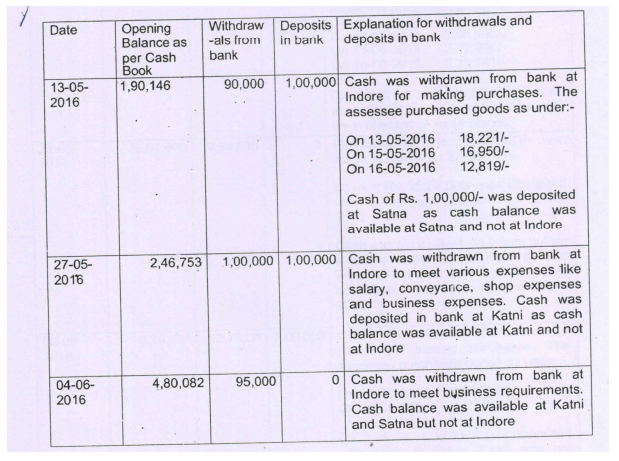
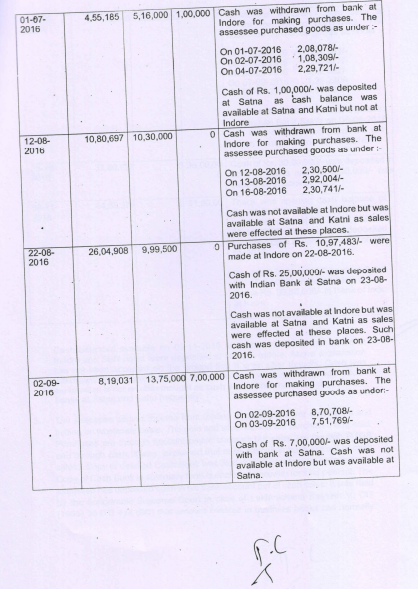
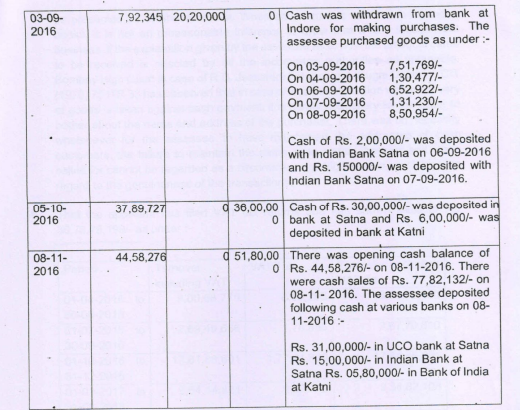
2. That the appellant has head office at Indore and branch office at Satna and Katni. Cash is withdrawn at Indore as centralized purchases are made at Indore. Sales are effected at branches at Satna and Katni. Such cash is retained at these places and deposited in bank at these places. Thus, cash was not available at Indore but was available at Satna and Katni.Cash was withdrawn from bank account at Indore for purchase of goods. Such explanation is not an after thought as cash at branches has been deposited in bank at Satna and Katni regularly.
3. That rejection of cash book and application of section 68 is unjustified and improper.Section 68 has no application when cash is received on account sales consideration. If trading results have been accepted, then purchases/sales can not be added u/s 68 as held in case of CIT vs. Pancham Dass Jain (2006) 205 CTR 0444 and other cases.
4. That cash balance of the assessee shown in its books was sufficient to cover the value of SBN notes and trading results have been accepted as genuine. High denomination notes could not be treated as income from undisclosed sources and assessee could not be required to prove the source of receipt of high denomination notes. Burden of proof that the high denomination notes encashed on their demonetisation constituted suppressed income of assessee, is on the Department. Neither cash sales nor the genuineness of account books were doubted. High denomination notes were legal tender at the relevant time and the assessee was neither required to record the identity of persons from whom these notes were received nor was required to prove the source of receipt of the notes.
5. That the appellant explained source of said cash deposits as sales of jewellery, produced sale bills and admitted same as revenue receipt as well as offered it to tax and assessee also represented outgo of stocks which was matching with sales. Purchases, sales and the Stock are interlinked and inseparable. Every purchase increases the stock and every sale decreases the stock. To disbelieve the sales either the assessee should not have the sufficient stocks in their possession or there must be defects in the stock registers/stocks. Once there is no defect in the purchases and sales and the same are matching with inflow and the outflow of stock, there is no reason to disbelieve the sales.
6. That the appellant declared Rs. 5,00,000/- under Prime Minister Garib Kalyan Yojna. He filed declaration under section 199C of the Finance Act, 2016 disclosing income of Rs. 5,00,000/- under Prime Minister Garib Kalyan Yojna Rules 2016. He paid tax of Rs. 2,49,500/- on 29-03-2017 and deposited Rs. 1,25,000/- with UCO Bank as per the scheme. Thus, addition to the extent of Rs. 5,00,000/- on account of SBN notes is unjustified and improper.
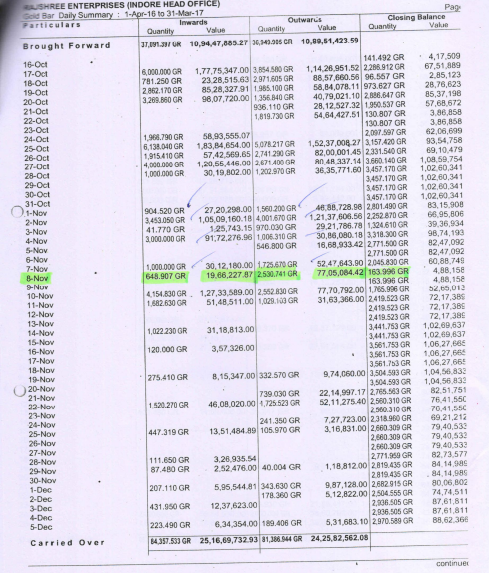
7. That the Id. CIT(A) has observed that the appellant has uploaded a copy of the Gold ornaments wherein, there is an outward entry for 40.083 grams on 18/10/2016. Thereafter,there is both an inward and an outward entry for the same quantity i.e. 1074.610 grams on26/10/2016 and then there is no inward or outward entry upto 21/11/2016. When gold ornaments have not been sold between 26/10/2016 and 21/11/2016, then the claim that the huge inflows of cash on 7th and 8th Nov 2016 were out of sale proceeds has no merit. TheId. . CIT(A) concluded that the appellant has failed to estab