


 Back
Back





2024 Supreme(Online)(ITAT) 1797
INCOME TAX APPELLATE TRIBUNAL (BANGALORE BENCH)
Shri Chandra Poojari, ACJ, Shri Prakash Chand Yadav, J
Shri Aravindan Vedhavaththiyar Singarachari – Appellant
Versus
DCIT, Circle – 5(3)(1), Bengaluru – Respondent
ITA Nos.665 & 666/Bang/2024
For the Appellants/Petitioners:Shri. V. Srinivasan, Advocate
For the Respondents: Ms. Anjala Sahu, CIT(DR)(ITAT), Bengaluru
The absence of a notice under Section 143(2) of the Income Tax Act renders reassessment proceedings void ab initio.
Headnote:(A) Income Tax Act, 1961 - Section 143(2), Section 148 - Reassessment proceedings - Assessment was quashed as void ab initio for lack of proper notice under Section 143(2). Court reinforced the necessity of adherence to statutory obligations in assessment process. (Paras 24, 25, 26)
(B) Legal Principles - Absence of statutory notice is a fundamental error that vitiates the proceedings, reaffirming judicial precedent.
(C)
Facts of the case:
The Assessing Officer reopened the assessment based on information of undisclosed properties. The assessee’s returns were scrutinized, leading to substantial income declarations.
(D)
Findings of Court:
The court found the reassessments to be without proper notice, thus invalidating them. (E)
Issues: The main issues were the validity of reassessment notices and jurisdiction under Section 148. (F)
Ratio Decidendi: The court established that non-issuance of notice under section 143(2) is fatal and must be strictly followed. (G)
Result: Appeals partially allowed.
| Table of Content |
|---|
| 1. reassessment initiated based on information regarding undisclosed income. (Para 1 , 2) |
| 2. notice under section 143(2) was not issued which is mandatory for assessment. (Para 3 , 4 , 5) |
| 3. arguments challenged the validity of reassessment and non-issuance of proper notices. (Para 6 , 7 , 8) |
| 4. court highlighted previous rulings as precedent for necessity of section 143(2). (Para 9 , 10 , 11 , 12) |
| 5. reassessment proceedings quashed due to absence of section 143(2) notice. (Para 24 , 25 , 26) |
ORDER
Per Prakash Chand Yadav, Judicial Member :
These two appeals of the assessee are arising from the orders passed by the NFAC, Delhi dated 08/03/2024 in DIN No. ITBA/NFAC/S/250/2023- 24/1062260533(1) for the Assessment Year (AY) 2016-17 & DIN No.ITBA/NFAC/S/250/2023-24/106226258(1) for AY 2018-19. Since issues involved in both the appeals are akin, we are deciding these appeals by common order. We will take AY 2016-17 as lead case and discussed the facts of the same for the sake of brevity.
2. The assessee is an individual, filed his return of income (ROI) originally on 04/08/2016 declaring an income of Rs.3260471/-. The same was processed u/s 143(1) of the Income Tax Act, 1961 (hereinafter called ‘the Act’) and thereafter the case of the assessee for the impugned year was reopened by the Department on the basis of following reasons :-
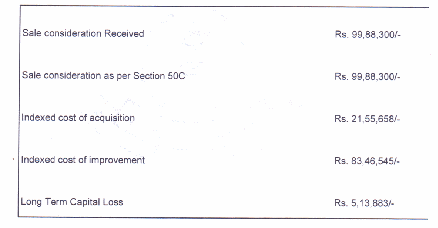
"In this case, information has been received from the Office of the Joint Director of Income Tax (I&CI), Bangalore regarding that the assessee had sols eight immovable properties during the year, but, disclosed capital gains only for one property. Further, the information was also received that the stamp duty value of all the eight properties has been assessed at Rs. 27,89,88,000/-. On receipt of the information, independent enquiries have been made and it is seen that the assessee has furnished ITR forA.Y. 2016-17 on 04/08/2016 declaring gross total income at Rs. 32.60,471/- and total income of Rs. 31,10,470/- after claiming deduction of Rs. 1.50,000/- under Chapter- VIA of the Income Tax Act, 1961 . In this ITR, the assessee has declared income from Salary Rs. 32,60,471/-and carry forward of current year loss from long term capital gains at Rs. 5,13,883/- . Further, on perusal of the Schedule of Capital Gains, it is seen that the assessee has declared long term capital loss as under:-
The copies of sale deeds of eight properties is available on records. The details of sale transactions carried out by the assessee and guidance value of the property and amounts forming part of computation of income shown in the Income Tax Return filed for AY. 2016-17 are tabulated as under:

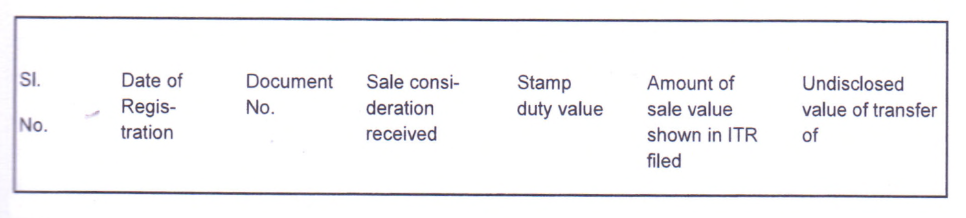
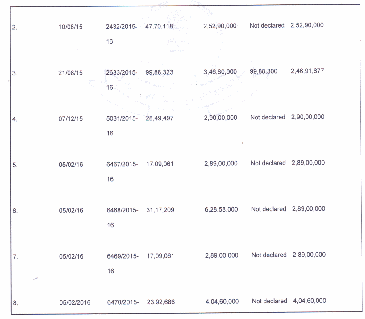

Thus, it can be seen that the assessee had received sale consideration on sale of eight properties amounting to Rs. 2,90,19,392/-, but, declared sale consideration on sale of property at Rs. 99,83,300/- only, which is pertaining to sale of only one property sold vide sale deed registered as document number 2633/201516 dated 21/08/2015 and the assessee has failed to disclosed capital gains on sale of remaining seven properties. In this case, the stamp duty value of all eight properties have been assessed by the Stamp and Registration Authority at Rs.26,89,99,677/-. Therefore, as per the provisions of Section 50C of the Income Tax Act, 1961 , the assessee is liable to declared long term capital gains by adopting deemed sale consideration at Rs. 26,89,99,677/-. However, the assessee has failed to do so. It has also been seen that the assessee has furnished incorrect details regarding sale consideration of one property sold and declared in the ITR as per the provisions of section 50C of the Income Tax Act, 1961 at Rs. 99,88,323/- as against the actual value assessed at Rs. 2,46,91,677/-. In view of these facts, the deemed sale consideration of the properties at Rs. 27,89,88,000/- has escaped assessment. It is seen from the ITR that the assessee has declared only income under the head Income from Salary. However, it is seen fr












