Back
Back





2024 Supreme(Online)(ITAT) 2160
INCOME TAX APPELLATE TRIBUNAL (DELHI BENCH)
Dr. B. R. R. Kumar, Sh. Sudhir Kumar, JJ
MAYAR HEALTH RESORTS LTD. NEW DELHI – Appellant
Versus
DCIT NEW DELHI – Respondent
ITA No. 5109/Del/2012 | ITA No. 6228/Del/2013 | ITA No. 326/Del/2015 | ITA No. 3548/Del/2018
For the Appellants/Petitioners: Sh. Raghav Sharma, CA, Sh. Shivam Garg, Adv.
For the Respondents: Sh. Anshul, Sr. DR
Membership fees received constitute income under mercantile accounting as services rendered, despite disputes regarding tax treatments on TDS and disallowances for specific expenses.
Headnote:(A) Income Tax Act, 1961 - Sections 143(3), 14A, 36(1)(iii), 145(2) - Membership fees and accounting policy - Appellant contested the addition of received membership fee as income during the assessment year 2008-09 - The Assessing Officer stated that the membership fees received is income and upheld the addition based on the principle that income accrues when a right to receive it is established. (Paras 10, 28)
(B) Appeal - It was upheld that deduction on disallowance should not be made when there is no earning of exempt income in accordance with Section 14A. Also, the notification from CBDT clarifying non-applicability of TDS deduction on specific financial service transactions was cited for decision. (Paras 18, 22, 24)
Facts of the case:
The assessee is a company providing health services, receiving membership fees. Disputes arose regarding the recognition of income pertaining to fees and various disallowances by the Assessing Officer. The appellant argued that fees should only be taxed when services are provided and presented consistent accounting practices over the years.
Findings of Court:
The court noted that membership fees constituted accrued income; hence, income realization should be aligned with the mercantile system of accounting. The claims regarding tax deductions were further dissected concerning exempt income and TDS obligations.
Issues: The principal issues included the accounting policy concerning membership fees and how household furniture policy and TDS obligations should be applied. The assessments were questioned on whether they were adherent to existing legal frameworks.
Ratio Decidendi: The court found that because the membership fees were not refundable and were fully received, they constituted adequate income. The appellant's unilateral choice in changing its accounting practices was rejected due to inconsistency with established tax principles.
Result: Appeals partly allowed.
| Table of Content |
|---|
| 1. disallowance due to improperly declared expenditure. (Para 2 , 3 , 19) |
| 2. membership fees constitute income upon accrual. (Para 10 , 18) |
| 3. tds obligations applied to specific financial transactions. (Para 12 , 22 , 24) |
ORDER
Per Dr. B. R. R. Kumar, Accountant Member:
The present appeals have been filed by the assessee against the orders of ld. CIT(A)-IX, New Delhi dated 22.06.2012, 27.09.2013, 2909.2014 and the appeal filed by the Revenue against the order of ld. CIT(A)-38, New Delhi dated 01.12.2017. Since, the issue involved in ITA No. 5109/Del/2012, ITA No. 6228/Del/2013 and ITA No. 326/Del/2015 are similar, they were heard together and being adjudicated by a common order.
2. In ITA No. 5109/Del/2012, following grounds have been raised by the assessee:
“1. That the assessment under section 143(3) is bad in law and is liable to be annulled.
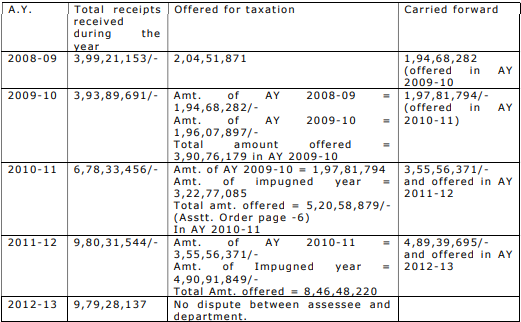
2. That the learned CIT(A) under the facts and circumstances of the case has committed a mistake of law in sustaining the action of the assessing officer for making the addition on account of membership fee amounting to Rs 1,94,68,282/- pertaining to the period from 1 April 2008 and onwards as shown under the head membership fee received in advance' on accrual basis of accounting over the life of membership period as per accounting standard as notified by CBDT under section 145(2) being mandatory on assessee to follow.
3. That the learned CIT(A) was not Justified on facts and law in sustaining the action of the assessing officer in ignoring the contention of the assessee that when the change of method of accounting is bonafide and mandatory u/s 145(2) and consistently followed in the subsequent years by the assessee company, no addition can be made by invoking the provision of section 145(3) of the Income Tax Act.
4. That the learned CIT(A) under the facts and circumstance of the case has committed a mistake of law in sustaining the action of the assessing officer in not accepting the change of policy of accounting in respect of membership fees from cash systematic mercantile system, as per provision of section 209 of the Companies Act and subsequently followed consistently year after year by the assessee company.
5. That the learned CIT(A) under the facts and circumstances of the case has committed a mistake of law in sustaining the action of the assessing officer for incorrectly holding that the assessee's action in apportionment of the income, which had accrued and received in the year itself, is not justified. The assessee has apportioned only the income received between the income accrued and not accrued during the year.
6. That the learned CIT(A) had acted against the law and facts of 07 the case in sustaining the addition of Rs. 1,94,68,282/- by incorrectly holding that the appellant had a vested right, with no obligation to return the same, the income is absolutely ascertained determined and specified over which the appellant has exclusive right in contravention of the Judgement of Jurisdictional Delhi High Court in case of CIT vs Dinesh Kumar Goyal 331 ITR 10 which is squarely applicable in case of assessee.
7. That the learned CIT(A) had acted against the law and facts by incorrectly holding that assessee acquire a right to received the 8 membership fees and the amount received by appellant in its own right and there was a debt incurred by the payers in favour of appellant and amount received by appellant was clearly in the nature of Accrual Income.
8. That the learned CIT(A) under the facts and circumstances of the case has committed a mistake of law in not allowing a sum of 1/5th of Rs.10,37,958 under section 35D(2)(c)(iii) of the income tax Act as the fund so received was invested in the expansion of the Existing project of the assessee.
9. That the learned CIT(A) under the facts and circumstances of the case has committed a mistake of law in confirming the action of the AO in not allowing a sum of Rs 304540/- out of total deferred revenue Expenditure out of to