


 Back
Back





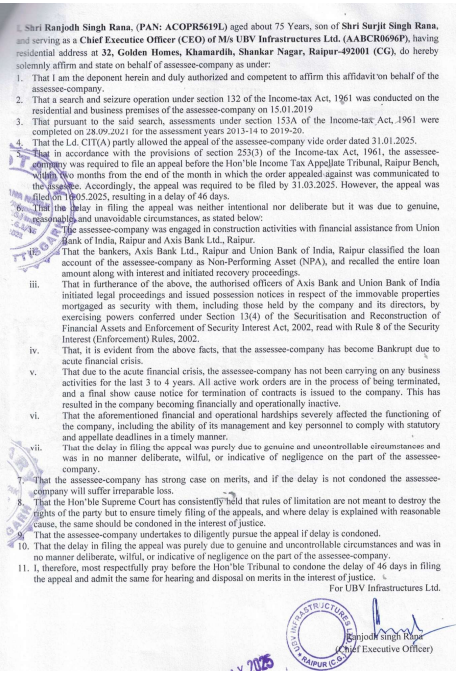
2025 Supreme(Online)(ITAT) 3621
INCOME TAX APPELLATE TRIBUNAL (RAIPUR BENCH)
SHRI PARTHA SARATHI CHAUDHURY, J, SHRI ARUN KHODPIA, ACJ
UBV Infrastructures Limited – Appellant
Versus
The Assistant Commissioner of Income Tax, Central Circle-1, Raipur (C.G.) – Respondent
IT(SS)A Nos. 20 to 25/RPR/2025
For the Appellants/Petitioners: Shri B Subramanyam, CA
For the Respondents: Shri Ram Tiwari, Sr. DR
The court emphasized the importance of natural justice in tax assessments, ruling that failure to provide a hearing violates due process, necessitating remand for reconsideration.
Headnote:(A) Income Tax Act, 1961 - Section 145(3) - Limitation Act, 1963 - Condonation of delay - Appeals filed after a delay of 46 days were condoned due to financial difficulties faced by the assessee, guided by principles of natural justice and prior judgments emphasizing a liberal approach towards delay in filing appeals. (Paras 4, 5, 9, 11)
(B) Natural Justice - The principles of natural justice were emphasized, particularly the right to be heard, as the Assessing Officer failed to provide the assessee with a proper opportunity before passing the assessment order, rendering the proceedings perverse. (Paras 7, 10, 11)
Facts of the case:
The appeals were filed by an infrastructure company against the orders of the CIT(Appeals) regarding assessment years 2013-14 to 2018-19, with a delay attributed to financial losses and lack of business activity. The grounds of appeal challenged the lack of a show cause notice and opportunity of hearing during the assessment.
Findings of Court:
The court found that the CIT(Appeals) did not adequately address whether the principles of natural justice were followed in the assessment process, necessitating a remand for reconsideration.
Issues: The main issues were the condonation of delay in filing appeals and the violation of natural justice concerning the lack of opportunity for the assessee to present their case during assessment.
Ratio Decidendi: The court held that the principles of natural justice must be adhered to, and in the absence of any evidence from the Revenue to show compliance, the appeals must be remanded for proper adjudication.
Result: Appeals allowed for statistical purposes.
| Table of Content |
|---|
| 1. introduction of the case and parties involved. (Para 1) |
| 2. request for condonation of delay in filing appeals. (Para 2 , 3) |
| 3. criteria for condoning delay based on substantial justice. (Para 4 , 5) |
| 4. consolidation of appeals based on similar issues. (Para 6) |
| 5. allegations of violation of natural justice in assessment. (Para 7 , 8) |
| 6. importance of natural justice in judicial proceedings. (Para 9 , 10) |
| 7. court's determination on the violation of natural justice. (Para 11) |
| 8. final decision allowing appeals for statistical purposes. (Para 12 , 13) |
आदेश / ORDER
PER BENCH:
The captioned appeals preferred by the assessee emanates from the respective orders of the Ld. CIT(Appeals)/NFAC, dated 31.01.2025 for the assessment years 2013-14 to 2018-19 as per the grounds of appeal on record.
2. At the very outset, the Ld. Counsel for the assessee submitted that the captioned appeals are time barred by 46 days. The Ld. Counsel has filed condonation petition a/w. affidavit praying for condonation of delay of 46 days each in filing of these appeals. The condonation petition and affidavit sworn in by Shri Ranjodh Singh Rana, CEO of M/s.UBV Infrastructure Limited is made part of this order and extracted as follows:
3. The Ld. Sr. DR principally opposed the condonation of delay but could not place on record any evidence to demonstrate that such delay caused was intentional or through deliberate conduct on the part of the assessee.
4. Be that as it may after careful consideration of the submissions of the parties as well as contents in the affidavit and condonation petition, we are of the considered view that such delay was caused for the fact that in the last four years there was no business activities of the assessee and they were running into financial loss, therefore, even applying the principles of preponderance of human probabilities, in such scenario, it was not possible for the assessee to look into the income tax matter preferring the appeal and therefore, such delay is categorized within the purview of the circumstances beyond the control of the assesse and are definitely not deliberate or malafide regarding the conduct of the assessee. Taking guidance from the judgment of the Supreme Court in the case of Vidya Shankar Jaiswal Vs. ITO, Ward-2, Ambikapur, Civil Appeal Nos……………../2025 [Special Leave Petition (Civil) Nos. 26310- 26311/2024, dated 31.01.2025, wherein it was held and observed that a justice oriented and liberal approach ought to be adopted while considering the aspect of condoning the delay involved in filing of the appeal. Also, the Hon’ble High Court of Chhattisgarh in the case of Jagdish Prasad Singhania Vs. Additional Commissioner of Income Tax (TDS), Raipur (C.G.), TAX Case No.17/2025, dated 24.02.2025, after relying on the judgment of the Hon’ble Supreme Court in the case of Vidya Shankar Jaiswal Vs. ITO, Ward-2, Ambikapur (supra) had held that a justice oriented and liberal approach be adopted while considering the application filed by the assessee for condonation of delay.
5. That in the recent judgment of the Hon’ble Supreme Court in the case of Inder Singh Vs. the State of Madhya Pradesh, Civil Appeal No…………/2025, Special Leave Petition (Civil) No.6145 of 2024, dated 21st March, 2025, the Hon’ble Apex Court while interpreting Section 5 of the Limitation Act, 1963 regarding the condonation of delay in respect of case of land acquisition has observed and held on the aspect of delay that although the delay cannot be condoned without sufficient cause, the merits of the case could not be discarded solely on the ground of delay. A liberal approach, therefore, should be taken in condoning the delay when limitation ground undermines the merits of the case and obstructs the substantial justice. In other words, the objective of the court should be to deliver substantial justice coupled with liberal and judicious approach while deciding the issue of limitation and whenever it is found that the case has merits which












