Back
Back





2025 Supreme(Online)(ITAT) 5015
INCOME TAX APPELLATE TRIBUNAL (HYDERABAD BENCH)
Shri Vijay Pal Rao, VP, Shri Manjunatha, G., AM
SHARE MICROFIN LIMITED HYDERABAD – Appellant
Versus
DEPUTY COMMISSIONER OF INCOME TAX CIRCLE-3(1) HYDERABAD – Respondent
ITA No.448/Hyd/2023
For the Appellants/Petitioners: Not mentioned
For the Respondents: Not mentioned
The failure to adhere to legal notifications on currency ceased transactions renders cash deposits in demonetized notes as unexplained income under the Income Tax Act.
Headnote:(A) Income Tax Act, 1961 - Section 69A - Assessment under scrutiny for A.Y. 2017-18 - Business activities of micro-finance company in question related to specified bank notes in demonetization period - The Assessing Officer assessed cash deposits of Rs.39.66 crores as unexplained money, citing violation of legal tender notification. - Assessee claims deposits were from recoveries of borrowers, which the court found untenable given the clear legislative intention of the demonetization. (Paras 9 to 15)
(B) Principle of Natural Justice - Procedural fairness in verification of claimed cash transactions by tax authorities must be upheld, and findings should align with the legitimate interpretation of the law. (Paras 9 and 11)
Facts of the case:
The assessee, a Non-Banking Finance Company, argued that cash deposits during the demonetization period represented recoveries from borrowers. The AO disallowed this by interpreting the demonetization notification that ceased the legal tender status for certain denominations.
Findings of Court:
The court determined the AO's assessment was correctly based on effective legal prohibitions post-demonetization, emphasizing adherence to legal notifications.
Issues: Whether cash deposits made in SBNs were legitimate recoveries or unexplained income in light of legal notifications regarding demonetization?
Ratio Decidendi: The essence of the judgment rested on the assessment being in line with legal precedents and proper verification processes, which were not followed by tax authorities in implicating the highest standards of accountability for financial transactions.
Result: Appeal allowed for statistical purposes.
| Table of Content |
|---|
| 1. assessee's cash deposits during demonetization deemed unexplained. (Para 3 , 4 , 10) |
| 2. assessee's defenses regarding legality of transactions maintained. (Para 5 , 6 , 7 , 12) |
| 3. legal tender status directly impacts transaction legitimacy. (Para 8) |
| 4. court confirms ao's position based on demonetization notifications. (Para 9 , 11) |
आदेश/ORDER
Per Vijay Pal Rao, Vice President
This appeal filed by the assessee is directed against the order dated 31/07/2023 of the learned CIT (A)-NFAC Delhi, for the A.Y.2017-18.
2. The assessee has raised the following grounds:
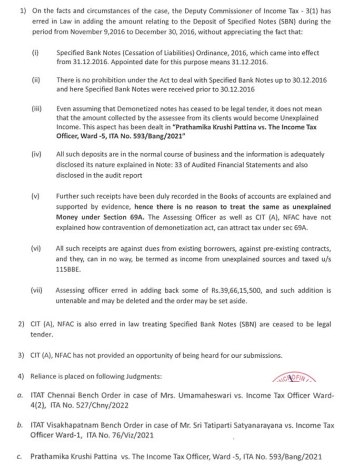
3. The assessee is a Non-Banking Finance Company (NBFC) registered with the RBI and engaged in micro-finance business since 1999. The assessee filed its return of income for the year under consideration on 27/10/2017 declaring total income at “Nil”. The case was selected for scrutiny under CASS under complete scrutiny. During the scrutiny assessment proceedings, the Assessing Officer noticed that the assessee has made cash deposits to the tune of Rs.39,66,15,500/- in the bank account during the demonetization period in Specified Bank Notes (SBNs). The Assessing Officer asked the assessee to explain the source of the deposits of SBNs during the demonetization period. In response, the assessee explained that the assessee is in the business of micro-finance and lending small loans to the poor and women in the rural area. It collects cash and ultimately deposits this amount in the Bank. Therefore, the assessee explained that the cash deposits made during the demonetization period were related to the day-to-day activities of the business of the assessee. The Assessing Officer did not accept this explanation of the assessee and held that as per the notification in S.O No.3407(E), dated 8/11/2016 issued by the Govt. of India, the SBNs in the denomination of Rs.500 and Rs.1000 were withdrawn as legal tender w.e.f. 09/11/2016 and permitted the deposit and such SBNs held by a person into his bank account. Thus, the Assessing Officer held that the acceptance of SBNs by the assessee after 8/11/2016 and deposit of the same in the bank account of the assessee were in contravention of the notification issued by the Govt. of India. The Assessing Officer accordingly held the said deposits of Rs.39,66,15,500/- as unexplained money u/s 69 of the I.T. Act, 1961 while passing the assessment order dated 30/12/2019.
4. The assessee challenged the action of the Assessing Officer before the learned CIT (A) but could not succeed.
5. Before the Tribunal, the learned AR of the assessee has submitted that the assessee operates under highly regulated environment as the activities of the assessee are regulated by the RBI. The assessee is required to maintain the record of category of customers, KYS norms, proper loan agreement, repayment schedule and disclosure of interest rates etc. The books of account of the assessee are subjected to annual audit as per the provisions of the Companies Act, 2013 as well as the Tax Audit under the I.T. Act, 1961. The RBI conducts annual inspection of the company’s records and to ensure the compliance with the RBI directions, the assessee is not permitted to take unsecured borrowings from any source other than the corporates. Therefore, generation of any unexplained income in the hand of the assessee is not possible. The assessee operates its business through a network of 700 branches spread out in 19 states. The disbursements of loan are made in the branch office, but the collections are made in the centers with each branch up to 9 and 10 centers. The centers are working close to the borrowers’ places and therefore, the collections are made in the center where group of women meet and repay the instalment. Thus, the Field Credit Officer collects the instalments and deposits in the bank account attached to the respective bank branches. Each and every transaction is recorded in the branch and also in the loan management system (LMS) at the Head of Office. Thus