


 Back
Back





2025 Supreme(Online)(ITAT) 5016
INCOME TAX APPELLATE TRIBUNAL (HYDERABAD BENCH)
Shri Vijay Pal Rao, VP, Shri Manjunatha, G., AM
SRI VENKATESWARA SWAMY DEVASTANAM JAMALAPURAM – Appellant
Versus
ITO. EXEMPTION WARD-1(3) HYDERABAD – Respondent
ITA Nos.1002 & 1003/Hyd/2024
For the Appellants/Petitioners: Not specified
For the Respondents: Not specified
Income of an administrative body under government oversight is exempt from tax under Section 10(23BBA), but the income of the temple itself is taxable.
Headnote:(A) Income Tax Act, 1961 - Sections 10(23BBA), 11, 12, 69A, 115BBC - Income exemption claims - Assessee's income from a temple claimed exempt under Section 10(23BBA) as managed by State-appointed Endowment Commissioner, denied on grounds of non-compliance with mandatory filing requirements - High Court directed to allow statutory remedy for appeal - Condonation of delay in filing appeal permitted. (Paras 2, 4-14)
(B) Court ruled that income of the administrative authority is exempt under Section 10(23BBA) but not the income of the temple itself, clarifying the conditions under which tax exemption applies. (Paras 13-14)
Facts of the case:
The appeals challenge the taxability of donations and certain exemptions denied by the learned CIT (A), relating to specific assessment years under scrutiny. The Court analyzed the legal framework surrounding exemptions applicable to religious and charitable trusts.
Findings of Court:
The Tribunal confirmed that while the management falls under the purview of the Endowment Act, the income of the temple itself remains taxable due to failure in fulfilling conditions mandated by the Income Tax regulations.
Issues: The Court addressed the proper classification of exempt entities and examined the implications of not filing a return of income.
Ratio Decidendi: The court emphasized the distinction between income of the administrative body versus that of temples under the Endowment Act; clarified that only bodies created by government authorities are exempt under Section 10(23BBA).
Result: Both the appeals filed by the assessee are partly allowed.
| Table of Content |
|---|
| 1. challenge to tax liability on donations received. (Para 1 , 2 , 6) |
| 2. claims of income exemption based on administrative oversight. (Para 4 , 7 , 9) |
| 3. issue regarding anonymous donations and tax implications. (Para 10 , 12) |
| 4. clarification on the applicability of tax exemptions for religious institutions. (Para 13) |
| 5. final ruling on the appeals filed. (Para 14) |
आदेश/ORDER
Per Vijay Pal Rao, Vice President
These appeals filed by the assessee are directed against two separate orders, both dated 19/02/2024 of the learned CIT (A)-NFAC Delhi, for the A.Ys. 2013-14 & 2016-17.
2. There is a delay of 160 days in filing the present appeals. The assessee has filed an application for condonation of delay. The learned AR of the assessee has submitted that during the pendency of the appeal before the learned CIT (A), the assessee filed a writ petition before the Hon'ble High Court for issuing directions to the learned CIT (A) and the Hon'ble High Court was pleased to give directions to the learned CIT (A)
accordingly. Thereafter, the assessee challenged the impugned order in the Writ Petition No.18335/2024 before the Hon'ble High Court. However, since the proper remedy was to file the appeal before the Tribunal, therefore, the Hon'ble High Court has allowed the assessee to avail the statutory remedy of filing appeal and also made it clear that the time consumed before the Hon'ble High Court shall not be counted for the purpose of the limitation before the Tribunal vide order dated 09/09/2024. Therefore, the delay of 160 days in filing the present appeal may be condoned and the appeal of the assessee be admitted for adjudication on merits.
3. On the other hand, the learned DR has objected to the condonation of delay in filing the present appeals.
4. We have considered the rival submissions as well as carefully perused the contents of the application for condonation of delay which are reproduced in para 5 to 7 of the order as under:
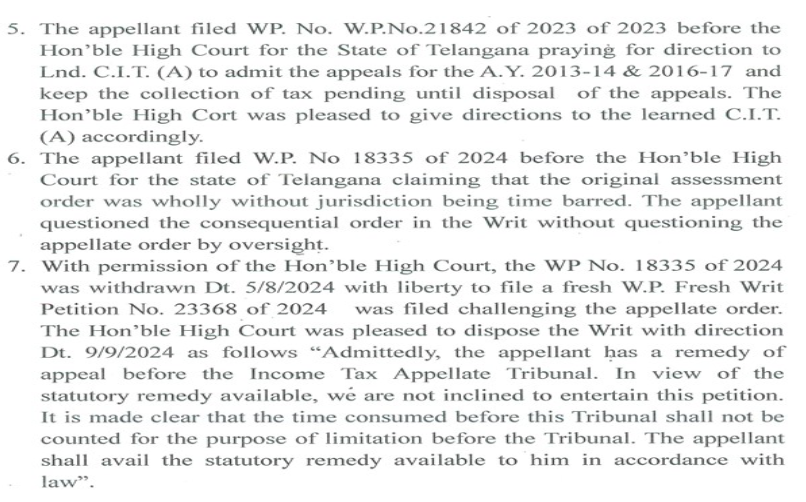
4. We further note that vide order dated 9/9/2024 in Writ Petition No.23368/2024, the Hon'ble High Court has observed in para 2 and as under:
“2. This petition assails order dated 19/02/2024 passed by the Appellate Authority. Admittedly, the petitioner has a remedy of appeal before the ITAT. In view of the statutory remedy available, we are not inclined to entertain this petition. It is made clear that the time consumed before this Court shall not be counted for the purpose of limitation before the Tribunal. The petitioner shall avail the statutory remedy available to him in accordance with law.
3. With the aforesaid, the Writ Petition is disposed of. There shall be no order as to costs. Interlocutory applications, if any pending, shall stand closed”.
5. Accordingly, when the time consumed before the Hon'ble High Court is excluded for the purpose of limitation in filing the appeal before this Tribunal as observed by the Hon'ble High Court, then the appeal of the assessee is found to be within the period of limitation and admitted for adjudication on merits.
6. The assessee has raised common grounds of appeals in these 2 appeals except the quantum of addition. The grounds raised by the assessee for the ay 2013-14 are reproduced as under:
6.1 The learned AR of the assessee has submitted that the learned CIT (A) has partly allowed the appeal of the assessee, however, the claim of exemption u/s 11 and 12 of the Act was denied on the ground that the assessee did not file the return of income as well as the audit report in Form-10B. He has thus, contended that the issue in these appeals arises that the assessee was not required to file the return of income when the case of the assessee is covered u/s 10(23BBA) of the I.T. Act, 1961. The 2nd issue raised by the assessee is regarding the donation received by the assessee in the shape of hundi i.e. a donation received in the donation box placed at Devasthanam and therefore, the same cannot be treated as anonymous donation to be taxed u/s 115BBC of the Act.
7. As rega












