
 Back
Back





INCOME TAX APPELLATE TRIBUNAL (MUMBAI BENCH)
Amit Shukla, Judicial Member, Arun Khodpia, Accountant Member
Mohammad Saleem – Appellant
Versus
Assistant Commissioner Of Income Tax Central Circle 4(4), Mumbai – Respondent
ITA No. 3862/MUM/2025 | ITA No. 3950/MUM/2025 | ITA No. 3951/MUM/2025 | ITA No. 3952/MUM/2025 | ITA No. 3953/MUM/2025 | ITA No. 3954/MUM/2025 | ITA No. 3955/MUM/2025
(A) Income Tax Act, 1961 - Sections 143(3), 153A, 153B, 153C - Search and seizure - Assessment of non-searched person - Limitation - Block of six assessment years - Relevant assessment year - Satisfaction note - Condonation of delay.
(B) The first proviso to Section 153C(1) of the Act introduces a legal fiction whereby the commencement point for computing the block of six assessment years for a non-searched person is the date of receipt of books of account, documents or assets by the jurisdictional Assessing Officer, not the date of search on the searched person. This position is authoritatively settled by the Supreme Court in CIT v. Jasjit Singh and followed by the Delhi High Court in PCIT v. Ojjus Medicare (P.) Ltd. and the Bombay High Court in Ashok Khandelwal v. Union of India. (Para 15-18)
(C) For assessment years falling beyond the six-year block but within ten years, the Assessing Officer can assume jurisdiction under Section 153C read with Section 153A only if the escaped income amounts to or is likely to amount to Rs. 50 lakh or more in the relevant assessment year. (Para 6.5-6.6)
(D) If an assessment year falls within the block of six assessment years as per Section 153C, the assessment must be framed under Section 153C read with Section 153A, and not under the regular provisions of Section 143(3). An assessment framed under Section 143(3) for such a year is without jurisdiction and void ab initio. (Para 7.2-7.4)
Facts of the case:
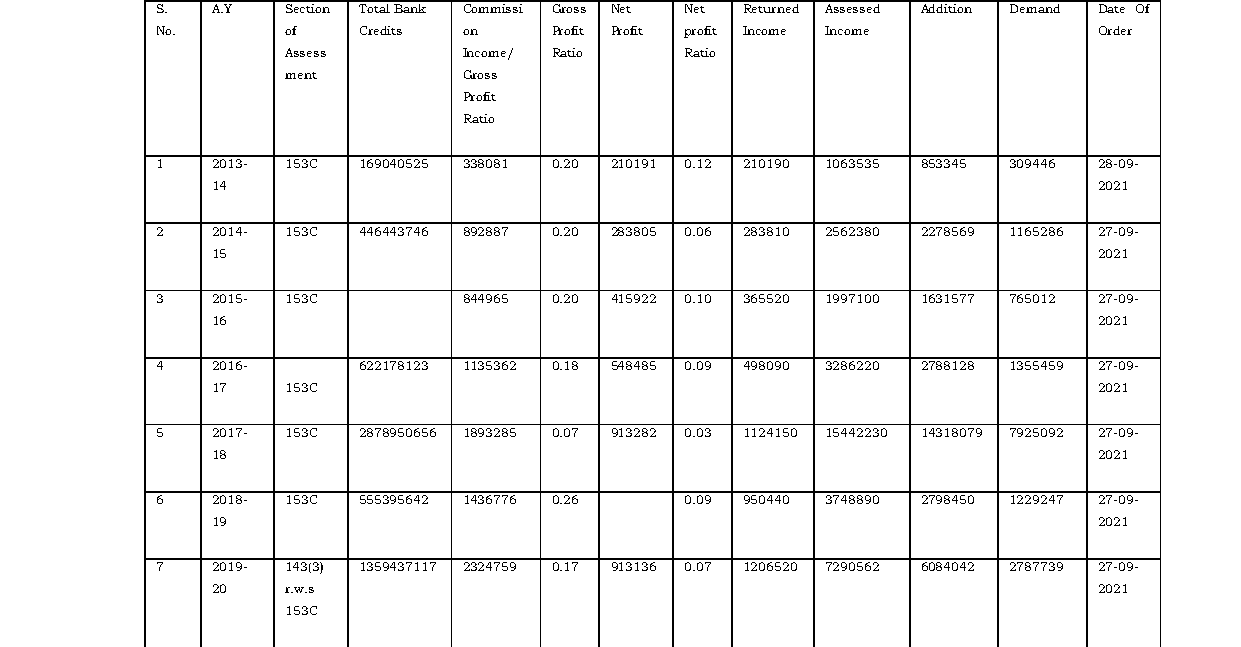
A search was conducted on the Allana Group on 03.01.2019. The satisfaction note under Section 153C for the assessee, a non-searched person, was recorded on 22.09.2020, and a notice under Section 153C was issued on 30.09.2020. The Assessing Officer completed assessments under Section 153C for AYs 2013-14 and 2014-15, and under Section 143(3) for AY 2019-20. The assessee challenged the assessments on the grounds of limitation and lack of jurisdiction. The assessee also appealed on merits for AYs 2015-16 to 2018-19, disputing the estimation of net profit at 0.5% of total sales.
Findings of Court:
The Tribunal held that the delay of 120 days in filing the appeals stood condoned as the assessee was an uneducated person and there was no intentional delay. For AYs 2013-14 and 2014-15, the Tribunal held that the relevant assessment year for the search was AY 2021-22, and the block of six preceding assessment years was AYs 2015-16 to 2020-21. Consequently, AYs 2013-14 and 2014-15 fell outside this block but within the ten-year period. However, since the additions for these years were far below Rs. 50 lakh, the conditions for treating them as "relevant assessment years" were not met, rendering the assessments void for lack of jurisdiction. For AY 2019-20, the Tribunal held that since this year fell within the six-year block, the assessment had to be framed under Section 153C, not Section 143(3); therefore, the assessment was quashed. For AYs 2015-16 to 2018-19, the Tribunal, without adjudicating other legal grounds, directed the Assessing Officer to adopt a net profit rate of 0.18% of the credit in the bank account (the average of the assessee's declared rates) or the higher rate already declared, for estimating income.
Issues: The main issues were: 1. Whether the assessments for AY 2013-14 and AY 2014-15 were barred by limitation and void for lack of jurisdiction, given the method of calculating the block of six years under Section 153C. 2. Whether an assessment for AY 2019-20, which fell within the six-year block of a search case, could be validly completed under Section 143(3) instead of Section 153C. 3. Whether the estimation of net profit at 0.5% of sales by the Assessing Officer was fair and justified.
Ratio Decidendi: The Tribunal, relying on the Supreme Court's decision in Jasjit Singh and the Delhi High Court's decision in Ojjus Medicare, held that for a non-searched person, the six-year block under Section 153C is reckoned from the date of handing over of seized material, not the date of search. The Tribunal also held that assessments for years outside this block but within ten years are only permissible if the escaped income is Rs. 50 lakh or more. Further, it held that an assessment for a year falling within the six-year block must be made under Section 153C/153A, and not under Section 143(3); otherwise, it is without jurisdiction.
Result: ITA 3862, 3950 & 3955 (AY 2013-14, 2014-15 & 2019-20) are allowed. ITA 3951 to 3954 (AY 2015-16 to 2018-19) are partly allowed for statistical purposes.
| Table of Content |
|---|
| 1. appeals arising from cit(a) orders under section 153c/143(3) of the income tax act, 1961. (Para 1) |
| 2. delay in filing appeals condoned due to lack of intentional delay by uneducated assessee. (Para 2 , 3) |
| 3. multiple appeals with identical facts heard together; issues categorized. (Para 4 , 5) |
| 4. jurisdiction under section 153c for assessment years beyond six-year block requires escaped income of rs. 50 lakh or more. (Para 6) |
| 5. assessment under section 143(3) for years within section 153c block is without jurisdiction and quashed. (Para 7) |
| 6. estimation of gross profit at average rate of 0.18% for assessee's business; scrutiny assessment not a bar. (Para 8) |
| 7. appeals partly allowed; assessments for certain years quashed, others remitted for recalculation. (Para 9) |
PER ARUN KHODPIA, ACCOUNTANT MEMBER:
The captioned appeals are filed by the assessee against the orders of CIT(A)/NFAC, 52, Mumbai (in short „the Ld. CIT(A)‟) dated 08.11.2024 for the Assessment Year 2013-14, 2014-15, 2015-16, 2016-17, 2017-18, 2018-19 and 2019-20, which in term arises from the order u/s 153C / 143(3) of the Income Tax Act, 1961 (in short „the Act‟) dated 28.09.202, 27.09.2021 passed by Assistant Commissioner of Income Tax Central Circle 4(4), Mumbai (in short „the Ld. AO‟).
Condonation of Delay:
2. The captioned appeals are time barred being filed with a delay of 120 days. In explanation for sufficient in intentional cause beyond the control of assessee, petitions for condonation are filed for all the years under consideration. Application along with affidavit for AY 2013-14 are reproduced as under:
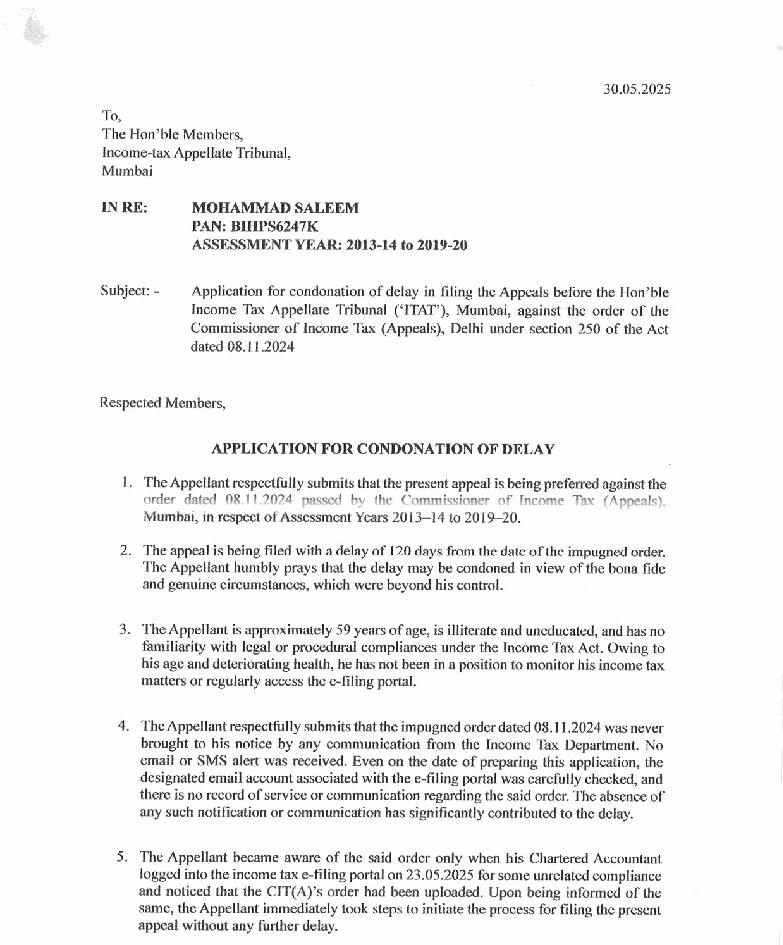
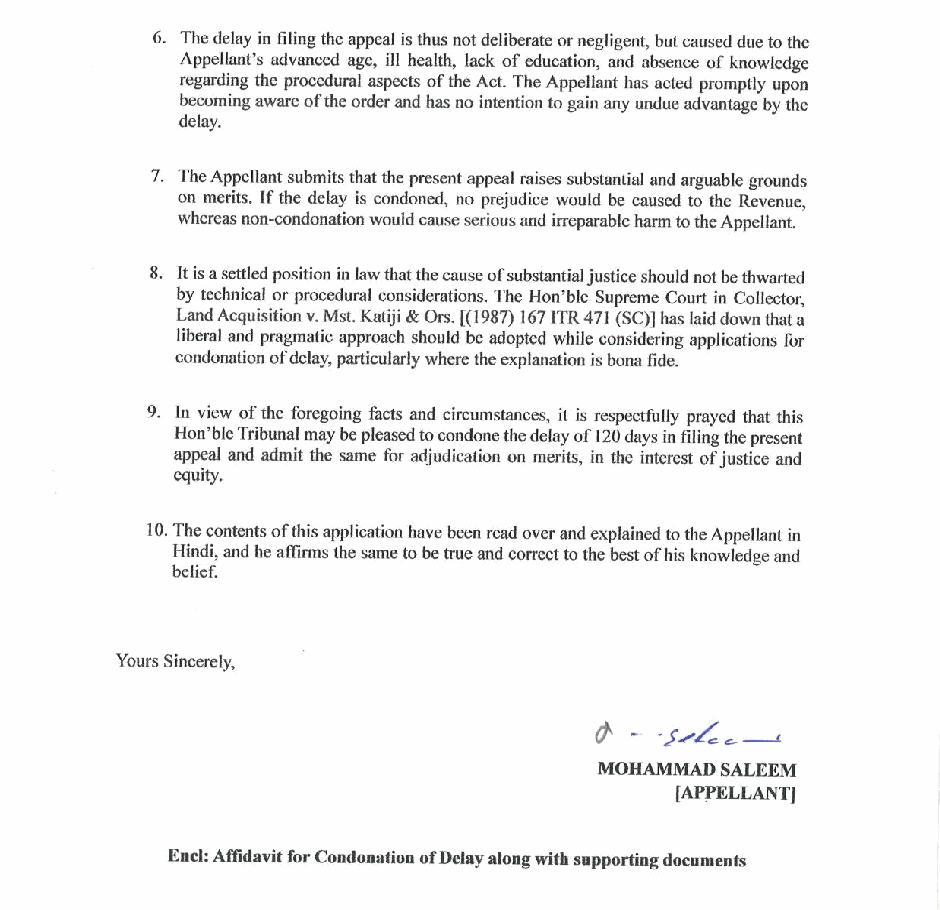
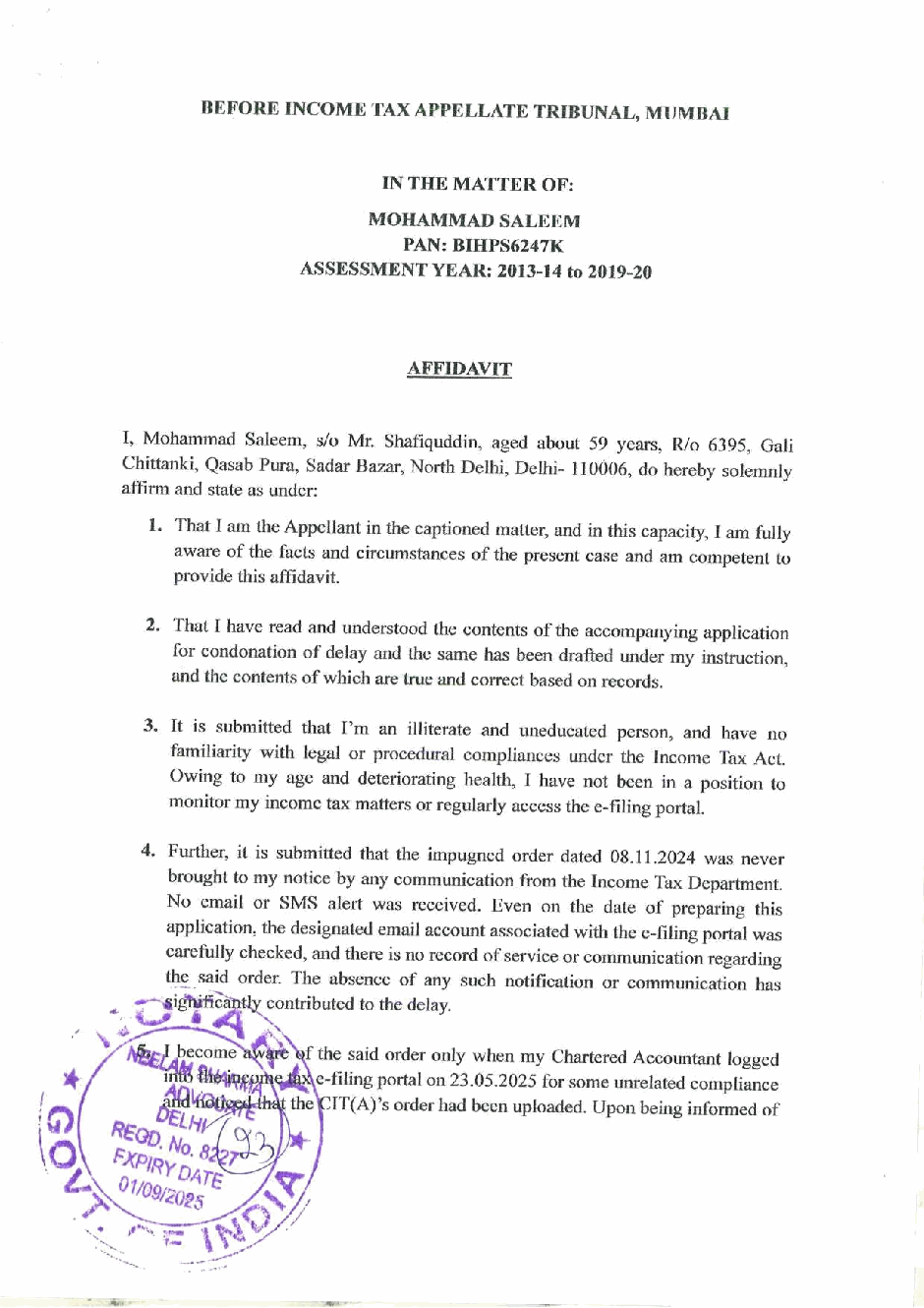
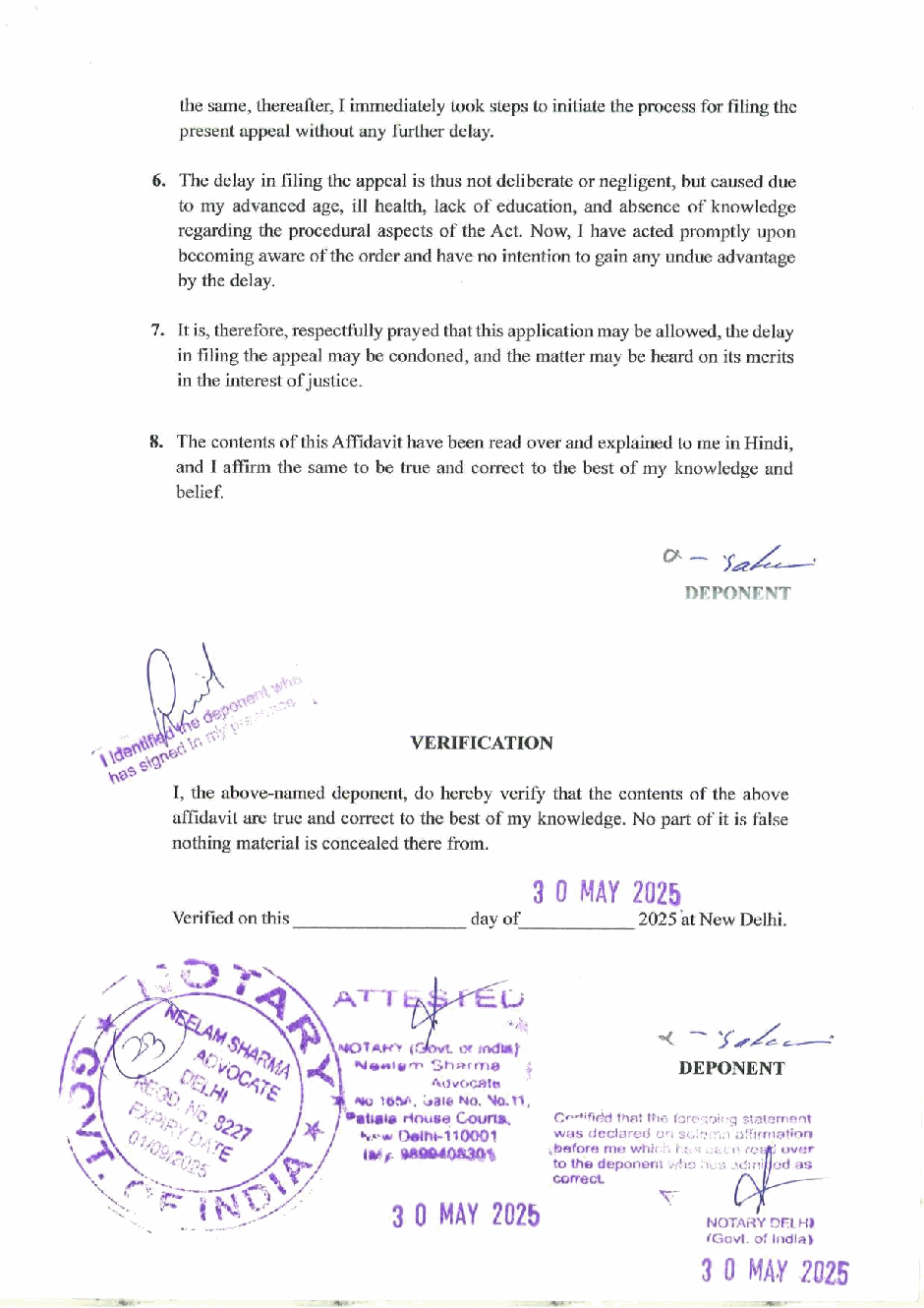
3. Going through the contents of the condonation petition and affidavit, we find substance in the request of the assessee, who is an uneducated person. The communication of the impugned orders was not received by the assessee through email or SMS, which could have come to his notice only when e-portal of department has been logged into by his chartered accountant. Nothing on records suggests any intentional or deliberate attempt of the assessee to delay the filing of appeal. We, thus, in the interest of justice condone the delay in filing of aforesaid appeals, so as proceed to adjudicate the same in terms of grounds of appeal raised therein.
4. All the aforesaid appeals pertain to same assessee, emerging from search and seizure action on Allana Group, having identical, interconnected and interwoven facts, therefore, these appeals, for the sake of brevity are heard together and are disposed off under this common order.
5. The issue raised in the aforesaid appeals are dividend in three parties,
(i). That the assessment years are completed after the stipulated date under the Act, accordingly, such assessments are barred by limitation and the assessing officer lacks assumption of jurisdiction to complete such assessments.
(ii). The assessment was complete u/s 143(3) instead of section 153C of the Act while the basis of assessment was a search and the assessment fails within the period of 6 years as per provision of section 153C r.w.s. 153A of the Act and
(iii). The remaining appeals are to decided, as per the grounds of appeal raised therein.
6. The first category of appeal pertains of assessment year 2013-14 and 2014-15.
ITA 3862/Mum/2025 for AY 2013-14 & 3950/Mum/2025 for AY 2014-15
6.1 For the aforesaid two appeals the assessee raised a specific issue in Ground No. 1 of the appeal, that the notice issued u/s 153C of the Act and the consequent assessment passed by the Assessing Officer are fundamentally flawed, being without jurisdiction, barred by limitation and passed in violation of the provisions of the Act.
6.2 To elaborate qua the aforesaid anomaly claimed in invoking the provisions of section 153C, Ld. AR submitted a written note before us which is extracted as under:
B. Proceedings for AY 2013-14 and AY 2014-15 are barred by limitation since the commencement point for the purposes of computation of the block of six Assessment years as per 1st P



An indispensable Tool for Legal Professionals, Endorsed by Various High Court and Judicial Officers
Please visit our Training & Support
Center or Contact Us for assistance

Scan Me!
India’s Legal research and Law Firm App, Download now!


For Daily Legal Updates, Join us on :



 Back to top


