
SupremeToday Landscape Ad
Back
Next
Judicial Analysis Court Copy Headnote Facts Arguments Court observation
Listen Audio Icon Pause Audio Icon
judgment-img

2026 Supreme(Online)(ITAT) 5838

INCOME TAX APPELLATE TRIBUNAL (BANGALORE BENCH)
Prashant Maharishi, Vice-President, Keshav Dubey, Judicial Member
Surekha – Appellant
Versus
ITO – Respondent
ITA No. 2419/Bang/2025


Advocates:
For the Appellants/Petitioners: Sri Balachandran, A.R.
For the Respondents: Sri N. Balusamy, D.R.

Notice u/s 143(2) issued to deceased assessee without notice to legal representatives u/s 159(2)(b) renders assessment void ab initio; defect not curable u/s 292B/292BB when AO aware of death.

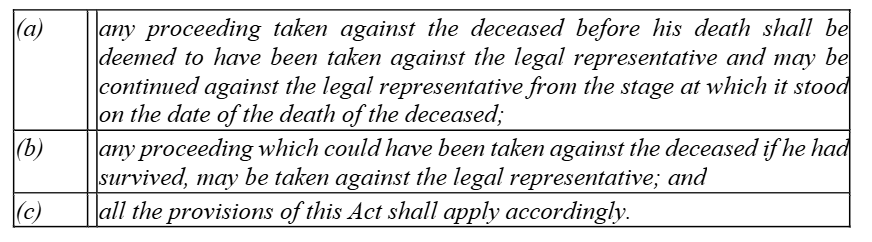
Headnote:(A) Income Tax Act, 1961 - Sections 143(2), 143(3), 159(2)(b), 292B, 292BB - Assessment proceedings - Validity of notice issued to deceased assessee - Notice u/s 143(2) issued and served after death of assessee on original assessee, without issuance to legal representatives - Assessing officer aware of death during proceedings yet proceeded without fresh notice to legal heirs - Section 159(2)(b) mandates separate notice to legal representatives for proceedings that could have been taken against deceased if alive - Such notice is jurisdictional and condition precedent for valid assessment u/s 143(3) - Defect not curable u/s 292B/292BB as it goes to root of jurisdiction - No statutory obligation on legal heirs to inform assessing officer of death - Entire assessment proceedings void ab initio and nullity. (Paras 7, 9, 9.1-9.7)

(B) Appellate Tribunal - Additional grounds - Legal grounds raising jurisdictional issues going to root of matter, based on facts on record without need for fresh investigation, admissible even at appellate stage for fair adjudication. (Paras 3-3.2)

Facts of the case:
Return filed declaring agriculture income; selected for scrutiny on agriculture income issue; assessee died prior to scrutiny notice u/s 143(2); notice issued post-death to deceased assessee; legal heir responded to notices u/s 142(1) and show cause; agriculture income partially disallowed by assessing officer as other sources income; CIT(A) partly confirmed addition after estimating sales and expenses.

Findings of Court:
Notice u/s 143(2) issued to dead person invalid; no notice issued to legal representatives u/s 159(2)(b); assessment order non est and quashed; proceedings void ab initio.

Issues: Whether assessment proceedings and order passed in name of deceased assessee, without notice to legal representatives, valid; whether defect curable u/s 292B/292BB; admissibility of additional legal grounds.

Ratio Decidendi: Notice u/s 143(2) to deceased assessee cannot initiate valid proceedings against legal heirs; section 159(2)(b) requires direct notice to legal representatives within time limit; knowledge of death by assessing officer during proceedings precludes curative provisions; jurisdiction fails without valid notice, rendering assessment nullity.

Result: Appeal allowed; assessment quashed.

Table of Content
1. admission of additional legal grounds permissible (Para 1 , 2 , 3)
2. agriculture income addition partially confirmed (Para 4 , 5 , 6)
3. parties contend assessment validity post-death (Para 7 , 8)
4. section 159(2)(b) mandates notice to legal heirs (Para 9)
5. appeal allowed; assessment quashed (Para 10)

ORDER

PER KESHAV DUBEY, JUDICIAL MEMBER:

This appeal at the instance of the assessee is directed against the order of ld. CIT(A)/NFAC dated 4.9.2025 vide DIN & Order No. ITBA/NFAC/S/250/2025-26/1080362875(1) passed u/s 250 of the Income Tax Act, 1961 (in short “The Act”) for the assessment year 2018-19.

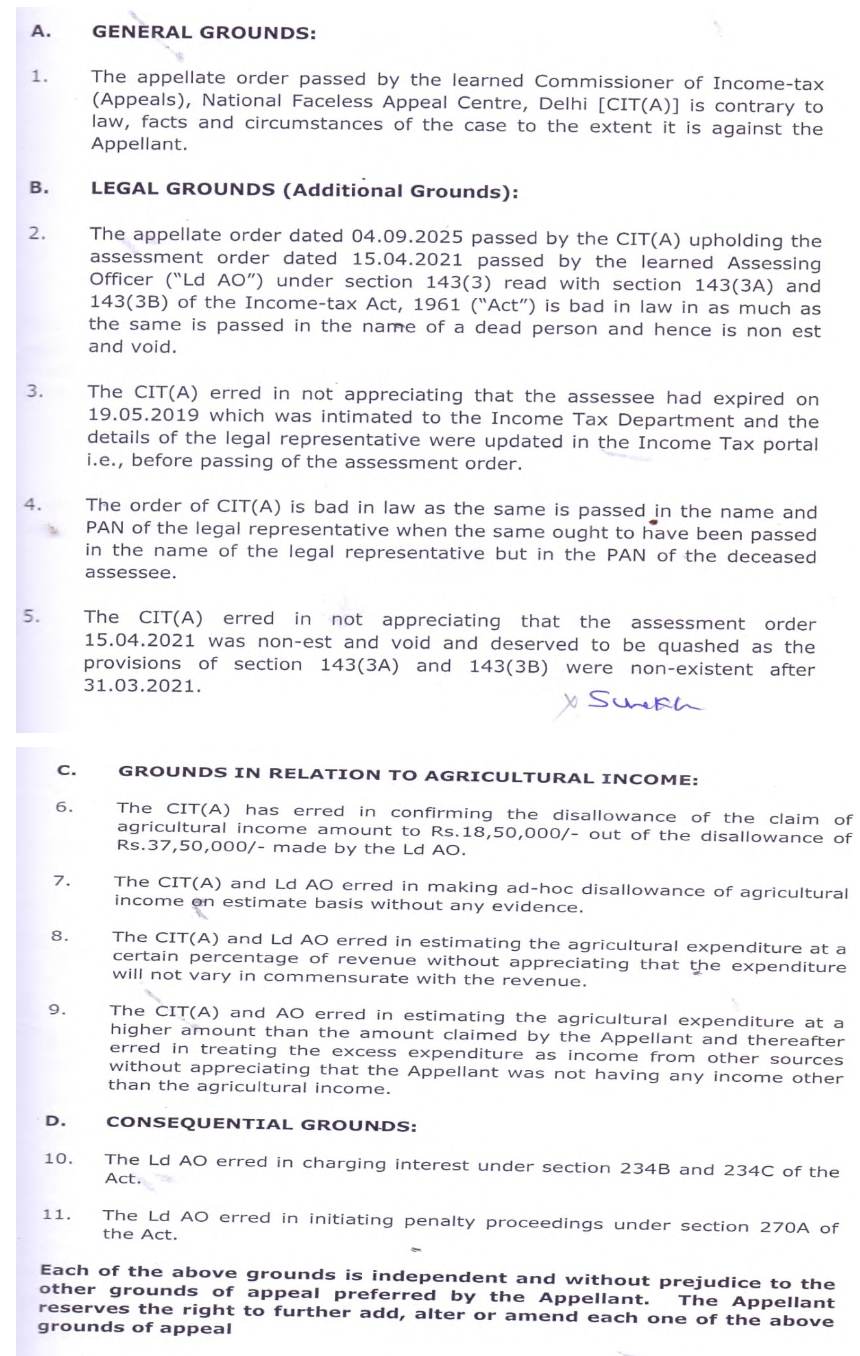
2. The assessee has raised the following grounds of appeal:
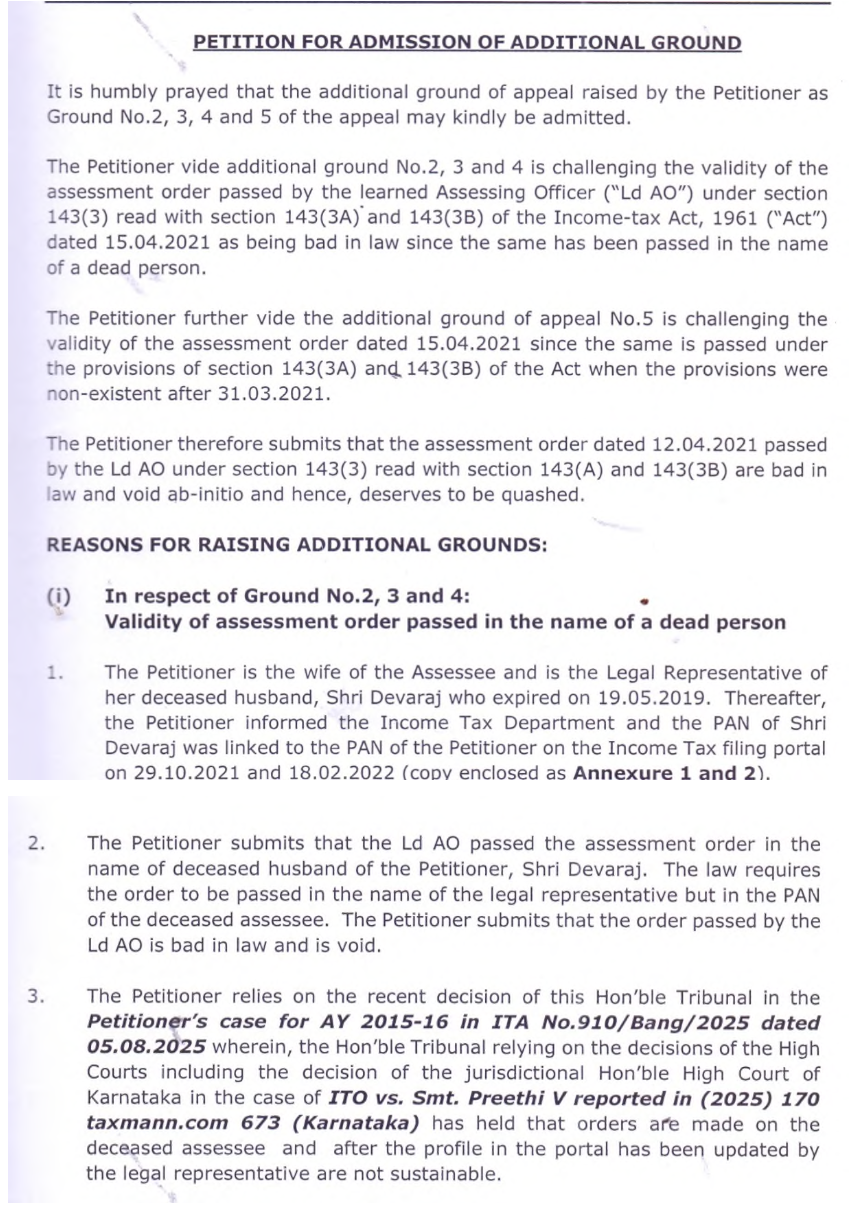
3. The assessee has raised the following additional grounds of appeal:-
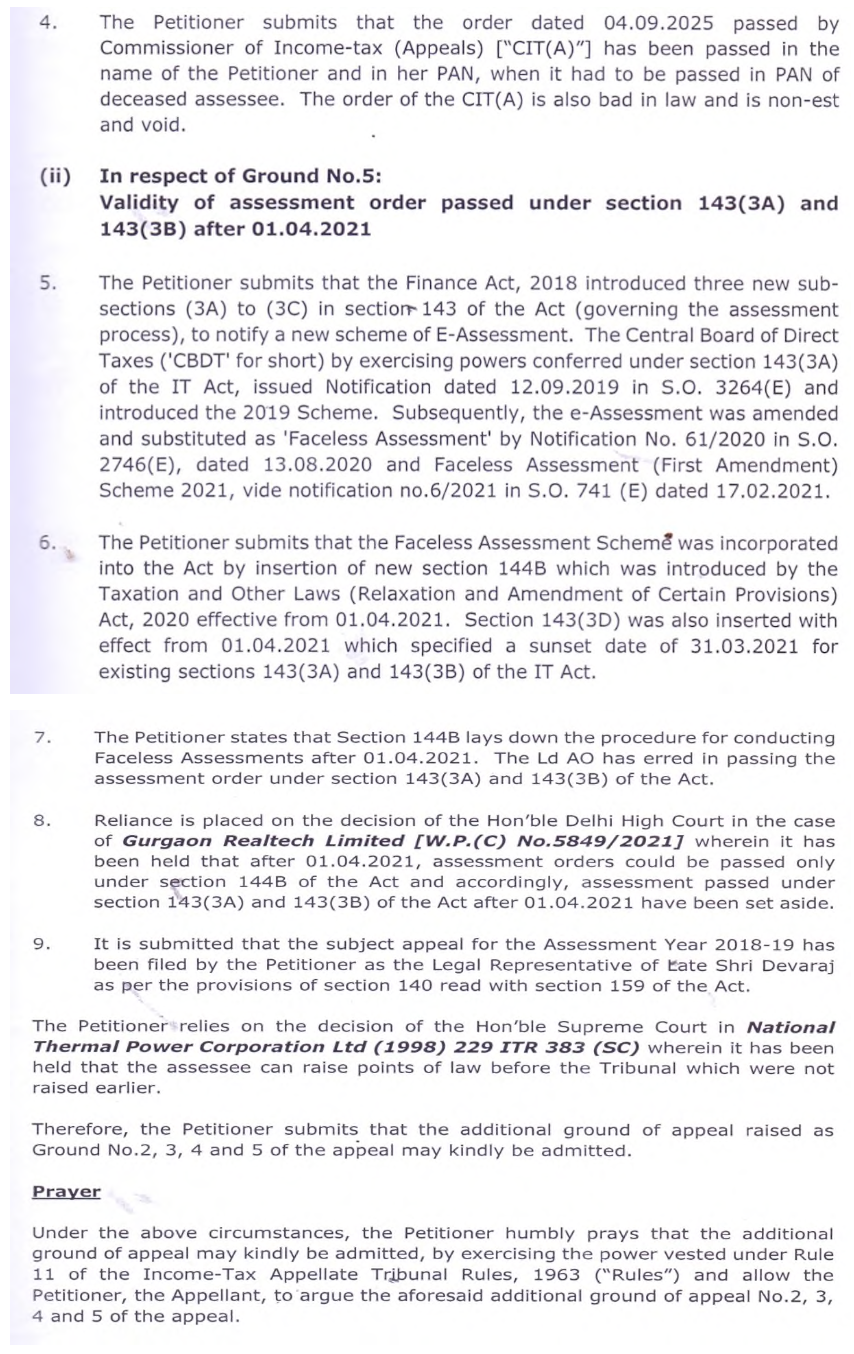
3.1 We have heard both the parties on admission of additional grounds. The Lucknow bench of the Hon’ble Allahabad High Court in the case of CIT Vs. Sahara India (2012) 347 ITR 331 held that a legal issue can be raised at any stage but there shall be good reason for admitting the additional ground.In our Opinion all the facts are already on record and there is no necessity of investigation of any fresh facts for the purpose of the adjudication of above grounds. Further we are also of the opinion that the additional grounds raised in the present case are purely legal in nature & therefore these are critical for a fair adjudication of the matter. The Hon’ble Madras High Court in the case of CIT Vs Indian Bank (2015) 230 Taxman 635 (Madras) held that Rule 11 of the I.T. Rules makes it clear that the assessee has the right to raise additional grounds and if the same is beneficial to the assessee, the same should be considered by the Tribunal.
3.2 Further, the Hon’ble Karnataka High Court in the case of Gundathur Thimmappa & Sons vs. CIT, Mysore, reported in (1968) 70 ITR 70 held that when the point raised by the assessee is a point which went to the root of the matter and affected not merely his liability to pay tax but also jurisdiction of the Tribunals and Authorities themselves to subject the amount concerned to tax, the Appellate Tribunal had the discretion to permit point of law to be raised for the first time in appeal because the question went to the root of the case. The Hon’ble Supreme Court in the case of National Thermal Power Co. Ltd. Vs CIT (1998) 229 ITR 383 held that undoubtedly, the Tribunal will have the discretion to allow or not allow a new ground to be raised. But where the Tribunal is only required to consider a question of law arising from the facts which are on record in the assessment proceedings, we fail to see why such a question should not be allowed to be raised when it is necessary to consider that question in order to correctly assess the tax liability of an assessee. Accordingly, we are inclined to admit the additional legal grounds for the purpose of adjudication as there was no investigation of any fresh facts otherwise on record and these are critical for a fair adjudication of the matter.

4. Now, first we proceed to adjudicate one of the legal grounds raised by the assessee challenging the validity of the assessment Order passed in the name of the dead person. The brief facts of the case are that the assessee e-filed his return of income for the assessment year 2018-19 on 31.07.2018 declaring total income of Rs. 25,31,420/-. The case of the assessee was selected for Limited scrutiny on the issue of “Agriculture Income”. Accordingly, notice under section 143(2) of the Act was served on 28/09/2019 and the notices 142(1) of the Act were issued & served on 30/12/2019, 12/02/2020 & 13/03/2021. In response, the spouse and legal heir of the deceased assessee had made online submission and furnished the details along with supporting documents. After considering the reply and evidence submitted, it was noticed by the AO that the assessee could file only five bills totaling to Rs.8,08,840/- only out of total agriculture income shown at Rs. 75,00,000/-. The assessee in it

Click Here to Read the rest of this document
1
2
3
4
5
6
7
8
9
10
11
SupremeToday Portrait Ad
supreme today icon
logo-black

An indispensable Tool for Legal Professionals, Endorsed by Various High Court and Judicial Officers

Please visit our Training & Support
Center or Contact Us for assistance

qr

Scan Me!

India’s Legal research and Law Firm App, Download now!

For Daily Legal Updates, Join us on :

whatsapp-icon Back to top

