
 Back
Back





INCOME TAX APPELLATE TRIBUNAL (RAIPUR BENCH)
Partha Sarathi Chaudhury, JM, Avdhesh Kumar Mishra, AM
Jagdish Prasad Singhania – Appellant
Versus
Additional Commissioner of Income Tax (TDS) – Respondent
ITA No.81/RPR/2023
| Table of Content |
|---|
| 1. penalty order passed after limitation period under section 275(1)(c) is time-barred. (Para 1 , 2 , 3 , 4) |
| 2. initiation of penalty proceedings is the date of first step, not show cause notice. (Para 5 , 6) |
| 3. appeal allowed as penalty is time-barred. (Para 7 , 8) |
आदेश/ORDER
PER PARTHA SARATHI CHAUDHURY, JM:
The present appeal preferred by the assessee emanates from the order of the Ld.CIT(Appeals)/NFAC, Delhi dated 29.07.2022 for the assessment year 2014-15 as per the grounds of appeal on record.
2. The contention in law assailed by the Ld. Counsel for the assessee is that penalty initiated u/s. 271C of the Income Tax Act, 1961 (for short ‘the Act’) is dated 27.06.2017 on the basis of the letter issued by the A.O to the Joint Commissioner of Income Tax (TDS), Raipur and the same is extracted as follows:
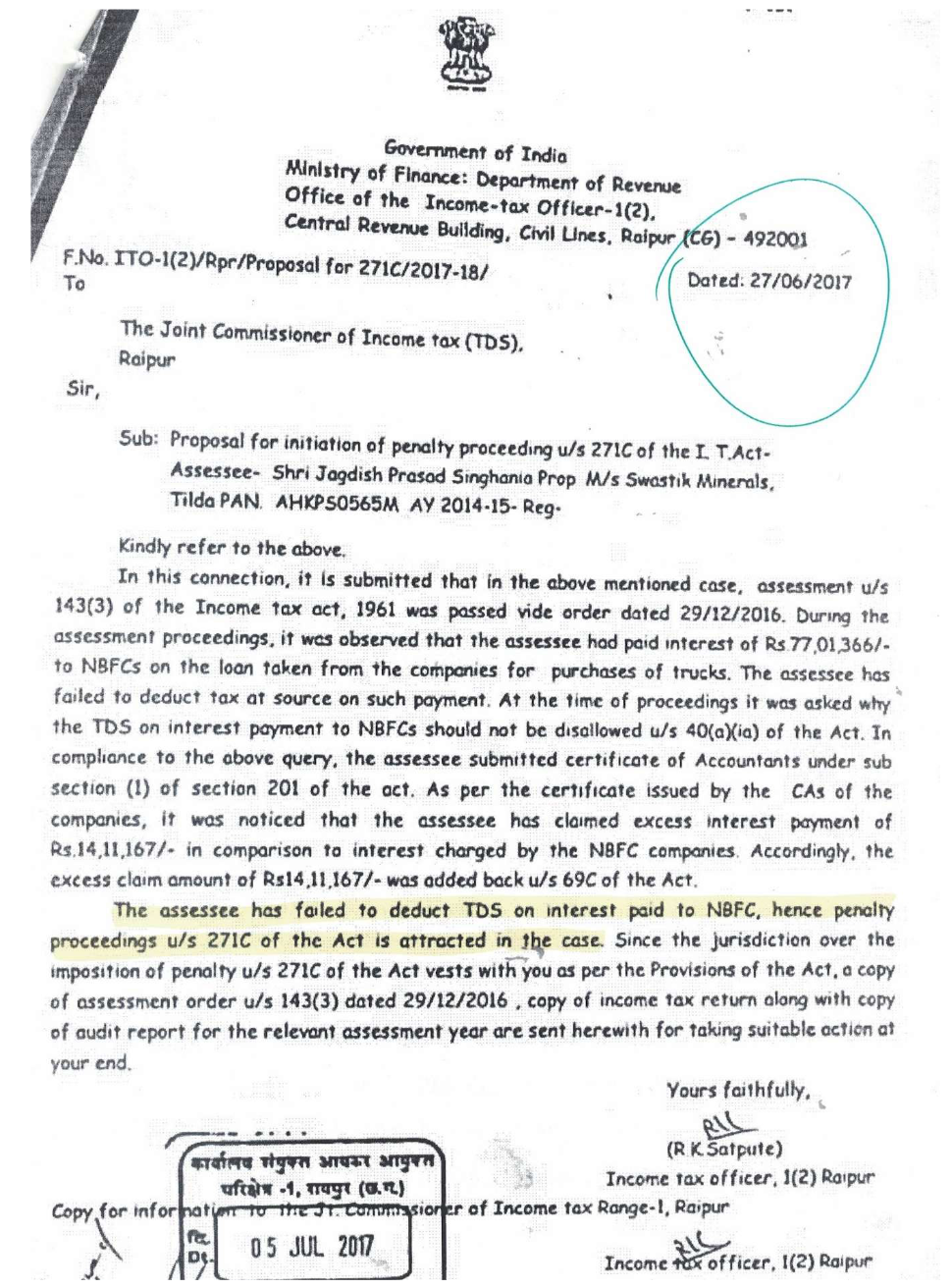
3. Further, it is contended by the Ld. Counsel for the assessee that the said imposition of penalty is barred by limitation as per Section 275(1)(c) of the Act. For the sake of completeness, Section 275(1)(c) of the Act is extracted as follows:
“275. (1) No order imposing a penalty under this chapter shall be passed___
xxxxx
(c) in any other case, after the expiry of the financial year in which the proceedings, in the course of which action for the imposition of penalty has been initiated are completed, or six months from the end of the month in which action for imposition of penalty is initiated, whichever period expires later.]”
4. It is evident from the penalty order that the said penalty u/s. 271C of the Act was imposed on 30th June, 2019 but as per the provisions of Section 275(1)(c) of the Act, time ends on 31.12.2017. Therefore, imposition of penalty through penalty order dated 30th June, 2019 is time barred and violative of Section 275(1)(c) of the Act.
5. The issue is no more “Res-Integra” for the fact that interpretation of the fiscal statutes has to be adhered to in its strictest form and there cannot be liberty provided to either of the parties for interpreting the provisions as per their own sweet will. The aforesaid provisions is clear that no order of imposition of penalty could be passed after expiry of six months from the end of the month, in which, action for imposition of penalty is initiated and in that manner, time ends on 31.12.2017 whereas, penalty has been imposed dated 30th June, 2019. This issue is squarely covered by the decision of the Hon’ble High Court of Delhi in the case of Pr. CIT-5 Vs. JKD Capital & Finlease Ltd. (2017) 81 taxmann.com 80 (Delhi), wherein it was held and observed as follows:
“10. Considering that the subject matter of the quantum proceedings was the non-compliance with Section 269 T of the Act, there was no need for the appeal against the said order in the quantum proceedings to be disposed of before the penalty proceedings could be initiated. In other words, the initiation of penalty proceedings did not hinge on the completion of the appellate quantum proceedings. This position has been made explicit in the decision in CIT v. Worldwide Township Projects Limited (supra) in which the Court concurred with the view expressed in Commissioner of Income- Tax v. Hissaria Bros. (2007) 291 ITR 244(Raj) in the following terms:
"The expression other relevant thing used in s. 275(1)(a) and cl. (b) of Sub-s. (1) of S. 275 is significantly missing from cl. (c) of s. 275(1) to make out this distinction very clear. We are, therefore, of the opinion that since penalty proceedings for default in not having transactions through the bank as required under ss. 269SS and 269T are not related to the assessment proceeding but are independent of it, therefore, the completion of appellate proceedings arising out of the assessment proceedings or the other proceedings during which the penalty proceedings under ss. 271D and 271E may have been initiated has no relevance for sustaining or not sustaining the penalty proceedings and, therefore, cl. (a) of sub-s. (1) of s. 275 cannot be attracted to such pr



An indispensable Tool for Legal Professionals, Endorsed by Various High Court and Judicial Officers
Please visit our Training & Support
Center or Contact Us for assistance

Scan Me!
India’s Legal research and Law Firm App, Download now!


For Daily Legal Updates, Join us on :



 Back to top


