
 Back
Back





HIGH COURT OF JHARKHAND
Sujit Narayan Prasad, Arun Kumar Rai, JJ
Neha Kumari – Appellant
Versus
Kunal Kumar – Respondent
First Appeal No.145 of 2024
| Table of Content |
|---|
| 1. factual background and initiation of restitution suit. (Para 1 , 2 , 3 , 4 , 5 , 6 , 7 , 8) |
| 2. appellant and respondent arguments. (Para 9 , 10 , 11 , 12) |
| 3. appellate court power and scope of evidence review. (Para 13 , 14 , 15 , 16 , 17 , 19 , 20 , 21 , 22 , 23 , 24 , 26 , 27) |
| 4. legal definition and interpretation of perverse judgments. (Para 28 , 29 , 30 , 31) |
| 5. requirements for decree of restitution of conjugal rights. (Para 32 , 33 , 34 , 35 , 36) |
| 6. evidence of cruelty and reasonable excuse for separation. (Para 37 , 38 , 39 , 40 , 41 , 42) |
| 7. assessment of evidence and findings of perversity. (Para 43 , 44 , 45 , 46 , 47 , 48 , 49 , 50 , 51 , 52 , 53) |
| 8. final order setting aside the lower court judgment. (Para 54 , 55 , 56) |
C.A.V on 20.01.2026 Pronounced on_28/01/2026 Per Sujit Narayan Prasad, J.
Prayer
1.The instant appeal under section 19(1) of the Family Courts Act, 1984 is directed against the judgment dated 10.05.2024 and decree dated 20.05.2024 passed in Original Suit No.459 of 2022 by the learned Addl. Principal Judge, Addl. Family Court No.II, Dhanbad, whereby and whereunder, the petition filed by the petitioner-husband (respondent herein) under Section 9 of the Hindu Marriage Act, 1955, has been allowed.
2. The brief facts of the case as pleaded in the plaint having been recorded by the learned Family Judge, needs to be referred herein as:
(i) The petitioner (respondent herein) and the respondent (appellant herein) are legally married husband and wife.
(ii) Their marriage was solemnized on 12-12-2013 at Baiju Batika Deoghar, according to Hindu Rites and Customs. After marriage, both the petitioner and respondent had been lived together as husband and wife. Out of the wedlock, the couple was blessed with two children. After the birth of her son, her behavior was changed and she always started quarreling with the petitioner and his family members without any cogent reason and she always left the house of the petitioner. The respondent put pressure upon the petitioner to live at her father's house but the petitioner refused to live at in-laws’ house. On 30-04-2018 the respondent has withdrawn from the society of the petitioner and she left the house of the petitioner without any cogent reason.
(iii) It is the further case that the petitioner made several attempts to bring the respondent but she always refused to come and join the society of the petitioner.
(iv) Cause of action of the suit arose on 30-04-2018 when the respondent withdrew from the society of the petitioner and finally arose on 07- 02-2021 when the respondent flatly refused to come and live with him. On the aforesaid pleadings, petitioner has sought relief to pass a decree for restitution of conjugal rights.
(v) Consequent to issue of notice, wife/respondent (appellant herein) had filed written statement wherein she had stated that the present suit is not maintainable either in law or on facts and circumstances of the suit. The case for restitution of conjugal rights has been filed against the respondent (appellant herein) without any rhyme and reason and just only to take benefit in the C.P. Case No.1119/21, under Section 498A IPC which is pending in the Civil Court, Dhanbad. The entire allegation made in the plaint are totally denied by the respondent. It is further stated that the petitioner is a criminal minded person and he has on several times beaten the respondent mercilessly.
(vi) On the basis of pleadings of the parties, following issues have been framed by the learned Family Judge for just and final decision of the case.
(I) Whether the respondent has sufficient cause to live separately from the petitioner?
(II) Whether the petitioner is entitled to a decree of Restitution of Conjugal Rights u/s 9 of Hindu Marriage Act?
3. In order to substantiate the case his case, the petitioner (respondent herein) has produced and examined altogether two witnesses, i.e., P.W.1, Kunal Kumar and P.W.2, Sanjay Chourasiya.
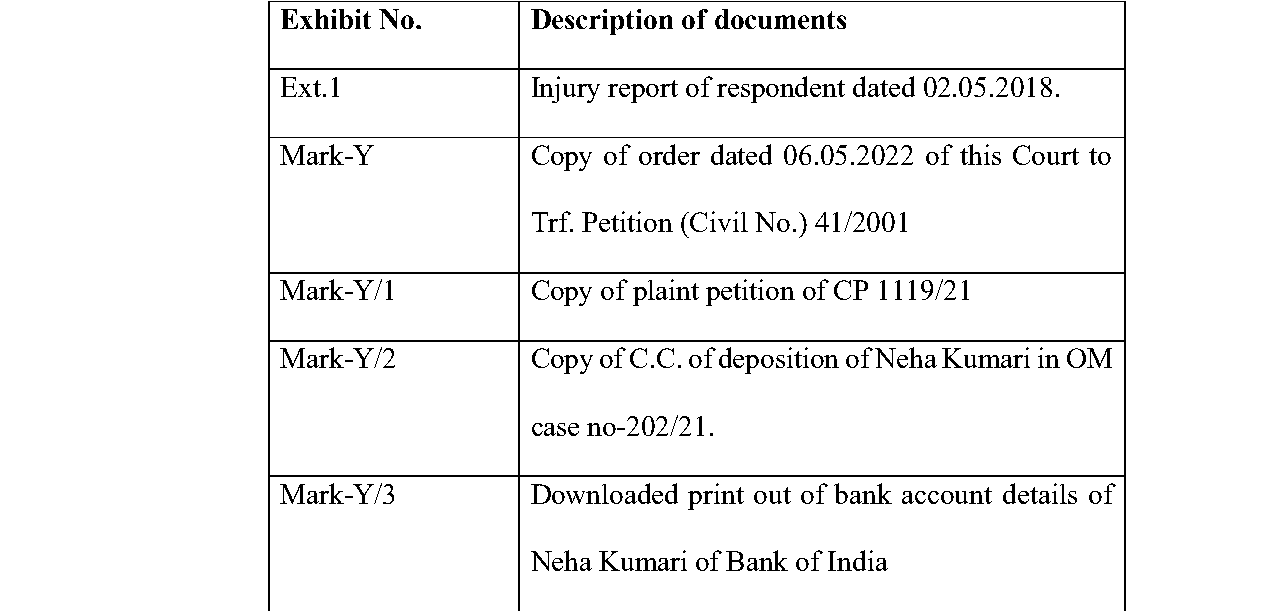
4. Further, the documentary evide




An indispensable Tool for Legal Professionals, Endorsed by Various High Court and Judicial Officers
Please visit our Training & Support
Center or Contact Us for assistance

Scan Me!
India’s Legal research and Law Firm App, Download now!


For Daily Legal Updates, Join us on :



 Back to top


