


 Back
Back





2025 Supreme(Online)(KAR) 4029
IN THE HIGH COURT OF KARNATAKA, DHARWAD BENCH
MR. JUSTICE HANCHATE SANJEEVKUMAR, J
Laxmibai W/o. Bhima Jarali – Appellant
Versus
Tayawa @ Tayakka W/o. Shankar Shile – Respondent
REGULAR FIRST APPEAL NO.3050 OF 2010 (PAR)
Advocate Appeared:
For the Appellant : SRI SHEKARGOUDA NAGANURI, ADV. FOR APPELLANTS AND PROP. A1 (A AND B);
For the Respondent:SRI B.S. KAMATE, ADV. FOR R1 TO R7 AND FOR R6 (A TO C); R1 AND R2 – DISMISSED AS ABATED; SRI S.M. TONNE, ADV. FOR PROP. R1(B),R2 (A) AND R4(A TO D); R1(A)-NOTICE HELD SUFFICIENT; SRI RAVI S.BALIKAI, ADVOCATE
The court affirmed that the burden of proof lies on the party claiming joint family status, and prior partition can be established through documentary evidence and witness depositions.
Headnote:(A) Hindu Succession Act, 1956 - Partition of joint family property - The plaintiffs claimed half share in ancestral properties, asserting they remained joint family properties. The defendants contended an earlier partition occurred in 1962, which was upheld by the Trial Court. (Paras 5, 9, 14, 23)
(B) Burden of Proof - The burden lies on the defendants to prove the existence of an earlier partition. The Trial Court found sufficient evidence, including revenue records and depositions, to establish that partition had occurred. (Paras 15, 22)
(C) Evidence - The court relied on documentary evidence and depositions from previous suits to determine the status of the properties. (Paras 20, 23)
Facts of the case:
The plaintiffs filed a suit for partition claiming ancestral properties, while the defendants asserted that a partition had already taken place in 1962, supported by various documents and testimonies.
Findings of Court:
The Trial Court concluded that the plaintiffs failed to prove joint family status and that the properties were no longer joint family properties due to the earlier partition.
Issues: The main issues were whether the plaintiffs could prove the properties were joint family properties and whether the defendants could establish the prior partition.
Ratio Decidendi: The court ruled that the evidence presented by the defendants, including revenue records and depositions from previous cases, sufficiently proved that a partition had occurred, thus dismissing the plaintiffs' claims.
Result: Appeal dismissed.
ORAL JUDGMENT
(PER: THE HON'BLE MR. JUSTICE HANCHATE SANJEEVKUMAR)
This appeal is filed by the plaintiff challenging the judgment and decree dated 11.01.2010 passed in O.S.No.8/2004 by the Court of Civil Judge (SR.DN), Hukkeri (for short, ‘Trial Court’), thereby, the suit filed for partition and separate possession is dismissed.
2. For the sake of convenience and easy reference, the parties are referred to as per their rankings before the Trial Court.
3. The plaintiffs have filed the suit for partition and separate possession claiming that plaintiffs and defendant No.9 are entitled to half share in all the suit schedule properties by contending that suit schedule properties are ancestral and joint family properties of plaintiffs and defendants by constituting Hindu Undivided Family.
4. The genealogy of the family of plaintiffs and defendants is given as under as under:
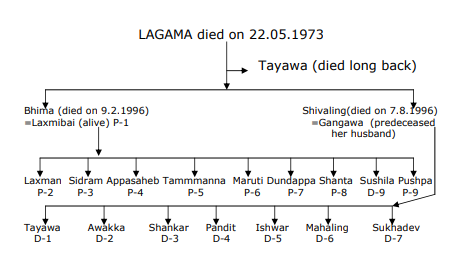
5. It is stated that the original propositus of family Lagama Jarali died on 22.05.1973 leaving behind his two sons namely Bheema and Shivaling. Bheema died on 09.02.1996 leaving behind his wife Laxmbai and six sons i.e., plaintiffs No.2 to 7 and three daughters i.e., plaintiffs No.8 and 9 and defendant No.9. Whereas, Shivaling Jarali died on 17.08.1996 leaving behind his two daughters i.e., defendants No.1, 2 and 5 and sons i.e., defendants No.3 to 7. The plaintiffs have pleaded that how they have occupied ancestral property through the original propositus Lagama Jarali. Further stated that the joint family was holding sufficient income and out of joint family funds, Lagama Jarali purchased the land bearing R.S.No.81/2 measuring 1 acre 33 guntas through registered Sale Deed dated 16.09.1966. Further pleaded that, out of joint family funds, Bheema and Shivaling have purchased the land bearing R.S.Nos.138/1B and 138/3 through registered Sale Deed dated 05.04.1968. Further pleaded that the main propositus Lagama Jarali had also purchased the land bearing R.S.No.139/2 out of joint family funds. The plaintiffs and defendants have also purchased the land bearing R.S.No.139/1B measuring 1 acre 11 guntas through registered Sale Deed dated 15.02.1972. Further stated that two house properties are also joint family properties, which are inherited from Siddappa Jarali. Thus by claiming that all the suit schedule properties are ancestral and joint family properties and there was no division in the family. Hence, filed the suit for partition and separate possession.
6. The defendants have filed a written statement by admitting relationship between plaintiffs and defendants. It is the main contention of defendants that there was earlier partition in the family and was acted upon. Therefore, it is the case made out by defendants that from the year 1962, there is no joint family status in the family of plaintiffs and defendants. Therefore, defendants by taking pleading that there was earlier partition and suit schedule properties are not the ancestral and joint family properties, hence, prays to dismiss the suit.
7. Upon the pleadings of the parties, the Trial Court has framed the following issues:
1. Whether plaintiffs are entitled to ½ share in the plaint schedule A, B & C properties as described in the plaint? And if so, along with defendant No.9?
2. Whether defendant No.3 proves that partition already taken place on 1st May 1962 in the presence of so called panchas as contended in the WS and got allotted their shares as per sketch maps pertaining to the plaint schedules?
3. Whether the defendant No.3 further proves the properties purchased after the purported partition of 1st May 1962 are self acquired properties between the plaintiffs and defendant No.9 and defendant No.3 in respect of suit schedule properties?
Re-caused Issue No.3
Whether defendant No.3 further proves the properties purchased after the purported partition of 1/5/1962 are self acquired properties between the plaintiffs and defendant No.9 and defendant No.3 to 7 in respect of schedule properties?
4. As to what order or d












