


 Back
Back





2025 Supreme(Online)(KAR) 2549
IN THE HIGH COURT OF KARNATAKA, DHARWAD BENCH
MR. JUSTICE SACHIN SHANKAR MAGADUM, MR. JUSTICE G BASAVARAJA, JJ
Akkamahadevi W/o Basangouda Patil – Appellant
Versus
Sangappa S/o Mahantappa Manakawad – Respondent
REGULAR FIRST APPEAL NO.100612 OF 2019 (DEC/PAR)
Advocate Appeared:
For the Appellant :SRI. C S SHETTAR, ADVOCATE
For the Respondent: SRI. SMT. CHETANA S. BIRAJ, ADV. FOR R7; SRI. G.G. GADAG, ADV. FOR R1
The burden of proof for a Will lies with the propounder, who must establish its due execution and validity, failing which the claim is dismissed.
Headnote:(A) Indian Evidence Act, 1872 - Section 68 - Indian Succession Act, 1925 - Section 63 - Partition suit - Plaintiff claimed share in properties after alleging wrongful sale by defendants - Court found no severance in joint family and upheld sale to discharge family debt - Plaintiff failed to prove the Will for inheritance - Suit barred by limitation. (Paras 11, 15, 21)
(B) Proof of Will - The burden of proof lies on the propounder to establish due execution and validity of the Will, which must be attested by witnesses as per statutory requirements. (Paras 15, 17, 20)
Facts of the case:
The plaintiff, daughter of Mahantappa, filed a partition suit claiming share in properties after alleging wrongful sales by defendants. The trial court found no evidence of a valid Will and ruled that the properties were sold to clear family debts.
Findings of Court:
The trial court ruled that the plaintiff failed to prove her claim over Schedule 'A' properties and that the sale was legitimate to discharge debts.
Issues: Whether the trial court's findings regarding the sale of Schedule 'A' properties and the validity of the Will were erroneous.
Ratio Decidendi: The court held that the plaintiff did not substantiate her claim over the properties and that the sale was necessary to settle family debts, emphasizing the burden of proof on the propounder of the Will.
Result: Appeal is dismissed.
JUDGMENT
(PER: HON'BLE MR. JUSTICE SACHIN SHANKAR MAGADUM)
Captioned appeal is by the plaintiff No.1, who has assailed the judgment and preliminary decree dated 23rd September, 2019 passed in O.S No.272 of 2015 on the file of the Senior Civil Judge and JMFC, Navalgund, insofar as denying share in Schedule ‘A’ Properties.
2. For the sake of brevity, the parties herein are referred to by their rank and status before the trial Court.
3. Before this Court delves into the matter, it necessary to cull out the family tree which is furnished along with the appeal memo. The same is extracted as under:
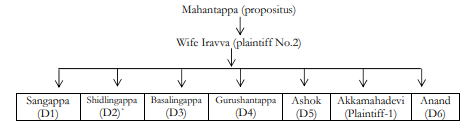
4. One Mahantappa is the propositus who has wife-Iravva (plaintiff No.2). The said couple is blessed with seven children. Akkamahadevi-Plaintiff No.1 who is the daughter of widow of Mahantappa, had filed a partition suit claiming share in Schedule ‘A’ and ‘B’ properties. Plaintiffs contend that, they along with defendants 1 to 6, constitute an undivided joint family and after the death of Mahantappa they have inherited the suit properties as legal heirs of deceased Mahantappa.
Plaintiffs specifically asserted that there is no severance in the family and they are in joint possession and enjoyment of all the suit schedule properties. Plaintiffs further pleaded that during the lifetime of Mahantappa, Defendant No.1-Sangappa commenced a business in the name and style “Sangameshwar Ginning Factory”, in which the deceased Mahantappa, Shiddaligappa, Ashok and Anand were partners having 25% share. The defendant No.1 was the sole working partner of the Firm.
5. Present suit is filed alleging that defendants 1 to 6 have managed to get their names entered in the records of rights by creating false documents taking undue advantage of the names reflected in the RTC. The suit schedule 1(A) and 1(B) properties including the ginning factory, machinery, tools are sold to defendant No.7 without the knowledge and behind the back of plaintiffs. Plaintiffs have further alleged that defendant No.1 has sold suit schedule 1(A) and 1(B) properties through the registered sale deeds dated 05th January, 2000 and 19th February, 2003 to defendant No.7. Hence, present suit is filed by the mother who is arrayed as plaintiff No.2 and daughter who is arrayed as plaintiff No.1, against sons, who are arrayed as defendants 1 to 6.
6. Pending Suit, Iravva died and the plaintiff No.1 is asserting title in Schedule ‘A’, as well as, Schedule ‘B’ properties alleging that the mother had bequeathed properties in favour of plaintiff No.1 under unregistered Will dated 15th October, 2015.
7. Defendants, on receipt of summons, tendered appearance and contested the suit by filing written statement. The defendants stoutly denied the entire averments made in the suit. Defendants, on the contrary, set up a plea of prior partition in the family. Defendants therefore claim that in terms of family partition, Schedule ‘A’ properties are exclusively allotted to the share of defendant No.1 who was also saddled with the responsibility of discharging all the loans raised by the Partnership Firm. Hence, prayed for dismissal of the suit by contending that he has sold Schedule ‘A’ properties to discharge the debt of the joint family. Defendant No.1 also claims that plaintiff No.2-mother is party to the said Partition Deed entered into in the year 1998 where she was allotted four acres of fertile land and this fact is suppressed by plaintiff No.2-mother.
8. Plaintiffs and defendants to substantiate their respective claims, have let in oral and documentary evidence and the trial Court taking cognizance of the sale deed executed in favour of defendant No.7 measuring 38 guntas in Survey No.155/C/1B through Registered Sale Deed dated 02nd December, 1999 evidenced at Exhibit P16 and defendant No.1 through Registered Sale Deed dated 19th February, 2003 evidenced at Exhibit P17 in respect of 5 guntas of land in Survey No.155/C/1, held that these lands were sold, to discharge the loan availed from KSFC. Trial Court als












