Back
Back





2025 Supreme(Online)(KAR) 3326
HIGH COURT OF KARNATAKA
M.NAGAPRASANNA, J
SRI GANGADHARAMURTY S/O. KUMBHINARASMA – Appellant
Versus
KARNATAKA UNIVERSITY DHARWAD – Respondent
WRIT PETITION NO. 101895 OF 2022 (GM-RES)
For the Appellants/Petitioners: SRI SUNIL S. DESAI
For the Respondents: SRI M.S.HIREMATH, SRI K.L.PATIL, SRI SOURAB SONDUR
The court emphasized that academic institutions must consider compliance with regulations alongside the circumstances and evidence presented by candidates before making decisions that affect their academic status.
Headnote:(A) Constitution of India - Articles 226 and 227 - Writ petition challenging cancellation of Ph.D. registration due to alleged delay in thesis submission - Petitioner contended that cancellation was arbitrary and against university regulations - Respondents argued compliance with regulations was not met - Court found that the petitioner had submitted necessary documents and attendance was maintained - Court quashed cancellation order and directed reconsideration of the petitioner's submissions. (Paras 1-14)
(B) Academic Regulations - The adherence to academic guidelines is crucial in maintaining the integrity of the educational process, but the university must also consider the circumstances and evidence presented by the candidate. (Paras 4, 11, 14)
Facts of the case:
The petitioner registered for a Ph.D. program on 30.11.2017, completed coursework, and submitted progress reports. The university cancelled his registration citing delays and attendance issues, which the petitioner contested.
Findings of Court:
The court observed that the petitioner had complied with attendance requirements and submitted progress reports. The cancellation order did not consider the documents provided by the petitioner.
Issues: The main issues involved the validity of the cancellation of the Ph.D. registration and the adherence to the university's regulations regarding thesis submission and attendance.
Ratio Decidendi: The court held that the university's cancellation of the Ph.D. registration was not justified as the petitioner had maintained attendance and submitted progress reports, emphasizing that the university must consider the evidence before making such decisions.
Result: Writ petition allowed; cancellation order quashed.
| Table of Content |
|---|
| 1. petitioner's ph.d. registration process. (Para 1 , 3) |
| 2. arguments regarding registration cancellation. (Para 4 , 5) |
| 3. court's consideration of the petitioner's compliance. (Para 6 , 7 , 12) |
| 4. regulations governing ph.d. attendance and submission. (Para 8 , 10 , 11) |
| 5. court's order to quash cancellation. (Para 14) |
ORAL ORDER
(PER: THE HON'BLE MR. JUSTICE M.NAGAPRASANNA)
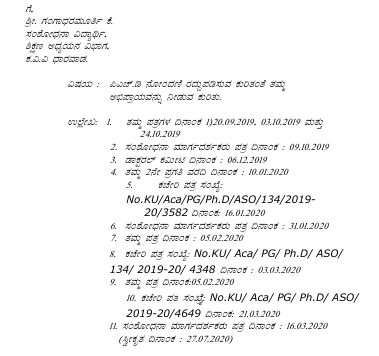
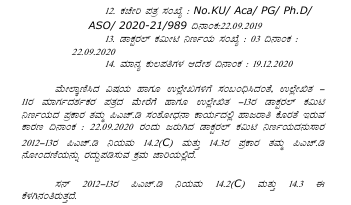
1. The petitioner is before this Court calling in question a communication, dated 31.01.2022 passed by the first respondent by which the thesis of the petitioner is declined to be accepted on the score that it has been submitted on delay.
2. Heard the learned counsel Shri Sunil S.Desai appearing for the petitioner; learned counsel Shri M.S. Hiremath appearing for respondent No.2; and the learned counsel Shri K.L. Patil along with Shri Sourab Sandur appearing for the respondent No.1.
3. The facts in brief germane are as follows:
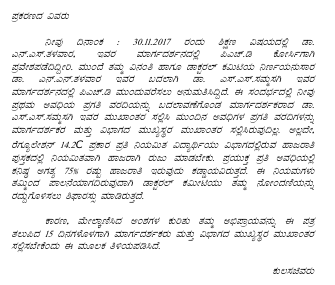
The respondent - University comes up with a proposal for a Ph.D. Course and the petitioner finding himself eligible gets registered for the Ph.D. programme as a full time Ph.D. candidate under the guidance of one Dr.S.S. Samasagi. This happens on 30.11.2017. The petitioner is said to have completed the Ph.D. coursework within one year from the date of the provisional registration and submits his research proposal to the University through the Research Supervisor or the guide as aforesaid. It transpires that the completion, prerequisites and acceptance for proposal, the Ph.D. registration gets confirmed. Therefore, the petitioner gets registered as a full time Ph.D. candidate on 10.01.2019 as his prerequisite or provisional registration gets confirmation. The petitioner after the confirmation is said to have submitted first half yearly progress report on 05.07.2019 through the guide and the same was continued from time to time at intermittent intervals. When things stood thus, a notice comes to be issued to the petitioner calling upon him to explain as to why the Ph.D. registration of the petitioner should not be cancelled for violating Rules 14.2(c) and 14.3 of the Regulations Governing the Doctoral Degree Programme (Ph.D.) and General Guidelines in the Karnataka University. The petitioner on receipt of the aforesaid notice submits a detailed reply denying the allegations of delay. The Research Supervisor or the Guide issues a notice to the petitioner seeking explanation for violation of the aforesaid Regulations. The petitioner again submits a representation that he has not received any information with regard to the delay as the petitioner has more than 75% attendance, notwithstanding this, the Ph.D. registration of the petitioner stood cancelled and therefore, the petitioner is at the doors of this Court.
4. Learned counsel appearing for the petitioner would vehemently contend that, the entire process that is led to the Ph.D. registration of the petitioner has taken place contrary to law. Learned counsel submits that it is the Guide who has not informed or submitted the thesis that was submitted to him to the appropriate authority within time. Therefore, he would submit that no fault can be laid with the petitioner and the Ph.D. registration could not have been cancelled on the said score.
5. Per contra, learned counsel Shri K.L. Patil submits that, action had to be taken in accordance with the Guidelines and the University was left with no choice as the submission of the thesis has happened on delay not once but delay at intermittent intervals, who is to be blamed is not the concern of the University. The papers do not reach the competent authority within the time, the result will be invocation of Rules 14.2(c) and 14.3 of the Regulations.
Accordingly, he would seek dismissal of the petition.
6. I have given my anxious consideration to the submissions made by the learned counsel appearing for the parties and perused the material on record.
7. The afore narrated facts are not in dispute. The link in the chain of events, and