Back
Back





2025 Supreme(Online)(KAR) 7399
IN THE HIGH COURT OF KARNATAKA DHARWAD BENCH
MR. JUSTICE HANCHATE SANJEEVKUMAR, J
Parvatevva W/o. Andangouda Patil – Appellant
Versus
Satyawwa W/o. Ashok Pujar – Respondent
REGULAR FIRST APPEAL NO.100344 OF 2017 (PAR) C/W RFA CROSS OBJ NO.100001 OF 2019
Advocate Appeared:
For the Appellant :SRI RAMESH I. ZIRALI, ADVOCATE
For the Respondent:SRI J.S. SHETTY, ADVOCATE
The court affirmed the validity of an earlier partition under Hindu law, establishing that plaintiffs were entitled to a share in properties allocated to Fakkiragouda, while rejecting claims from Andangouda's heirs.
Headnote:(A) Hindu Succession Act, 1956 - Section 23 - Partition suit - Plaintiffs claimed 1/4th share in properties of Fakkiragouda, asserting joint family status - Defendants contended properties were ancestral and joint - Trial Court decreed suit, granting plaintiffs share in suit schedule 1(A) properties, rejecting counterclaim of defendants 3 to 5 - Court confirmed earlier partition in 1955, establishing separate shares for Fakkiragouda and Andangouda. (Paras 10, 11, 26)
(B) Joint Family Property - The court recognized the validity of oral partition under Hindu law, affirming that properties allotted to Fakkiragouda were not subject to claims from Andangouda's heirs. (Paras 24, 26)
Facts of the case:
The plaintiffs, descendants of Fakkiragouda, filed for partition claiming 1/4th share in properties after a partition in 1955, while defendants claimed rights as heirs of Andangouda. (Paras 4, 10)
Findings of Court:
The Trial Court found that the plaintiffs were entitled to 1/4th share in the properties of Fakkiragouda, dismissing the counterclaim of defendants 3 to 5 based on established prior partition. (Paras 10, 26)
Issues: The court addressed whether the plaintiffs and defendants were joint family members and if the plaintiffs were entitled to a share in the suit schedule properties. (Paras 8, 14)
Ratio Decidendi: The court upheld the earlier partition, stating that the plaintiffs' claim was valid only concerning properties allotted to Fakkiragouda, and that the counterclaim by defendants was unfounded. (Paras 10, 26)
Result: Appeals dismissed; judgment and decree of the Trial Court confirmed.
ORAL JUDGMENT
(PER: THE HON'BLE MR. JUSTICE HANCHATE SANJEEVKUMAR)
The appeal in RFA No.100344/2017 is filed by the defendants No.4 and 5 in the suit, challenging the judgment and decree dated 05.08.2017, passed by the Addl. Senior Civil Judge, Gadag, in O.S.No.86/2009, whereas cross objection in RFA bearing RFA CROB No.100001/2018 is filed by the plaintiffs No.1 and 2 in the suit, for modification of the judgment and decree passed by the trial Court.
2. For the purpose of convenience and easy reference, ranking of the parties is referred to as per their status before the trial Court.
3. The plaintiffs have shown the genealogy as follows:
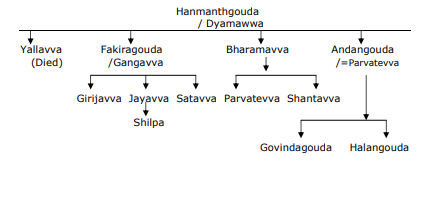
4. By showing the above said genealogy, the plaintiffs have filed suit for partition for claiming 1/4th share each in the suit schedule properties. It is pleaded by the plaintiffs that Hanmantgouda is having four children namely Yallavva, Fakiragouda, Bharamavva and Andangouda of which Fakiragouda and Andangouda are two male children. Therefore, partition was effected between them in the year 1955 and the suit schedule properties were fallen to the share of Fakiragouda. Therefore for claiming the share in the suit schedule properties given to Fakiragouda, the present suit is filed for partition for claiming 1/4th share each.
5. Initially, defendants No.1 and 2 were made as parties. Later on defendants No.3, 4 and 5 came on record as defendants. Defendants No.1 and 2 have filed the written statement denying the plaint averments. Fakiragouda was having wife by name Gangavva and was having only three daughters. Therefore, defendant No.1 has been adopted by the said Gangavva after demise of Fakiragouda in the year 1984 through registered adoption deed. It is further pleaded, plaintiff No.1, defendant No.2 and mother of plaintiff No.2 who are daughters of Gangavva had “given khubooli” (consent) before the revenue authorities by relinquishing their right over the suit schedule properties and they have received movables like cash, silver, gold in lieu of their share in the movable properties. Therefore, the plaintiffs, defendant No.2 and mother of plaintiff No.2 have no manner of right, share in the suit schedule properties. Therefore, prays to dismiss the suit.
6. After impleading defendants No.3, 4 and 5, they have filed the written statement contending that defendant No.3 is the son of Yallavva and defendant No.4 is the wife of Andangouda and defendant No.5 is the daughter of Bharamavva. Therefore, they being legal heirs of Yallavva and Bharamavva are also having their rights of share in the suit schedule properties. Therefore, they are also entitled for share in the suit schedule properties.
7. Also, defendant Nos.3 to 5 have filed counterclaim for claiming their share in the suit schedule properties on the ground that, they being legal heirs of Yallavva, Bharamavva and Andangouda, they are entitled to an equal share as that of the plaintiff. Hence, filed counterclaim.
8. Based on the pleadings of the parties, the Trial Court has framed the following issues and additional issue:
1. Whether the plaintiffs prove that, they themselves and defendants are joint family members?
2. Whether the plaintiffs prove that, the suit schedule properties are joint family properties and they are having 1/4th share each by metes and bounds?
3. Whether the defendant No.1 proves that, late Fakkiragouda and Gangawwa have taken him as their adopted son on 15.02.1984 for which a registered adoption deed was executed before the Sub Registrar Shirahatti?
4. Whether the defendant No.1 proves that, the plaintiffs have already taken their share in terms of silver, gold and cash as contended in para No.8 of written statement?
5. Whether the plaintiffs are entitled for the relief’s sought for?
6. What order or decree?
ADDITIONAL ISSUE
1. Whether the defendant No.3 to 5 proves that they are also entitled to the share in the suit schedule properties?
9. In order to prove the case, plaintiff No.1 is examined as PW-1 and two other witnesses as PW-