


 Back
Back





2025 Supreme(Online)(KAR) 12359
KARNATAKA HIGH COURT
SRI.MANJUNATH DASAPPA – Appellant
Versus
THE STATE OF KARNATAKA – Respondent
WP 7812 / 2025
Revenue Officers can only correct clerical or arithmetical errors; substantive modifications are beyond their jurisdiction.
Headnote:(A) Karnataka Land Revenue Act, 1964 - Section 58 - Power of Revenue Officer to amend orders - The Deputy Commissioner modified his initial order regarding land classification, which was held illegal as it did not pertain to clerical or arithmetical mistakes but rather a substantive modification. (Paras 10, 16, 24)
(B) Jurisdiction of Revenue Officers - The Deputy Commissioner’s authority to amend orders is limited to clerical errors and does not extend to modifying substantive findings. (Paras 16, 18)
Facts of the case:
The petitioner contested the classification of land as B-Kharab, initially rejected by the DDLR, and sought corrections from the Deputy Commissioner, who later modified the order, leading to legal challenges. (Paras 1-9)
Findings of Court:
The KAT correctly ruled that the Deputy Commissioner lacked jurisdiction to modify the order on merits as it did not involve clerical or arithmetical mistakes. (Paras 10, 24)
Issues: Whether the Deputy Commissioner could modify the merits of his original order under Section 58 of the Act. (Paras 14, 30)
Ratio Decidendi: The court emphasized that substantive modifications by a Revenue Officer are not permissible under the guise of clerical corrections, affirming the KAT’s decision. (Paras 24, 31)
Result: Writ petition dismissed.
CAV ORDER
1. In the year 2013, the petitioner herein approached the Deputy Director of Land Records (the DDLR contending that the B–Kharab land in Sy.Nos.183/1 and 183/2 were already cultivated by him and the same should therefore be given to him.
2. The DDLR by his order dated 19.09.2014 rejected this claim and classified the extent of 23 acres 5 guntas in Sy.No.183 as Saravu and Kallubande i.e., he classified it as B-Kharab land, over which there were communal rights involved. He thus held that the petitioner could not be granted the same.
3. Being aggrieved by this, the petitioner filed a revision to the Deputy Commissioner and on 13.10.2014, the Deputy Commissioner, after hearing the parties proceeded to pass an order in the following terms:
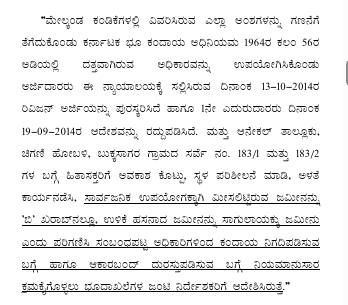
4. As could be seen from the above, the Deputy Commissioner directed that notice be issued to the concerned, a spot inspection be conducted, a measurement be made and the portion which was to be utilized by the public that is B-Kharab would have to be determined and the remaining cultivable area would have to be assessed for payment of land revenue.
5. It is therefore clear that the question of determination of the land which was to be utilized by the public at large and which was required to be classified as B-Kharab was left open and to be determined by the Joint Director.
6. However, after the said order was passed on 17.08.2017, the petitioner herein had made an application on 27.09.2017 contending that there were several errors in the order and they were required to be corrected. The Deputy Commissioner accepted this request and exercising his purported powers under Section 58 of the Karnataka Land Revenue Act proceeded to pass a corrigendum order in the following terms:

7. As could be seen from the above, as against the original order which had directed an enquiry to be conducted to determine the extent of land being utilized by the public and, thereafter, classify the remaining cultivable land for the purpose of land revenue, the Deputy Commissioner, by way of his corrigendum, proceeded to state that only 3 acres of land was being utilized by the public and was required to be classified as B-Kharab and the remaining 15 guntas was to be classified as A-Kharab and the remaining extent of 19 acres 10 guntas was to be verified as to whether it was cultivable and be assessed.
8. Essentially, therefore, the Deputy Commissioner modified his earlier order on its merits and by way of a corrigendum recorded a finding that only 3 acres of land was B-Kharab, 15 guntas was A-Kharab and the determination was required to be made only as to whether the remaining 19 acres 10 guntas was fit for cultivation.
9. Being aggrieved by this corrigendum, the Commissioner of Survey Settlement and Land Records approached the Regional Commissioner. However, these proceedings were challenged by the petitioner by filing W.P.No.5441/2022 before this Court and this Court allowed the writ petition and permitted the Commissioner to prefer an appeal to the Karnataka Appellate Tribunal (the KAT) within a period of four weeks.
10. Accordingly, the Commissioner, Survey Settlement of Land Records preferred an appeal to the KAT and the KAT on consideration of the matter came to the conclusion that the power available to the Deputy Commissioner under Section 58 of the Karnataka Land Revenue Act , 1964 (hereinafter referred to as theAct) was only to correct clerical or arithmetical mistakes in the order passed by him and he had no jurisdiction to modify the order on merits. The KAT accordingly allowed the revision and set aside the corrigendum order dated 03.10.2017.
11. Being aggrieved by this order of the KAT, the petitioner is before this Court.
12. Learned Senior counsel Sri.C.K.Nanda Kumar contended that the order of the KAT was incorrect, and the Deputy Commissioner did have the power to correct any errors, which were apparent on the face of the record and, therefore, the reasoning was incorrect.
13. He places reliance on












