
 Back
Back





KARNATAKA HIGH COURT
S.R. KRISHNA KUMAR, C.M. POONACHA, JJ
LAXMAN S/O. SIDDAPPA PASCHAPUR – Appellant
Versus
SMT. SHANTAWWA W/O. FAKIRAGOUDA PATIL – Respondent
Regular First Appeal No. 100152 of 2020|Regular First Appeal No. 100561 of 2019|Regular First Appeal No. 100113 of 2020
| Table of Content |
|---|
| 1. appeals arise from prior suit judgments (Para 2 , 3 , 4 , 5) |
| 2. plaintiff claims ancestral property rights (Para 6 , 7 , 9) |
| 3. trial court's issues framed for resolution (Para 12 , 13) |
| 4. evidence presented by parties during trial (Para 14 , 17) |
| 5. legal conclusions on property ownership (Para 21 , 23 , 35) |
| 6. final judgment modifies trial court's decree (Para 45 , 46) |
ORAL JUDGMENT
(PER: THE HON'BLE MR. JUSTICE S.R. KRISHNA KUMAR)
2. RFA.No.100561/2019 is preferred by defendant Nos.6, 7, 9 and 10, while RFA.No.100152/2020 and RFA.No.100113/ 2020 are preferred by defendant Nos.8 and 5 respectively in O.S.No.90/2014.
3. All these appeals arise out of the judgment and decree dated 18.11.2019 passed in O.S.No.90/2014 by the II Additional Senior Civil Judge and JMFC, Gokak, [Hereinafter referred to as the ‘Trial Court’]
4. The said suit filed by the sole plaintiff-Shantawwa, for partition and separate possession of her alleged share in the suit schedule properties, for declaration, injunction and other reliefs was partly decreed by the Trial Court in favour of the plaintiff against the defendants.
5. For the purpose of convenience, the parties are referred to as their respective ranks before the Trial Court.
6. The brief facts giving rise to the present appeal are that the plaintiff instituted the aforesaid suit, contending, inter alia, that she is the daughter of one late Mallawwa, who was, in turn, the daughter of Ramappa Kenchannavar and Hanamawwa. It was contended that the original propositus, Ramappa, died in the year 1941, while his wife, Hanamawwa, died on 10.11.1979. The said Ramappa and Hanamawwa had four children, namely; Mallawwa (the plaintiff’s mother), Laxmibai (defendant No.2), Venkawwa and Yallawwa. The plaintiff-Shantawwa had a sister, Gangawwa, who died unmarried and issueless.
7. The defendant No.1 is the son of defendant No.2- Laxmibai, while defendant No.3 is the son of late Venkawwa and defendant No.4 is the son of late Yallawwa. The genealogy of the parties as contended in the plaint is as under:
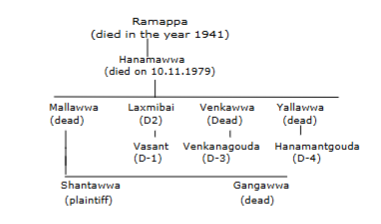
8. Mallawwa was married to late Sheshappa, who was the father of the plaintiff and the deceased Gangawwa.
9. The plaintiff contended that after the demise of Ramappa in 1941, the suit schedule properties became the ancestral joint family properties of Hanamawwa and her four daughters, including Mallawwa, the mother of the plaintiff. It was further contended that, subsequent to the demise of Hanamawwa on 10.11.1979, the suit schedule properties became ancestral joint family properties in the hands of her four daughters, including Mallawwa, and consequently, the plaintiff became entitled to a share in the said properties. It was also contended by the plaintiff that, although her father, Sheshappa, claimed that Hanamawwa had executed a Will in his favour, the same was negatived in a suit in O.S.No.18/1980. The said suit O.S.No.18/1980 was filed by the Sheshappa against the daughter of Hanamawwa, seeking a decree of permanent injunction, which was dismissed and the dismissal was confirmed by the Appellate Court in R.A.No.110/1981 and by this Court in RSA No.800/1986. So also, the suit in O.S.No.305/1989 for declaration, injunction and possession, was dismissed by the Trial Court on 05.03.1990. In the plaint, the plaint schedule properties comprised of the following four immovable properties:
i) R.S.No.470/1 measuring 10 acres 32 guntas.
ii) R.S.No.470/2 measuring 5 acres 16 guntas.
iii) R.S.No.115 measuring 26 acres 16 guntas.
iv) R.S.No.470/3 measuring 5 acres 16 guntas.
10. The plaintiff contended that, taking advantage of his name appearing in the revenue records, the aforesaid Sheshappa alienated the suit schedule properties in favour of the defendants No.5 to 11-alienees, and the said alienations were not binding upon the plaintiff’s legitimate share in the suit schedule properties. It was also contended that a suit in O.S.No.15/1991 was filed by the plaintiff’s mother, Mallawwa, and her sister, Laxmibai, seeking d



An indispensable Tool for Legal Professionals, Endorsed by Various High Court and Judicial Officers
Please visit our Training & Support
Center or Contact Us for assistance

Scan Me!
India’s Legal research and Law Firm App, Download now!


For Daily Legal Updates, Join us on :



 Back to top


