


 Back
Back





2025 Supreme(Online)(Kar) 32867
KARNATAKA HIGH COURT
N S SANJAY GOWDA, J
RAJASHEKAR GOWDA – Appellant
Versus
STATE OF KARNATAKA – Respondent
WRIT PETITION NO. 30088 OF 2018 (LR)
For the Appellants/Petitioners: SRI VEERENDRA R PATIL
For the Respondents: SRI V SHIVA REDDY, SRI S V PRAKASH
Oral evidence is insufficient to override credible documentary evidence regarding land occupancy rights.
Headnote:The judgment considers the conferment of occupancy rights under relevant statutes including the Karnataka Land Revenue Act, 1964. The facts indicate a dispute over land rights and occupancy claims by a tenant. The court's findings emphasized the credibility of documentary evidence over oral testimony in determining occupancy. The key issue was the validity of the Land Tribunal's conclusion on tenant occupation. The court ruled the tribunal's decision to be unsustainable in light of the documentary evidence.
| Table of Content |
|---|
| 1. challenging occupancy rights conferred by land tribunal. (Para 1 , 2 , 3 , 4 , 5 , 6) |
| 2. debate over evidence and tenant's occupancy status. (Para 9 , 10 , 11 , 12) |
| 3. emphasis on the credibility of documentary evidence over oral testimony. (Para 13 , 14 , 15 , 16 , 17 , 18 , 19 , 20 , 21 , 22 , 23 , 24 , 25 , 26 , 27 , 28 , 29 , 30 , 31) |
| 4. conclusion on the sustainability of tribunal's decision. (Para 32) |
| 5. petition allowed and occupancy claim rejected. (Para 33 , 34 , 35) |
ORAL ORDER
1. This writ petition is filed by the landlord challenging the conferment of occupancy rights by the Land Tribunal in favour of the tenant.
2. The land involved in this writ petition is Survey No.1/2 which totally measures 10 acres 14 guntas, but, the claim of the tenant was only in respect of 03 acres 11 Guntas.
3. The land in question was initially owned by one Lakshmoji Rao (respondent No.3) who executed a sale deed on 24.11.1976 in favour of one Veera Sangana Gowda (father of petitioner Nos.1 and 2).
4. It was the case of the tenant who filed an application in Form No.7 on 21.09.1976 that he was the tenant of the land in question for a period of ten years prior to the filing of Form No.7 and he was hence entitled to be conferred with occupancy rights.
5. The Land Tribunal on 06.10.1981 had conferred occupancy rights in favour of the tenant, as against which Writ Petition No.29951 of 1981 was filed by the son of Veera Sangana Gowda who purchased the property in the year 1976 and this Court allowed the writ petition on 30.05.1984 and remanded the matter to the Land Tribunal for fresh consideration.
6. The Land Tribunal on remand has come to the conclusion that the land in question was a tenanted land and had stood vested with the State as on 01.03.1974 and consequently, the sale deed executed in favour of Veera Sangana Gowda was of no consequence and it has therefore proceeded to confer occupancy rights on the tenant. The Land Tribunal has also taken into consideration the oral depositions given by the witnesses who had deposed on behalf of the tenant.
7. The order of the Land Tribunal is extracted for the better understanding of the manner in which the application has been considered:
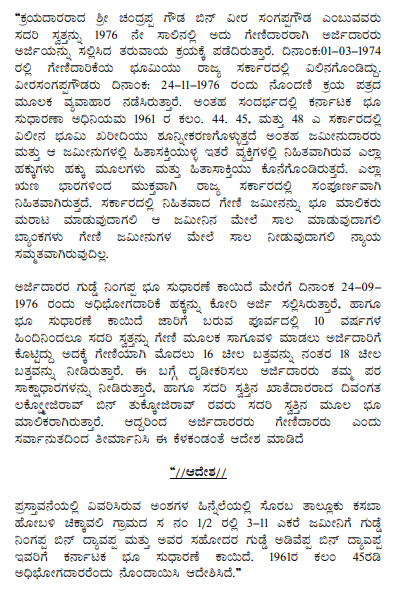
8. As could be seen from the above, the main reason for the Land Tribunal to confer occupancy rights is that Veera Sangana Gowda had purchased the property after 01.03.1974, by which time the land had stood vested in the State and he had thus acquired no title. The Land Tribunal while passing the impugned order has also basically considered the oral evidence of the tenant to come to the conclusion that the tenant was in cultivation of the land as on the relevant date.
9. It is the case of the learned counsel appearing for the petitioner that the Land Tribunal has basically ignored the revenue records for the relevant years, which clearly indicated that the land was in possession of the vendor till the year 1976 and thereafter, the name of the purchaser was entered both in the Khatedar's column and in the Cultivator's column.
10. It is his case that the Land Tribunal has not even taken into consideration several aspects of the deposition of the witnesses during the course of their cross-examination, which fundamentally indicated that their evidence was not trustworthy and ought to have been rejected.
11. Sri S.V.Prakash, learned counsel appearing for the tenant, on the other hand, contended that the entries in the RTC’s would not be the conclusive piece of evidence to arrive at the conclusion that the tenant was in possession. He submitted that it was perfectly open for the Land Tribunal to rely upon the oral evidence of the witnesses who had deposed on behalf of the tenant to come to the conclusion that the land was tenanted and the applicant had been cultivating the land. He submitted that the Land Tribunal has basically recorded a finding of fact which ought not to be interfered with in a petition file under Article 226 of the Constitution of India.
12. In












