
 Back
Back





THE HIGH COURT OF KARNATAKA
MR. SACHIN SHANKAR MAGADUM, J
RICHA MISHRA – Appellant
Versus
THE STATE OF KARNATAKA – Respondent
WRIT PETITION NO. 25691 OF 2025 (GM-RES)
| Table of Content |
|---|
| 1. details of parties and complaint. (Para 1 , 2 , 3) |
| 2. arguments regarding video conferencing rules. (Para 4 , 5 , 6) |
| 3. court's analysis of rules and circumstances. (Para 7 , 8 , 9 , 10 , 11 , 12 , 13 , 14 , 15 , 16) |
| 4. decision to relax video conferencing rules. (Para 17) |
| 5. conclusion and order for video conferencing. (Para 18 , 19) |
ORAL ORDER
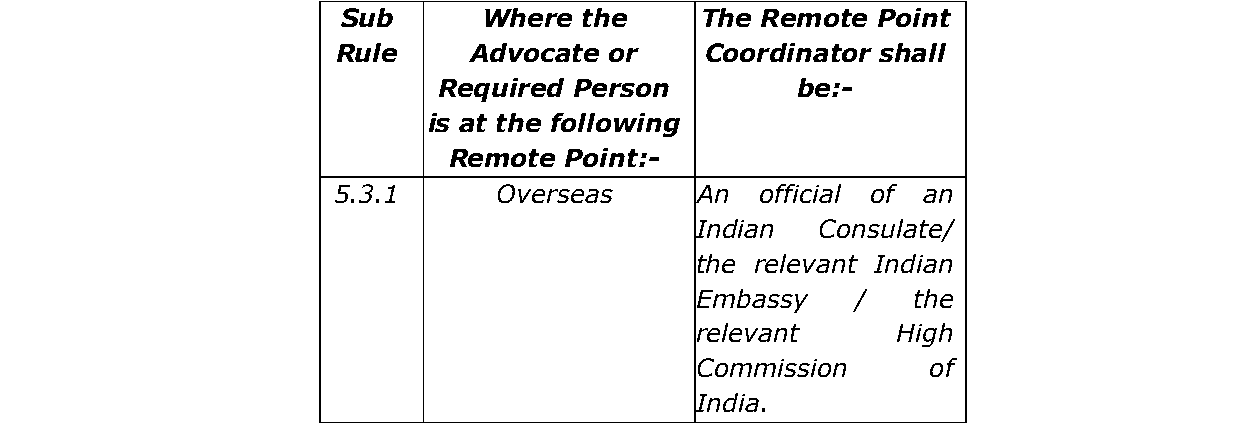
This petition is by the complainant seeking relaxation of Rule 5.3.1 of Video Conferencing Rules, 2020 of this Court, to enable the complainant to record her further examination-in-chief and also to subject herself for cross - examination by the respondent-husband by dispensing recording of evidence through Indian Embassy or the High Commission of India.
The facts leading to the case are as under:
2. The petitioner is the complainant, who has lodged a complaint before the jurisdictional Police Station alleging commission of offences punishable under Sections 498A and 377 read with Section 34 of the IPC , as well as under Sections 66E and 67 of the Information Technology Act, 2000 . On the basis of the said complaint lodged by the petitioner, who is respondent No.2’s wife, the jurisdictional Police registered the crime. Upon completion of investigation, the Investigating Officer has filed the final report/charge sheet, in which respondent No.2, who is the husband of the petitioner, is now arraigned as an accused and is presently facing criminal prosecution for the aforementioned offences.
3. The petitioner, who is presently residing in the United States of America, has approached this Court seeking relaxation of Rule 5.3.1 of the Video Conferencing Rules. Her grievance is that, due to the difference in time zones, the working hours of the Indian Embassy/Consulate do not coincide with the sittings and timelines of the Indian Courts. As a result, she is unable to avail the services of the Embassy to facilitate her participation in further proceedings. On this ground, she prays that the Court exercise its discretion to relax the rigours of Rule 5.3.1 and permit her to depose by way of video conferencing from her residence in the United States.
4. Learned counsel for the petitioner submits that the petitioner is not an accused or a witness, but rather the complainant, who has set the criminal law in motion. Therefore, strict adherence to Rule 5.1 of the Video Conferencing Rules, which contemplates the presence of a Coordinator even at the remote point, may not be insisted upon in her case. He contends that this Court, in exercise of its inherent jurisdiction, is empowered to relax the applicability of Rule 5.3.1 and permit the petitioner to record the remainder of her examination-in-chief as well as her cross-examination from her residence in the United States, without the mandatory requirement of routing the process through the Embassy.
5. Per contra, learned counsel appearing for respondent No.2-husband places reliance on the very same Rules to contend that the petitioner has not first moved the trial Court, where the matter is pending adjudication. Instead, she has approached this Court directly, and therefore, the present petition is not maintainable. In the alternative, it is urged that respondent No.2 harbours a genuine apprehension that during the course of cross-examination, the video conferencing session may abruptly get disconnected, particularly at a stage when crucial questions are put to the complainant, which might otherwise elicit material admissions fatal to the prosecution case. It is therefore submitted that such contingencies would cause serious prejudice to respondent No.2.
6. In reply, learned counsel for the petitioner submits that such apprehension is unfounded, inasmuch as more than half of the chief-examination of the petitioner has already been completed without any disruption or disconnection in the virtual mode. He further submits that his client is willing to place on record an undertaking that she shall not disconnect the session during the course of her



An indispensable Tool for Legal Professionals, Endorsed by Various High Court and Judicial Officers
Please visit our Training & Support
Center or Contact Us for assistance

Scan Me!
India’s Legal research and Law Firm App, Download now!


For Daily Legal Updates, Join us on :



 Back to top


