Back
Back





2025 Supreme(Kar) 2171
IN THE HIGH COURT OF KARNATAKA AT BENGALURU
S.R.KRISHNA KUMAR, J.
Manju S., S/o Srinivasa – Petitioner
Versus
The State Of Karnataka – Respondent
WRIT PETITION NO. 2138 OF 2025 (EDN-RES)
Decided On : 11-12-2025
For the Petitioner:Sri. Umashankar B. M., Advocate
For the Respondent:Sri. Manjunath K., Hcgp, Sri.Girish Kumar R., Advocate
Court ruled ITI qualifications are acceptable as equivalent to Pre-University for law course eligibility, reinforcing legal principles established in previous judgments.
Headnote:(A) Bar Council of India (Rules) - Definition of eligibility for admission to law degree courses - Eligibility for three year LL.B. degree requires graduation from a recognized university and does not specifically exclude ITI qualifications in lieu of PUC, subject to satisfaction of conditions stated in Rules - The impugned endorsement dated 21.09.2024 was quashed, allowing the petitioner admission to LL.B. course in interest of justice. (Paras 8, 9, 19)
(B) Writ of Mandamus - Directing respondents to issue an eligibility certificate based on prior judgments of this Court establishing the consideration of ITI as equivalent for admission - Court reiterates the necessity of adhering to prior case laws for consistency and fair assessment of qualifications. (Paras 3, 4, 6)
Facts of the case:
The petitioner challenged the denial of admission to the three-year LL.B. course based on the respondents' assertion that an ITI qualification was not equivalent to the required 10+2 qualification, despite established precedents recognizing it as such.
Findings of Court:
The court noted that existing Rules and Regulations of the Bar Council did not explicitly require completion of 10+2 to be eligible for admission, favorably impacting the petitioner’s standing.
Issues: Whether the ITI qualification adequately fulfilled the equivalency requirements for law course eligibility and the legality of the respondents’ decision in denying admission.
Ratio Decidendi: The court held that prior judgments dictated the need to consider ITI as equivalent to Pre-University qualifications, supporting the petitioner's eligibility and aligning with the Bar Council's intent.
Result: The writ petition was allowed, directing respondents to issue the eligibility certificate within fifteen days.
| Table of Content |
|---|
| 1. responses and legal arguments regarding eligibility. (Para 5 , 6 , 7) |
ORDER :
S.R.KRISHNA KUMAR, J.
In this petition, petitioner seeks the following reliefs:
“(i) To issue a WRIT OF MANDAMUS, in the nature of Order or direction, directing the Respondent No.2 to issue an eligibility certificate to the petitioner as per the Annexure-A and thereby permit the Petitioner herein to participate in the examination to be held from 20.01.2026 in respect of subject of 1st Semester in Three Year LL.B. Degree Course in Law, in the interest of justice and equity.
(ii) To grant such other relief as this Hon’ble Court may be pleased to deem fit to grant in the circumstances of the case to meet the ends of justice and equity.”
2. Heard the learned counsel for the petitioner and learned counsel for the respondents and perused the material on record.
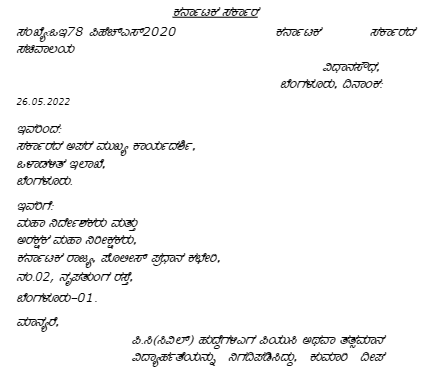
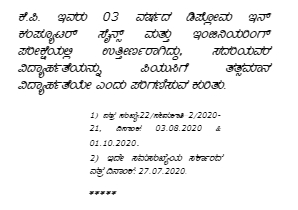
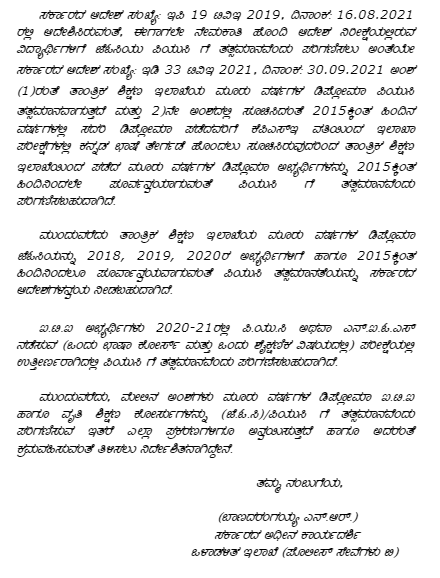
3. A perusal of the material on record would indicate that the issue in controversy involved in the present petition is directly and squarely covered by the judgments of this Court in the cases of Sri.Naveenkumar K.V., Vs. The Karnataka State Law University and Ors. – W.P.No.26757/2024 dated 01.10.2024 and Rakesh Shetty Vs. The State of Karnataka and Ors. - W.P.No.31737/2024 dated 09.12.2024.
4. In Sri.Naveenkumar K.V.’s case, (supra), this Court has held as under:
In this petition, petitioner seeks the following relief:
i) Issue a Writ in the nature of certiorari to quash the impugned endorsement bearing Application ref No.LW002S240001257 dated 21.09.2024 issued by the 1st respondent vide Annexure-R and consequently, direct the respondent No.1 to issue eligibility certificate in favour of petitioner by considering his qualification for admission to Three Year Law Degree Course in any of the Recognized colleges of the 1st respondent, in the interest of justice and equity.
ii) Grant such other reliefs as may be deems to be fit to the facts and circumstances of the case, in the interest of justice and equity."
2. Heard the learned Counsel for the petitioner and learned Counsel for respondent No.1 and perused the material on record.
3. A perusal of the material on record would indicate that issue in controversy involved in the present petition is directly and squarely covered by the judgments of this Court in the cases of Mr.Abubakar Vs.Karnataka State Law University and others- W.P.No.200642/2021 dated 08.12.2021 and Sri N.Dinesh Vs. The Karnataka State Law University -W.P.No.15723 of 2023 dated 22.08.2023.
4. In Abubakar's case (supra), this Court has held as under:
"The petitioner has completed his SSLC in the academic year 2009-10 from Urdu High School, Jewargi, District Kalaburagi. Thereafter, he has completed I.T.I (Electrician), a two years course from Shri Noorandeshwar I.T.I, Jewargi in the year 2012. Thereafter, he has passed three years B.A. Degree in the year 2020 from Gulbarga University, Kalaburagi. Thereafter, he has approached respondent No.2 for admission to three years LL.B course. The same has been rejected by respondent No.2 on the ground that the petitioner has not passed 10+2+3 as contemplated under the law. Aggrieved by the same, the petitioner has preferred this writ petition.
2. The contention of the respondents is that the petitioner ought to have passed Pre-university after passing 10th standard and thereafter should have completed his Degree and then only he would be eligible for admission to LL.B. But, the petitioner has completed a I.T.I course for two years and hence he is not being considered for admission to LL.B.
3. Rule 2(vi) of the Rules of Legal Education framed by the Bar Council of India (hereinafter referred to as ‘the Rules’) defines ‘Bachelor degree in law’ as under:
“2(vi) “Bachelor degree in law” means and includes a degree in law conferred by the University recognized by the Bar Council of India for the purpose of the Act and includes a bachelor degree in law after any bachelor degree in science, arts, commerce, engineering, medicine, or any other disc