


 Back
Back





2025 Supreme(Online)(Kar) 441070
2025 KHC-D 17375
IN THE HIGH COURT OF KARNATAKA AT DHARWAD
M.NAGAPRASANNA, J.
Appasaheb S/o Shankar Murgude – Appellant
Versus
The Common Cadre Committee Employees of Primary Co-Operative Agriculture and Rural Development Banks, Bengaluru – Respondent
Writ Petition No. 111162 of 2015
Decided On : 08-12-2025
Advocates Appeared :
For the Appellant : Shivaraj P. Mudhol
For the Respondents : Girija S. Hiremath, P.R. Bentur, K.S. Mantur, K.H. Bagi
ORDER :
1. The petitioners are before this Court seeking for the following prayer:
1. To issue writ in the nature of mandamus direct the respondents No.1 to 11 to regularize the service of the Petitioners to their respective posts in their respective banks from the date of their initiation appointment and to pay all monetary benefits by allowing this writ petition.
2. To issue any other orders, directions as deems fit in the circumstances.
2. Heard the learned counsel Sri.Shivaraj Mudhol for the petitioners, learned HCGP Smt.Girija Hiremath for the respondent Nos.2 and 3-State, the learned counsels Sri.P.R.Bentur and Sri.K.S.Mantur appearing for respondent No.1 and the learned counsel Sri.K.H.Bagi appearing for respondent No.9.
3. The petitioners were initially employed by the Primary Co-operative Agriculture and Rural Development Banks in various capacities. Some of the petitioners who are no more, their legal representatives are brought on record. The range of which the petitioners are appointed are from Second Division Assistant to typist, watchman and several other employments in respondent Nos.4 to 11-Banks which all come under the supervision of the respondent No.1-Common Cadre Committee.
4. The petitioners were employed by the respective Banks on different dates. The dates of their commencement of employment, is as follows:
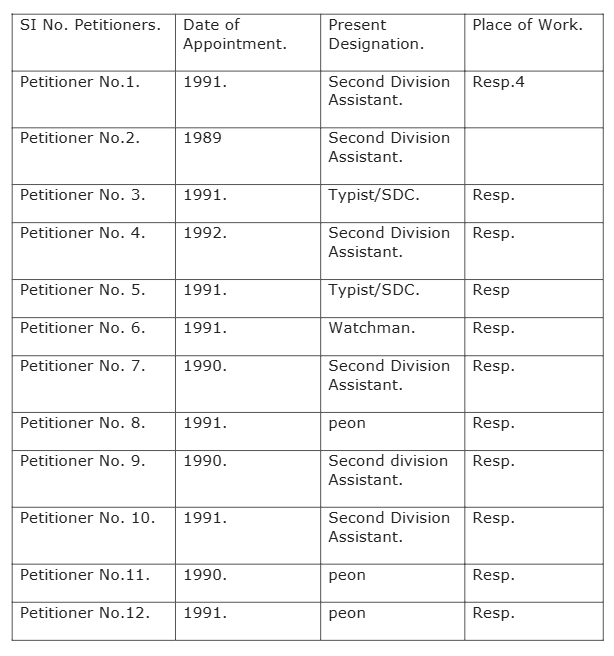

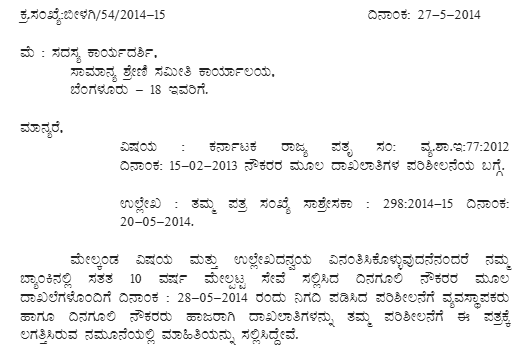
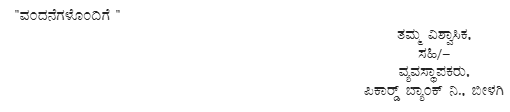
6. To the said document, the entry and subsistence of services of these petitioners are also indicated. Identical representations were submitted by several of the employees and those employers to whom the said employees had submitted their representations also had recommendations in their favour made to the Common Cadre Committee, the first respondent. Those representations did merit consideration at the hands of the Common Cadre Committee and ultimately approved by the Government by directing regularisation of their services. The communication and the order read as follows:
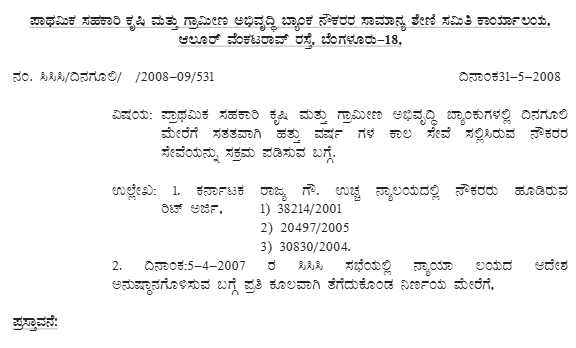
7. It was concerning three employees who had entered service or joined services in those respective Banks on 20.02.2001, on 07.10.2002 and on 24.06.2002. Their services had not yet been completed to the tune which the Apex Court had directed in State of Karnataka v. Umadevi, (2006) 4 SCC 1. Notwithstanding the same, those services of those employees come to be regularised, while the same treatment is not meted out to these petitioners. Therefore these petitioners are before the Court seeking a direction by chance of a writ in the nature of mandamus directing the respondents to consider their cases for regularisation as was considered by the Common Cadre Committee and approved by the Competent Authority, as is found in the order quoted supra. It is therefore, they are at the doors of this Court.
8. The learned counsel appearing for the petitioners would vehemently contend that the respondents has practised invidious discrimination in ordering regularisation of its employees as one set of similarly placed employees have had the benefit of regularisation and the other set, the petitioners herein are left out. Therefore the learned counsel would seek parity in treatment towards the regularisation of their cases by the hands of the respondent-State.
9. The learned HCGP, appearing for the respondent Nos.2 and 3 would vehemently refute the submissions in contending that these employees were employed on work basis not for the full day, but nonetheless daily wages. The learned HCGP would also admit that the petitioners












