SupremeToday Landscape Ad
Back
Next
Judicial Analysis Court Copy Headnote Facts Arguments Court observation
Listen Audio Icon Pause Audio Icon
judgment-img

2026 Supreme(Online)(Kar) 2017

THE HIGH COURT OF KARNATAKA
MR. M.NAGAPRASANNA, J
RAVINDRA KUMAR – Appellant
Versus
CHIEF ADMINISTRATIVE OFFICER, PRINCIPAL DISTRICT AND SESSIONS COURTS – Respondent
CRIMINAL PETITION NO. 11759 OF 2023


Advocates:
For the Appellants/Petitioners: SRI. VINAYA KUMAR N.D
For the Respondents: SRI. B.V. VIDYULATHA

For prosecution under Section 193 IPC, a deliberate falsehood in significant matters must be established, not mere contradictions or inaccuracies.

Headnote:This case analyzed the invocation of Sections 193 and 340 of the IPC and Cr.P.C., focusing on the offence of giving false evidence. The petitioner appealed against the charges stemming from prior judicial proceedings. The court found that mere contradictions in testimony did not meet the threshold for perjury, ultimately quashing the ongoing proceedings. Issues of perjury were explored with references to relevant statutes and precedents. The court concluded that continuance of the proceedings constituted an abuse of process of law.

Table of Content
1. judicial observations on evidence and case proceedings. (Para 1 , 5)
2. evidence and charges against the appellant. (Para 2 , 3 , 4)

ORAL ORDER

Heard Sri. Vinay Kumar N.D., learned counsel appearing for the petitioner and Smt. B.V. Vidyulatha, learned counsel appearing for the respondent.

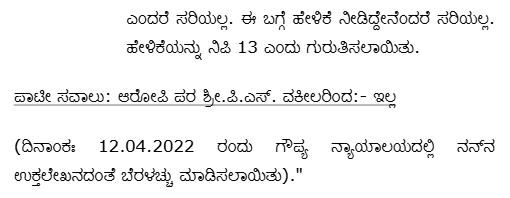
2. The petitioner is before this Court calling in question the proceedings in CC.No.89/2022. The proceedings in CC.No.89/2022 has a history. Therefore, it is necessary to take a little walk in the history. A crime had been registered against one Shridhar in Spl. S.C. No.11/2021 for the offences punishable under Sections 376 and 420 of the IPC and Sections 3(1)(r), 3(1)(w) and 3(2)(va) of the Scheduled Castes and Scheduled Tribes (Prevention of Atrocities) Act, 1989. The said case ends up in acquittal. In the said proceedings, the present petitioner tenders his evidence. The examination and cross-examination of the witness is as follows:
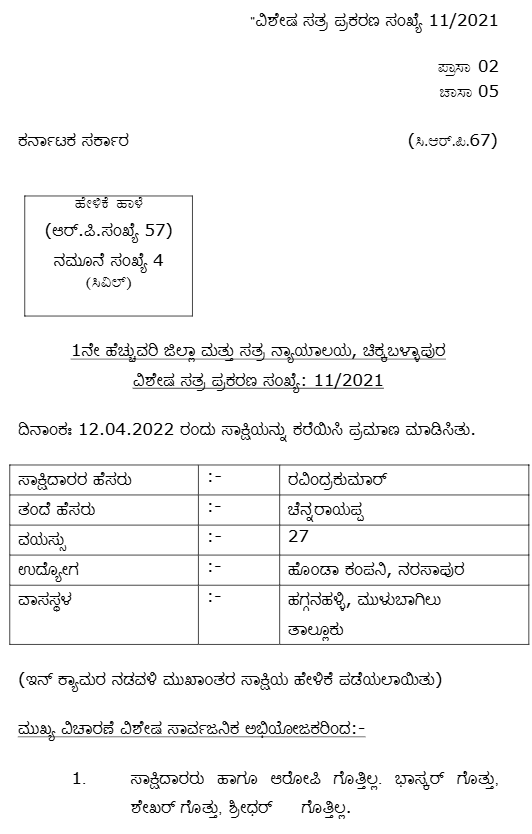
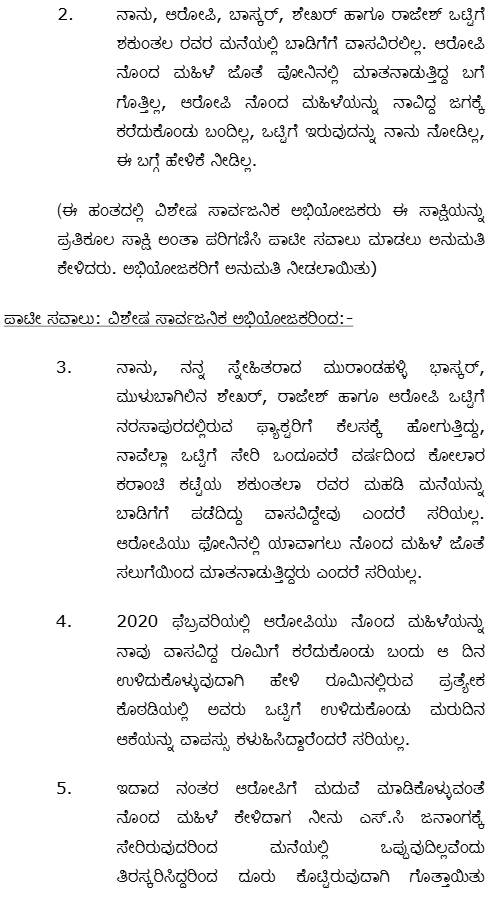
The petitioner tenders his evidence in the said crime in Spl. S.C. No.11/2021, which was for the offences as indicated hereinabove against one Bhaskar. While so saying, the petitioner appears to have deposed that the petitioner, Bhaskar, Shekhar and Rajesh were residing as tenants in the property owned by one Shakuntala - CW6. In the cross- examination, it is denied that all of them together were staying as tenants in the said premises. Therefore, a private complaint is made by the Chief Administrative Officer of the Principal District and Sessions Court, Chikkaballapura against the petitioner, invoking the provisions of Sections 340 (1)(b), 340(3)(b) read with 195(1)(b)(i) of the Cr.P.C. for the offence punishable under Section 193 of the IPC , which comes to be registered in PCR No.3/2022. The concerned Court then takes cognizance of the offence punishable under of the on 30-05-2022 and a criminal case is registered against the petitioner in CC No.89/2022, which is called in question in the present petition.

3. There is contradiction, no doubt, between the examination and cross-examination, but the issue is the acquittal of the said accused in Spl. S.C. No.11/2021 rather ostensibly has not been ordered on the false evidence tendered by the petitioner. In the light of this admitted fact, the offence punishable under Section 193 of the IPC for giving or fabricating false evidence before the concerned Court by the petitioner cannot spring, as it is necessary on the evidence that is tendered, which is later found to be false there should have been benefit taken by the accused. I deem it appropriate to quote the judgment of the Apex Court in the case of JAMES KUNJWAL v. STATE OF UTTARAKHAND , 12024 SCC OnLine SC 1943 , wherein the offence of giving false evidence punishable under of the is interpreted, and it is held as follows:

“…. …. ….

9. Hence, in the attending facts, the short question that falls for consideration of this Court is whether the contents of the affidavit filed before the High Court, as taken note of in the impugned order, constitutes an offence under Section 193 IPC , as defined in Section 191 ?

10. Section 191 IPC which defines the offence, reads as under:—

“191. Giving false evidence. Whoever, being legally bound by an oath or by an express provision of law to state the truth, or being bound by law to make a declaration upon any subject, makes any statement which is false, and which he either knows or believes to be false or does not believe to be true, is said to give false evidence.

Explanation 1.— A statement is within the meaning of this section, whether it is made verbally or otherwise.

Explanation 2.— A false statement as to the belief of the person attesting is within the meaning of this section, and a person may be guilty of giving false evidence by stating that he believes a thing which he does not believe, as well as by stating that he knows a thing which he does not know.”

Section 193 IPC , under which the appellant is sought to be prosecuted is extracted below for refere

Click Here to Read the rest of this document
1
2
3
4
5
6
7
8
9
10
11
SupremeToday Portrait Ad
supreme today icon
logo-black

An indispensable Tool for Legal Professionals, Endorsed by Various High Court and Judicial Officers

Please visit our Training & Support
Center or Contact Us for assistance

qr

Scan Me!

India’s Legal research and Law Firm App, Download now!

For Daily Legal Updates, Join us on :

whatsapp-icon Back to top