
 Back
Back





HIGH COURT OF KERALA
P.V.KUNHIKRISHNAN, J
FATHIMABI – Appellant
Versus
STATE OF KERALA – Respondent
Crl.MC 5665/2018
Key Points: - Minor injuries inflicted by a parent in a disciplinary context do not constitute an offence under Section 75 of the Juvenile Justice Act (!) (!) . - The prosecution failed to establish malice or excessive force, and the injuries were minor in nature (!) (!) . - Parental disciplinary actions do not fall under the Juvenile Justice Act when reasonable force is used and no serious harm is caused (!) (!) . - Continuation of prosecution is deemed unnecessary to prevent abuse of court process (!) (!) . - Principles from prior case law recognize implied consent to reasonable discipline by parents and teachers, provided it is not excessive or malicious (!) (!) .
ORDER
This criminal miscellaneous case is filed to quash the proceedings in C.C.No.540/2018 on the file of the Judicial First Class Magistrate Court, Malappuram. Petitioner is the accused in the above case. The above case is charge-sheeted against the petitioner alleging offence punishable under Section 75 of the Juvenile Justice (Care and Protection of Children) Act, 2015 (for short, JJ Act).
2. The case is registered based on a complaint launched by the minor son aged 10 years old of the petitioner before the Police on 09.04.2018 alleging that his mother, the petitioner herein, beat him up on his backside and when he tried to run, his mother hit on his nose and blood came from his nose in the premises of Family Court, Malappuram. It is alleged that while the minor son and his younger sister were talking with their mother in the premises of Family Court, and when the minor son told the mother that since she had filed the case they have to come to the Court frequently, the mother beat up and hit him. Based on the above complaint, Annexure-I FIR was registered. After investigation, the Police filed the final report, as evident by Annexure-VII. According to the petitioner, even if the entire allegations are accepted, no offence is made out under Section 75 of the JJ Act.
3. Heard the learned counsel for the petitioner and the learned Public Prosecutor. I also heard the learned counsel for the 2nd respondent.
4. According to the petitioner, the allegations against the petitioner are all false and there are several litigation pending between the petitioner and her husband including the custody of the children. It is the case of the petitioner that, the case is falsely launched against the petitioner, who is the mother of the child, and the child gave such a statement at the instance of her husband. The counsel for the 2nd respondent submitted that the contentions raised by the petitioner are all matters of evidence and the petitioner has to prove the same before the trial court.
5. This Court perused Annexure-VII final report. The allegation in Annexure-VII final report is extracted hereunder:
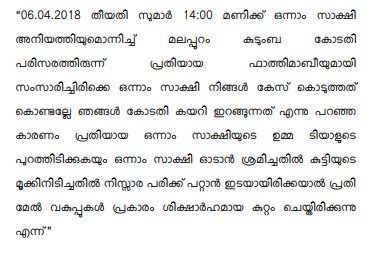
6. Admittedly the accused is the mother of the child. According to the prosecution, when Charge Witness No.1 told the petitioner that they were forced to come to the court because of her case, because she filed complaint, the petitioner beat him and when Charge Witness No.1 tried to ran away, Charge Witness No.1 sustained injury. Admittedly the injuries are minor in nature. No nasal bone fracture is seen as per the wound certificate. In such circumstances, when a mother beat her own child, the offence under Section 75 of the JJ Act is attracted is the question to be decided. This Court considered similar situation in several cases. In Jomi v. State of Kerala [2024 KHC 574], this Court considered a case in which there was allegation that a student was beaten by the school teacher, when she failed to secure fair marks in a test paper. It will be better to extract the relevant portion of the above judgment:
“8. In Rajan @ Raju's case (supra), this Court in Paragraph No.11 observed that the precedents cited by the petitioner were all rendered prior to the advent of the JJ Act, 2000. However, the principles laid down can be applied to the instant case as well. In the cited cases, their Lordships have taken a view that when a student is sent by his parent or guardian to a school, the parent or guardian must be deemed to have given an implied consent to the child being under the discipline and control of the school authorities and to the infliction of such reasonable punishment as may be necessary for the purposes of school discipline or for correcting him. The courts have taken the view that the school teacher, in view of his peculiar position, must in the nature of things, have authority to enforce discipline and correct a pupil, who is put in his charge. The courts have also taken the view that it can be assumed that when a parent entrust a child



An indispensable Tool for Legal Professionals, Endorsed by Various High Court and Judicial Officers
Please visit our Training & Support
Center or Contact Us for assistance

Scan Me!
India’s Legal research and Law Firm App, Download now!


For Daily Legal Updates, Join us on :



 Back to top


