


 Back
Back





2024 Supreme(Online)(KER) 39425
HIGH COURT OF KERALA
P.V. KUNHIKRISHNAN, J
VELAYUDHAN – Appellant
Versus
STATE OF KERALA – Respondent
Crl.MC 2414/2019
SHAJIN S.HAMEED, SRI.SANGEETHARAJ.N.R, SMT.MARY RANZOM LOUIZ
Charges of cheating and exorbitant interest require proof of fraudulent intent, which was not established in this case.
Headnote:(A) Kerala Prohibition of Exorbitant Interest Act, 2012 - Sections 3 r/w 9 - Indian Penal Code, 1860 - Sections 406 and 420 - Quashing of proceedings - Allegations of exorbitant interest and cheating were not substantiated as the necessary ingredients for the offences were not made out - The court emphasized that mere civil disputes should not be converted into criminal cases. (Paras 6-10)
(B) Criminal Procedure - The court clarified that the prosecution must establish fraudulent intent for charges under Section 420 IPC, which was not present in this case. (Paras 6-8)
(C) Money Lending - The court noted that the petitioner did not charge exorbitant interest as defined under the applicable laws, thus dismissing the charges under the Kerala Prohibition of Charging Exorbitant Interest Act. (Paras 8-9)
Facts of the case:
The petitioner was accused of cheating and misappropriating a vehicle and documents after lending Rs. 2,00,000/- with high-interest rates. The complainant alleged non-return of the vehicle and failure to share profits from the rental of the vehicle.
Findings of Court:
The court found no merit in the allegations, stating that the offences under IPC and the Kerala Act were not made out, and quashed the proceedings.
Issues: The main issues included whether the allegations of cheating under Section 420 IPC were substantiated and whether the interest charged was exorbitant as per the Kerala Act.
Ratio Decidendi: The court held that allegations of cheating require proof of dishonest intent at the outset of the transaction, which was absent in this case.
Result: Crl.M.C is allowed; all further proceedings are quashed.
ORDER
This Crl.M.C is filed to quash proceedings in C.C.No.3565/2017 on the file of the Judicial First Class Magistrate Court, kunnamkulam. The above case is charge sheeted against the petitioner alleging offences punishable under Sections 3 r/w 9 of the Kerala Prohibition of Exorbitant Interest Act, 2012 , and also under Section 406 and 420 IPC .
2. The prosecution case is that the de facto complainant during December 2014 borrowed an amount of Rs. 2,00,000/- from the accused after giving his swift car bearing registration no.KL-46-J-9703, passport, two cheques and a stamp paper as security. He also agreed to pay an amount of Rs.20,000/- per month as interest. According to the de fact complainant, he paid interest for about 7 months. During April 2017, the de facto complainant demanded the accused to return the vehicle and other documents, but he did not return it. It is the case of the de facto complainant that accused hired the vehicle of the de facto complainant and others, thereby earned Rs.24,000/- as rent monthly. Therefore, it is alleged that the accused committed the offence.
3. Heard the learned counsel for the petitioner and Learned Public Prosecutor. There is no representation for the second respondent.
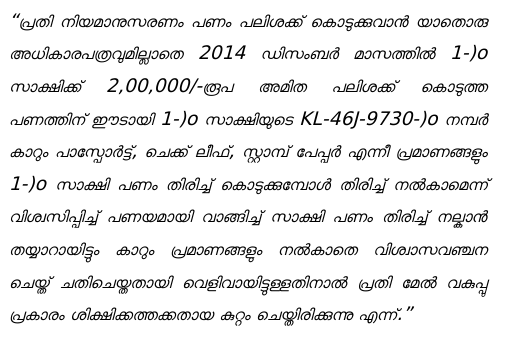
4. Annexure B is the final report in this case. It will be better to extract the relevant portion of Annexure B:
5. The main offence alleged against the petitioner is under Section 420 IPC . Whether the above allegation attracts under is the first question to be decided.
6. The Apex Court considered the ingredients to attract Section 420 IPC inSubbiah C. @ Kadambur Jayaraj v. Superintendent of Police [2024 KHC 6288]. The relevant portion of the above judgment is extracted hereunder:
“40. The complainant has clearly alleged that the accused caused him monetary loss because the appropriate share of profits was not passed on to him after some plots from the entire chunk had been sold. This Court in the case of Sarabjit Kaur v. State of Punjab and Anr, 2023 SCC OnLine SC 201 observed that: -
"A breach of contract does not give rise to criminal prosecution for cheating unless fraudulent or dishonest intention is shown right at the beginning of the transaction. Merely on the allegation of failure to keep up the promise will not be enough to initiate criminal proceedings".
41. Similarly, in the case of Vijay Kumar Ghai v. State of W.B., 2022 (7) SCC 124, this Court while tracing the earlier decisions on the subject observed as under:
24. This Court in G. Sagar Suri v. State of U.P. (G. Sagar Suri v. State of U.P., 2000 (2) SCC 636) observed that it is the duty and obligation of the criminal court to exercise a great deal of caution in issuing the process, particularly when matters are essentially of civil nature.
25. This Court has time and again cautioned about converting purely civil disputes into criminal cases. This Court in Indian Oil Corpn. (Indian Oil Corpn. v. NEPC India Ltd., 2006 (6) SCC 736) noticed the prevalent impression that civil law remedies are time consuming and do not adequately protect the interests of lenders/creditors. The Court further observed that : (Indian Oil Corpn case (Indian Oil Corpn v. NEPC India Ltd., 2006 (6) SCC 736)
"13. ... Any effort to settle civil disputes and claims, which do not involve any criminal offence, by applying pressure through criminal prosecution should be deprecated and discouraged."
42. Thus, we are of the firm view that the necessary ingredients of the offences punishable under S.406 and S.420 IPC are not made out against the accused appellants from the admitted allegations set out in the complaint and the charge sheet. It cannot be doubted that a dispute which is purely civil in nature has been given a colour of criminal prosecution alleging fraud and criminal breach of trust by misusing the tool of criminal law.”
7. Similarly inSharif Ahmed v. State of Uttar Pradesh [2024 KHC 6251], the Apex Court again considered the ingredients of Section 420 IPC . The relevant porti












