
 Back
Back





HIGH COURT OF KERALA
MARY JOSEPH, J
SAJEESH – Appellant
Versus
ASWATHY – Respondent
Crl.Rev.Pet/1491/2018
Execution - Family Law - CPC 89 - The court upheld the execution of maintenance order based on the agreement, interpreting default in clauses regarding joint divorce petition and payment, leading to enforcement of the distress warrant.
Fact of the Case:
A revision petition arose after the execution of a maintenance order was sought due to the failure of the husband to comply with an agreement executed under Section 89 of the CPC, which stipulated a divorce petition and financial support to the wife.
Finding of the Court:
The court found that since the husband defaulted on the initial obligations outlined in the agreement, the wife was justified in seeking execution of the order, which included issuing a distress warrant for the unpaid amount.
Issues: Whether the execution proceedings initiated by the wife violated the terms of the agreement executed under Section 89 of the CPC, particularly Clause (7) which stated no execution if other clauses were satisfied.
Ratio Decidendi: The court determined that default in complying with the essential clauses of the agreement negated the husband's claim to avoid execution of the maintenance order, affirming the right of the wife to seek enforcement.
Final Decision: The revision petition was dismissed.
ORDER
Dated this the 15th day of January, 2021
The revision on hand is filed against judgment dated 07.09.2018 of Court of Sessions, Kollam whereby Crl.Appeal No.202 of 2017 is dismissed and the order passed by Judicial First Class Magistrate Court-II, Kollam on 25.05.2017 is confirmed.
2. The Judicial First Class Magistrate Court-II, Kollam has allowed Crl.M.P.No.7290 of 2015 and thereby directed the petitioner to take steps to execute the order passed by it in M.C.No.67 of 2010. The order reads:-
“Heard. Perused. Counter petitioner has not so far complied the lawful order. Counter petitioner has not raised any valid reason for non payment. Counter petitioner has been produced. Found capable of complying the final order and despite so failed to comply the order. So distress warrant has been ordered, petitioner shall take steps. Issue distress warrant to 9/8/17.”
3. The learned counsel for the revision petitioner urged on the basis of an agreement executed by the parties under Section 89 of the Code of Civil Procedure , 1908 that the respondent has undertaken by Clause (7) of it not to resort to execution of the order passed by Judicial First Class Magistrate Court-II, Kollam. According to him, execution proceedings was initiated by the respondent in violation of Clause (7) of the agreement and therefore the court below ought not to have entertained the same and passed the impugned order. A copy of the agreement is made available for perusal. The court below had noticed after perusing the agreement that compliance of Clause (7) was subject to compliance of Clauses (1) to (6) preceding that. The court found that 1st and 2nd among the six Clauses viz. filing of a joint petition for divorce and payment of Rs.20,00,000/- by husband to wife, have been defaulted and therefore, the petitioner is not entitled to derive the benefit of Clause (7).
4. It is further contended by the revision petitioner that time limit was not prescribed for filing a joint petition seeking divorce by mutual consent and for payment of Rs.20,00,000/- in favour of respondent. According to him Clause (7) having been subscribed by the respondent, she is precluded from pursuing with the execution of the order passed in M.C.No.67 of 2010. According to him, in that context the Judicial First Class Magistrate Court-II, Kollam ought not to have entertained Crl.M.P No.7290 of 2015, issued distress warrant and directed her to take steps for the purpose and the appellate court ought not to have confirmed the above order.
5. It is urged by the revision petitioner that time limit was not prescribed in the agreement executed by the parties for compliance of the terms, directing filing of a joint petition for obtaining a decree for divorce by mutual consent and payment of Rs.20,00,000/- to the wife.
6. The memorandum of agreement executed by the parties is made available to this Court. It is testimonial of the settlement of issues among the parties in a mediation process and arrival of 13 Clauses as part of settlement, which are extracted hereunder:
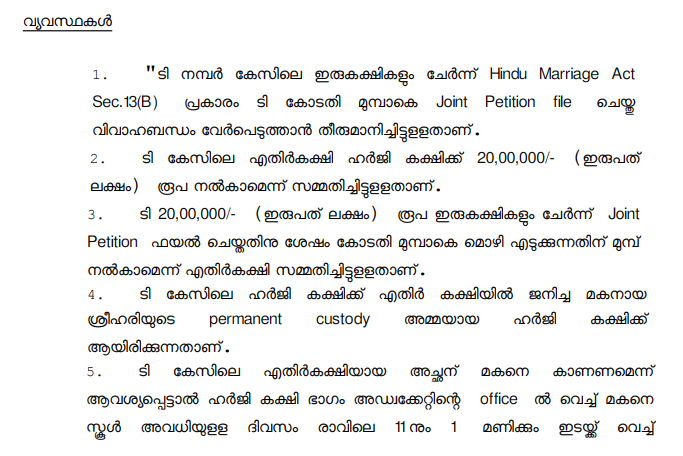
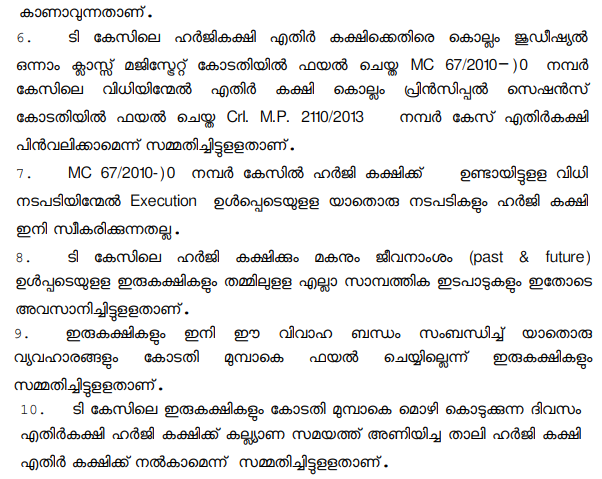
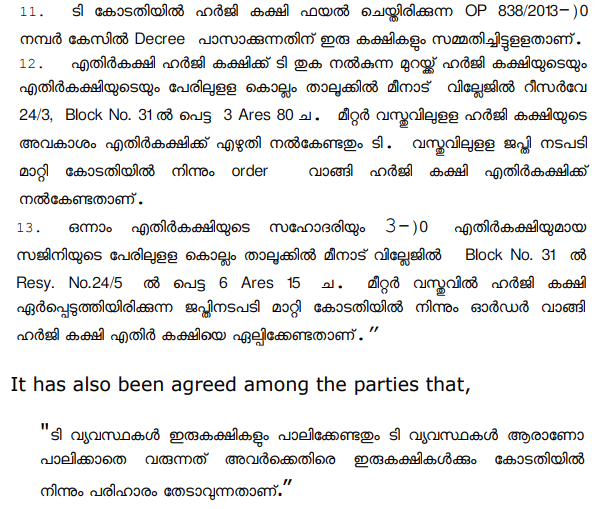
7. The learned counsel for the respondent has pointed out that the 1st and 2nd Clauses in the agreement were not complied with by the revision petitioner. According to the learned counsel, it is specifically provided in the agreement that in case of default in compliance of any of the Clauses by one of the parties, the opposite party is entitled to proceed against in legal proceedings to redress his/her grievances.
8. Clause (1) only refers to a joint obligation of the parties to file a petition seeking for a decree of divorce on mutual consent and it is something to be pursued with by them jointly, whereas Clause (2) refers to the sole liability of the revision petitioner to pay Rs.20,00,000/- to the respondent.
9. The agreement was executed on 18.12.2013 and Crl.M.P was filed by the wife for getting the order in M.C.No.67 of 2010 executed in the year 2017, after a lapse of four years. True that time limit is not prescribed for complia



An indispensable Tool for Legal Professionals, Endorsed by Various High Court and Judicial Officers
Please visit our Training & Support
Center or Contact Us for assistance

Scan Me!
India’s Legal research and Law Firm App, Download now!


For Daily Legal Updates, Join us on :



 Back to top


