Back
Back





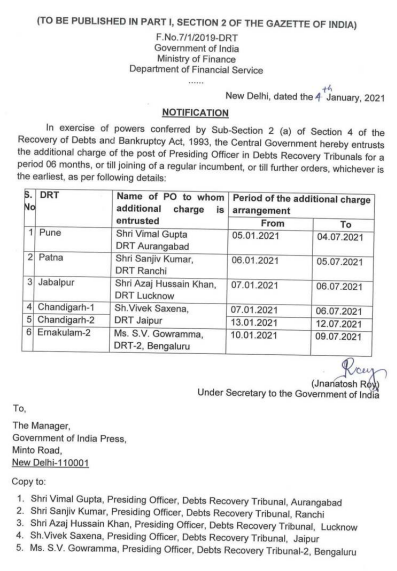
2021 Supreme(Online)(KER) 1339
HIGH COURT OF KERALA
S.MANIKUMAR, CJ, J, SHAJI P.CHALY, J
M/S. KERALA FASHION JEWELLERY, D.NO.PP/VI, 656, MANJERY ROAD, PANDIKKAD, MALAPPURAM-676 521 – Appellant
Versus
THE UNION OF INDIA – Respondent
WA. No. 384 OF 2021 | WP(C) NO. 2966/2021(U)
For the Appellants/Petitioners: SRI.P.CHANDRASEKHAR, SRI.K.K.MOHAMED RAVUF, SRI.SATHEESH V.T., SMT.MANJARI G.B.
For the Respondents: SRI P.VIJAYAKUMAR, SRI.PHILIP T.VARGHESE, SRI.THOMAS T.VARGHESE, SMT.ACHU SUBHA ABRAHAM, SMT.V.T.LITHA, SMT.K.R.MONISHA, SMT.SHRUTHI SARA JACOB, SRI. JAGADEESH LAKSHMAN
The court upheld that the Central Government's power to assign a Presiding Officer to a Debt Recovery Tribunal is restricted to within the Tribunal's jurisdiction, per statutory provisions.
Headnote:(A) Recovery of Debts and Bankruptcy Act, 1993 - Sections 3 and 4(2) - Authorization of Presiding Officer for Debt Recovery Tribunal - The Central Government's action of assigning additional charge to a Tribunal outside its jurisdiction was impugned as violating statutory provisions. The court ruled that only a Presiding Officer within the same jurisdiction can be authorized to discharge such functions, thus quashing the earlier notification by the Central Government. (Paras 3, 4, 9-15)
(B) Administrative Law - Judicial Accountability - The power of the Central Government over Tribunal composition must align with statutory limitations and ensure litigants have access to justice in accessible locations (Paras 4, 10).
Facts of the case:
The petitioners challenged the additional charge of a Debt Recovery Tribunal to a Presiding Officer from a different state, claiming it violated the Recovery of Debts and Bankruptcy Act, 1993.
Findings of Court:
The impugned notification was quashed on grounds of jurisdictional overreach and statutory non-compliance.
Issues: Whether the Central Government can appoint a Presiding Officer from another state and the interpretation of the Recovery of Debts and Bankruptcy Act, 1993 regarding additional charges of Tribunals.
Ratio Decidendi: The court found that the functions of a Debt Recovery Tribunal must remain within the same jurisdiction and the appointment of officers from different states violates the intent of providing accessible justice to litigants.
Result: Writ appeal is allowed and the previous notification is quashed.
| Table of Content |
|---|
| 1. the restrictions on appointing presiding officers outside state jurisdiction must adhere to the recovery of debts and bankruptcy act. (Para 2 , 3 , 4) |
| 2. authority and power vested in the central government for tribunal appointments must comply with statutory definitions. (Para 9 , 10 , 11) |
| 3. statutory provisions thwart overreach in tribunal appointments, ensuring accessibility for litigants within their jurisdiction. (Para 12 , 13 , 14 , 15) |
JUDGMENT
Dated this the 23rd day of March, 2021
S. Manikumar, CJ
Being aggrieved by the judgment dated 5.2.2021 in W.P.(C) No.2966 of 2021, instant writ appeal is filed.
2. Short facts leading to the filing of the writ petition are petitioners are the applicants in S.A. No.372 of 2018 on the file of the Debt Recovery Tribunal-II, Ernakulam, filed under Section 17(1) of the SARFAESI Act, 2002 , challenging the physical possession measures taken by the 4th respondent-M/s. Kotak Mahindra Bank Limited, Mumbai, represented by its Managing Partner. The petitioners are aggrieved by the additional charge given by the Union of India, 1st respondent, to the 3rd respondent, the Presiding Officer of Debt Recovery Tribunal-II, Bangalore, as the said action of issuing order authorising the Presiding Officer of one Debt Recovery Tribunal to act as such, as additional charge by the 1st respondent, is ultra vires of Section 4 sub sections (2)(a) and (b) of the Recovery of Debts and Bankruptcy Act, 1993 , which came into force from 2016, repealing and substituting the previous provision, authorising additional charge to the Presiding Officer of another Debt Recovery Tribunal. The petitioners, therefore seek, to quash Exhibit-P1 notification dated 4.1.2021 and for issuance of a writ of prohibition against the 3rd respondent restraining from acting as in charge of Debt Recovery Tribunal-II, Ernakulam, as per Exhibit P1, and also for a direction to 1st respondent to entrust the additional charge of Debt Recovery Tribunal-II, Ernakulam to any Presiding Officer or Judicial member of any other Tribunal established and constituted under any other law other than the functioning under the Government of India in Ernakulam till a regular incumbent joins as a Presiding Officer in Debt Recovery Tribunal- II, Ernakulam, or till further orders.
3. After hearing the learned counsel for the parties, the learned single Judge dismissed the writ petition, holding thus:
“6. It is trite that every word used in the legislation is to be given meaning. The golden rule is to adopt to the ordinary meaning of the words used and to the grammatical construction unless the same leads to manifest absurdity. The inconvenience however great would be of little consequence. Similarly, it is also well established that such interpretation as would reduce the legislation to futility needs to be avoided.
In the case in hand, the term 'Tribunal' is defined to mean that the Tribunal established under sub section 1 of Section 3 of the Recovery of Debts and Bankruptcy Act, 1993 . The Central Government is empowered to establish one or more Tribunal to be known as DRT by notification for exercising the jurisdiction, power and authority conferred on such Tribunal under the said Act. If the meaning of the word 'Tribunal' as defined by this Act is kept in mind, then it is clear that the Government can entrust the charge of one DRT to any other DRT so also to other Tribunals established under any other law for the time being in force. The provisions of sub section 2 of Section 4 cannot be read to exclude entrustment of powers of one DRT with another DRT.”
4. Assailing the correctness of the said judgment, appellants have, inter alia, raised the following grounds:
A. Learned Single Judge went wrong in holding that power of the Central Government to entrust the charge of a Debt Recovery Tribunal to any other Debt Recovery Tribunal, established under any other law, is in addition to the power of the Central Government to entrust the charge of on