
 Back
Back





IN THE HIGH COURT OF KERALA AT ERNAKULAM
Easwaran S., J
SUSAN THOMAS @ SUMOL – Appellant
Versus
THOMAS KURIAN – Respondent
RSA NO. 278 OF 2022 | AS NO.15 OF 2020 | OS NO.439 OF 2011
| Table of Content |
|---|
| 1. introduction of parties and case background. (Para 1 , 2) |
| 2. parties contest the application of two succession laws. (Para 3 , 4 , 5) |
| 3. arguments regarding the application of the indian succession act versus the christian succession act. (Para 6 , 7) |
| 4. analysis of when succession opens and the pertinent laws at play. (Para 9 , 10 , 11) |
| 5. provisions of the christian succession act as relevant to the case. (Para 12 , 14 , 15 , 16) |
| 6. consideration of the widow's share under applicable laws. (Para 17 , 18) |
| 7. conclusion on applications and implications of various provisions. (Para 19 , 20) |
| 8. principles governing ouster and adverse possession among co-owners. (Para 21 , 22 , 23 , 24 , 25) |
| 9. court analysis of evidence regarding ouster claims. (Para 26 , 27 , 28 , 29) |
| 10. legal implications of claims raised and the resulting judgments. (Para 30 , 31) |
JUDGMENT
This appeal raises certain multifaceted questions regarding the interpretation of the Christian Succession Act, 1092 (TC) and the Indian Succession Act, 1925 . The defendants 2 to 4, who resisted a suit for partition successfully, were visited with reversal of the judgment by the first appellate court and have come up in the present second appeal.
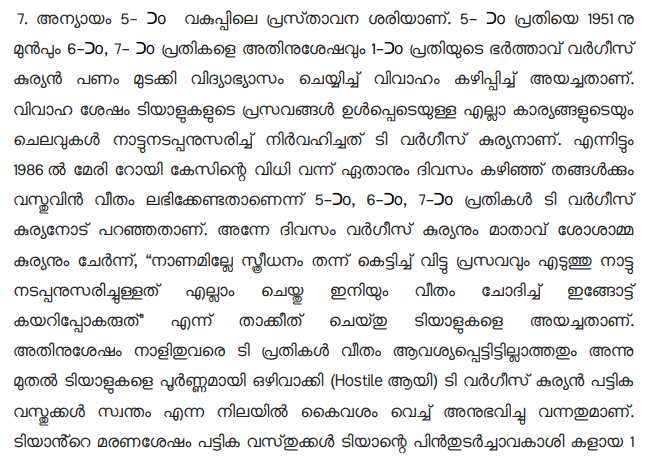
2. The brief facts necessary for the disposal of the appeal are as follows: One Sri.Kurian Varghese had extensive properties. Item No.1 of the plaint schedule property consists of 25 Ares in resurvey No.148/12 of Kaviyoor Village, Thiruvalla Taluk, Pathanamthitta District. Item No.2 consists of 44.80 Ares in resurvey No.180/14 of the same village. Mr.Kurian Varghese married Smt.Sosamma and in the wedlock, they had five children, Sri.Varghese Kurian, Sri.Thomas Kurian, Smt.Annamma Mathew, Smt.Aleyamma Thomas and Smt.Saramma Oommen. Sri.Kurian Varghese inherited the plaint schedule property from his father through partition deed No.634/1111 M.E. In the year 1940, Sri.Kurian Varghese died and Smt.Sosamma Kurian died in the year 1999. The plaintiff instituted the suit for partition on 03.10.2011 as O.S.No.439/2011 contending that he is entitled to 4/5th share of the plaint schedule property. During the pendency of the suit, it appears that the daughters of Sri.Kurian Varghese and Smt.Sosamma executed a release deed in favour of the plaintiff and therefore, an amendment was sought for partition of the plaint schedule property to 4/5th share. The basis of the execution of the release deed was, the declaration of law by the Hon’ble Supreme Court inMary Roy and Ors. v. State of Kerala and Ors. [ (1986) 2 SCC 209 ].
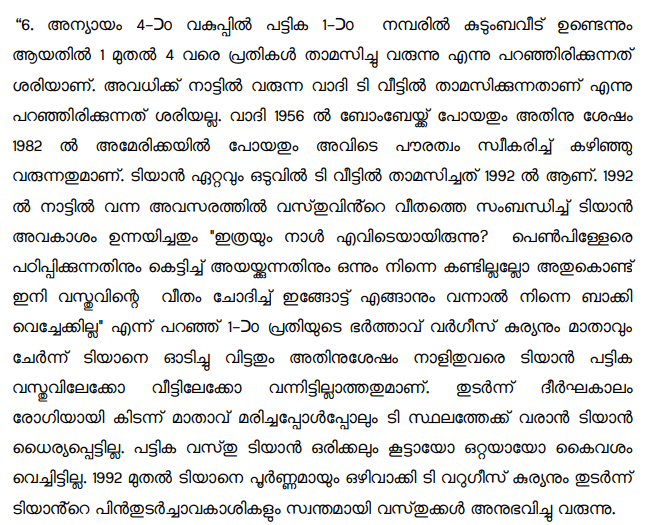
3. The defendants resisted the claim, contending that the provisions of the Indian Succession Act, 1925 will not apply, since the succession opened in the year 1940 on the death of Mr.Kurian Varghese and hence the provisions of the Christian Succession Act, 1092 (TC), will apply. It was further contended that, even if the plaintiff had any resemblance of share over the plaint schedule property, the same was hit by the principles of ouster. On behalf of the plaintiff, Exts.A1 to A4 were marked and PW1 and PW2 were examined. On behalf of the defendants, Exts.X1 and X2 were marked through third party and DW1 to DW3 were examined. Exts.C1 and C2 are the reports of the Advocate Commissioner. The trial court, on appreciation of the oral and documentary evidence, came to the conclusion that the provisions of the , will not apply and that going by the principles of ouster, the defendants had with the knowledge of the plaintiff opened an unequivocal denial of title from 1989 onwards, which was not disputed till 2011 and hence, defendants 1 to 4 had perfected title by ouster and the plaintiff is not entitled to get any relief as prayed for.
4. Aggrieved, the plaintiff took up the matter before the Sub Court, Thiruvalla, in A.S.No.15/2020. The first appellate court, on reappreciation of evidence, came to the conclusion that the plaintiff had made out a case for partition and that, going by the principles laid down by the Hon’b






An indispensable Tool for Legal Professionals, Endorsed by Various High Court and Judicial Officers
Please visit our Training & Support
Center or Contact Us for assistance

Scan Me!
India’s Legal research and Law Firm App, Download now!


For Daily Legal Updates, Join us on :



 Back to top


