
 Back
Back





IN THE HIGH COURT OF KERALA AT ERNAKULAM
ALEXANDER THOMAS, J
MARUNNOLI VIJAYALAKSHMI – Appellant
Versus
TAHSILDAR, KOYILANDI TALUK CIVIL STATION – Respondent
WP(C).No. 39769 of 2018
| Table of Content |
|---|
| 1. petitioners challenge the property mutation denial based on gift deeds. (Para 1 , 3 , 4 , 6) |
| 2. tahsildar lacks jurisdiction to decide property titles. (Para 2 , 11) |
| 3. legal validity of alienation conditions and thavazhi discussed. (Para 7 , 8 , 10 , 12 , 14) |
| 4. the court orders the petitioners' rights to be recognized and acted upon. (Para 15 , 16) |
| 5. court reaffirms that administrative authorities must follow legal provisions regarding property title. (Para 17) |
JUDGMENT
The petitioners are aggrieved by the impugned decision of the 1st respondent Tahsildar rendered as per Ext.P-15 proceedings dated 5.12.2017, whereby their respective requests for mutation of the respective properties obtained by them, through the respective gift deeds have been rejected. The prayers in this Writ Petition (Civil) are as follows:
“i) issue a writ of certiorari or any other appropriate writ order or direction quashing the original of Ext.P-15.
ii) issue a writ of mandamus or any other appropriate writ order or direction directing the 1st respondent to receive Land Tax after transfer of registry for the property of the writ petitioners and;
iii) issue such other orders as this Honourable Court may deem fit to grant.”
2. Heard Sri.B.Krishnan, learned counsel appearing for the petitioners and Sri.Saigi Jacob Palatty, learned Senior Govt. Pleader appearing for the respondents.
3. The petitioners are donees in gift deeds as per Exts.P1, P-3, P-5 P-7, P-9 and P-13 all of which have been executed and registered on 11.5.2015 before the SRO, Payyoli. The gift deeds are executed by Meenakshi Amma and Narayani Amma, to whom the petitioners' properties belong, it is stated. Donees are their children. Their requests for transfer of registry and mutation and to receive basic land tax have been rejected by the 1st respondent as aforementioned Ext.P-15 proceedings dated 5.12.2017. The impugned Ext.P-15 proceedings dated 5.12.2017, reads as follows:
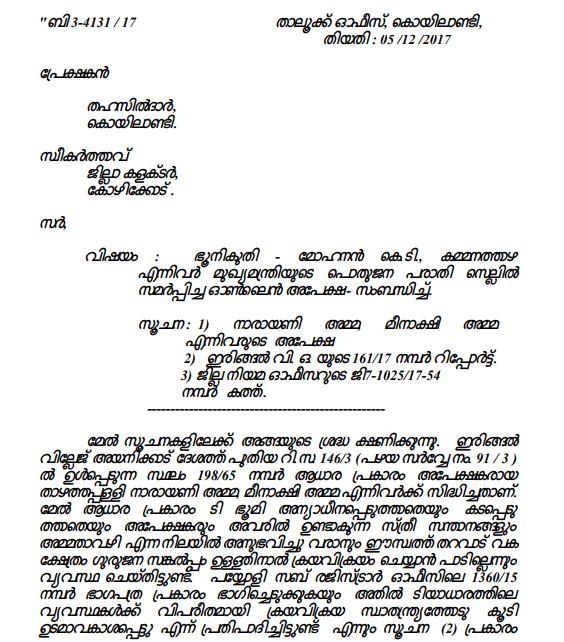
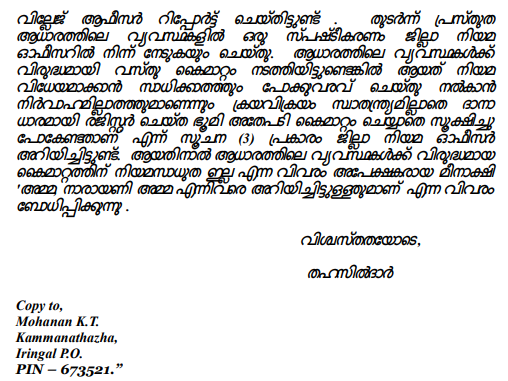
4. Smt.Narayani Amma transferred to the petitioners 1, 2 and 7 to her children, through the gift deeds as per Exts.P-1, P-3 and P-11 respectively and to petitioners 5 and 6 through Ext.P-9 gift deed. Similarly Smt. Meenakshi Amma has transferred 12.40 ares of land to petitioners, 3, 4 and 8 through the gift deeds as per Exts.P-5, P-7 and P-13 respectively. The case of the 1st respondent is that the aforementioned Smt. Narayani Amma and Smt.Meenakshi Amma had got right over the subject property in question on the basis of registered gift deed No.198/1965 of SRO, Payyoli, executed by their mother, Kalyani Amma. It is the contention of the 1st respondent that it is specifically stipulated in aforementioned registered gift deed No.198/1965 of SRO, Payyoli, executed by Kalyani Amma, that the subject property therein is to be possessed as ancestral property and its rights will devolve only on female descendants and in addition to the ancestral temple and the gurujana sankalpam, in the property also stands transferred. The further case of the 1st respondent is that based on the legal opinion that he has obtained from the District law officer concerned, the transfer of registry sought for by the petitioners in the instant case on the basis of Exts.P1, P-3 P-5 P-7, P-9, P-11 and P-13 gift deeds cannot be granted as Smt. Narayani Amma and Meenakshi Amma do not have the right to alienate the property going by the descriptions and stipulations in gift deed No.198/1965, etc. In other words, though the abovesaid gift deeds executed in favour of the petitioners have been duly registered by the Sub Registrar concerned in terms of the provisions contained in the Registration Act, 1908, the 1st respondent takes the stand that he has the right to decide whether the petitioners have title in spite of registered gift deeds and that since he is convinced that the petitioners do not have title, as the donees did not have right to alienate the property, the request for transfer of registry and mutation cannot be granted.
5. From the






An indispensable Tool for Legal Professionals, Endorsed by Various High Court and Judicial Officers
Please visit our Training & Support
Center or Contact Us for assistance

Scan Me!
India’s Legal research and Law Firm App, Download now!


For Daily Legal Updates, Join us on :



 Back to top


