
 Back
Back





IN THE HIGH COURT OF KERALA AT ERNAKULAM
AMIT RAWAL, MURALEE KRISHNA S., JJ
Lance Naik Pappachen S (EX NO.2590820 A) – Appellant
Versus
Union of India – Respondent
WP(C) NO. 10464 OF 2024|TA NO.64 OF 2010
| Table of Content |
|---|
| 1. petitioner seeks pension post-service discharge. (Para 1 , 2) |
| 2. petitioner argues service conditions caused disability; respondents cite medical board's findings. (Para 4 , 5) |
| 3. regulations outlining service-related disability and judicial review rights discussed. (Para 6 , 7) |
| 4. courts can review medical board decisions under judicial review for errors. (Para 8) |
| 5. court endorses broader interpretation of disability claims and directs payment modalities. (Para 9 , 10 , 11 , 12) |
| 6. petition allowed; direction for immediate pension issuance. (Para 13) |
JUDGMENT
Muralee Krishna, J.
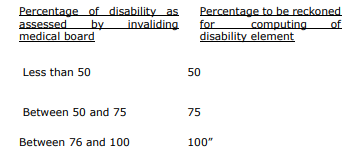
The petitioner is the applicant in T.A No.64 of 2010 on the file of the Armed Forces Tribunal, Regional Bench, Kochi (‘the Tribunal’ for short). He filed this writ petition under Article 226 of the Constitution of India , challenging the order dated 13.08.2010, whereby the Tribunal rejected the claim of the petitioner for disability pension, which, according to him, has to be rounded off to 50% for life.
2. The petitioner was enrolled in the Indian Army on 12.03.1986, and after 17 years and 7 months of qualifying service, he was discharged on 01.11.2003 due to low medical category as no sheltered employment was available. The Release Medical Board assessed his disability ‘Benign Essential Tremors’ at 30% for life. However, the Medical Board opined that the disability is neither attributable to nor aggravated due to military service. The disability element of pension claim and the subsequent statutory appeals preferred by him were rejected, upholding the opinion of the Medical Board. Thereafter, the petitioner approached this Court by filing W.P.(C)No.27288 of 2009, and after the formation of the Tribunal, the writ petition was transferred to the Tribunal and it was renumbered as T.A No.64 of 2010. The Tribunal also dismissed the claim of the petitioner in view of the opinion of the Medical Board that the disability is neither attributable to nor aggravated due to military service.
3. Heard Sri.Ratheesh B, the learned counsel for the petitioner, and Sri. K.R Rajkumar, the learned Central Government Counsel (CGC) for the respondents.
4. The learned counsel for the petitioner would submit that the petitioner was hale and healthy at the time of entering the military service. He was put in 14 years of field service in his total 17 years of service. He suffered the disability due to the service conditions and was treated in different military hospitals. The Tribunal failed to properly appreciate the facts on record and thus entered a wrong finding. The learned counsel relied on the judgment of the Apex Court inDharamvir Singh v. Union of India and Others [ (2013) 7 SCC 316 ], Sukhvinder Singh v. Union of India & Ors [ (2014) 14 SCC 364 ] andUnion of India and another v. Rajbir Singh [ (2015) 12 SCC 264 ] in support of his arguments.
5. On the other hand, the learned CGC would submit that the Medical Board assessed the disease as neither attributable to nor aggravated by military service, and hence, no interference is needed to the impugned order of the Tribunal.
6. It is worth to extract Regulations 423(a) and (c) of Chapter VIII of Regulations for Medical Services 1983 to appreciate the findings of fact and law arrived at by the Tribunal.
The said Regulations read thus:
“(a) For the purpose of determining whether the cause of a disability or death is or is not attributable to service, it is Immaterial whether the cause giving rise to the disability or death occurred in an area declared to be a Field Service/Active Service area or under normal peace conditions. It is however, essential to establish whether the disability or death bore a casual connection with the service conditions. All evidence both direct and circumstantial, will be taken into account and benefit of reasonable doubt, if any, will be given to the individual. The evidence to be accepted as reasonable doubt, for the purpose of these instructions, should be of a degree of cogency, whic



An indispensable Tool for Legal Professionals, Endorsed by Various High Court and Judicial Officers
Please visit our Training & Support
Center or Contact Us for assistance

Scan Me!
India’s Legal research and Law Firm App, Download now!


For Daily Legal Updates, Join us on :



 Back to top


