Back
Back





2025 Supreme(Online)(Ker) 49998
IN THE HIGH COURT OF KERALA AT ERNAKULAM
Devan Ramachandran, M.B. SNEHALATHA, JJ
MISHAMOL M – Appellant
Versus
SANDEEP PAVITHRAN – Respondent
Mat.Appeal No.374 of 2025 | OP(HMA) No.530 of 2016
For the Appellants/Petitioners: SMT.THANUJA ROSHAN
For the Respondents: SRI.ARAVIND GHOSH
Divorce by mutual consent under Section 13B of the Hindu Marriage Act is valid when both parties voluntarily agree without coercion and affirm that disputes are settled amicably.
Headnote:(A) Hindu Marriage Act, 1955 - Sections 13(1)(i-a) and 13B - Divorce by mutual consent - Both parties agreed to dissolve marriage and submitted a memorandum of settlement, where they affirmed no coercion or collusion - Court finds agreement lawful and acknowledges irretrievable breakdown of marriage - Appeal allowed and prior judgment set aside. (Paras 1, 3, 8, 10)
(B) Consent in Divorce - A divorce by mutual consent is valid when both parties voluntarily agree, free from coercion, and the court is satisfied that all disputes have been resolved amicably. (Paras 7, 8)
Facts of the case:
This appeal was filed by the wife against the divorce granted by Family Court under specific provisions of the Act. The parties had reached a settlement regarding their disputes.
Findings of Court:
The court accepted the memorandum of settlement, confirming that the parties sought divorce mutually and voluntarily.
Issues: The main issue was the legitimacy of the mutual consent divorce application and whether the terms were lawful.
Ratio Decidendi: The court determined that the marriage had irretrievably broken down and that the mutual consent of the parties affirmed the validity of their request for divorce, satisfying the conditions under the Act.
Result: Appeal allowed; decree of divorce granted.
| Table of Content |
|---|
| 1. appeal details and background. (Para 1) |
| 2. settlements reached between parties. (Para 2) |
| 3. examination of settlement terms. (Para 3 , 4 , 6) |
| 4. court's satisfaction of consent and irretrievable breakdown. (Para 7 , 8) |
| 5. granting of divorce by mutual consent. (Para 9 , 10) |
JUDGMENT
M.B.Snehalatha, J Mat.A No.374/2025 is an appeal preferred by the wife from the judgment and decree of divorce granted in O.P( HMA )No.530/2016 of Family Court, Alappuzha filed by her husband under Section 13 (1) (i-a) and (iii) of the Hindu Marriage Act.
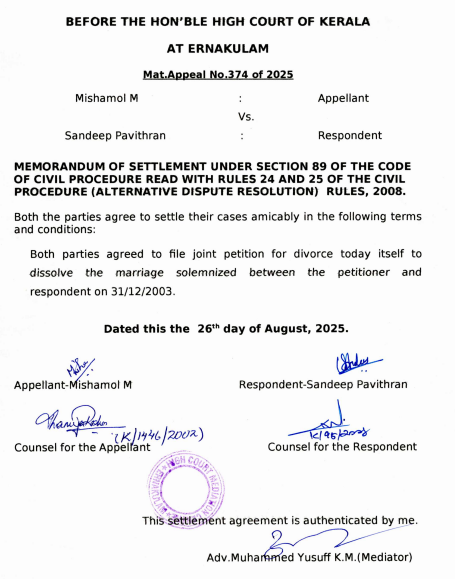
2. Today, when this appeal came up for hearing, the learned counsel appearing for both sides submitted that the entire disputes between the parties have been settled and a joint petition and memorandum of mediation settlement agreement have been filed before this Court.
3. We have examined the memorandum of agreement and we notice that it has been signed by the parties and subscribed by their counsel. The terms of the agreement are lawful and therefore, the settlement arrived at by the parties is accepted.
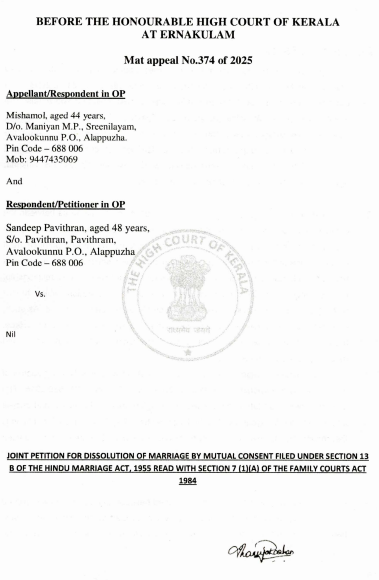
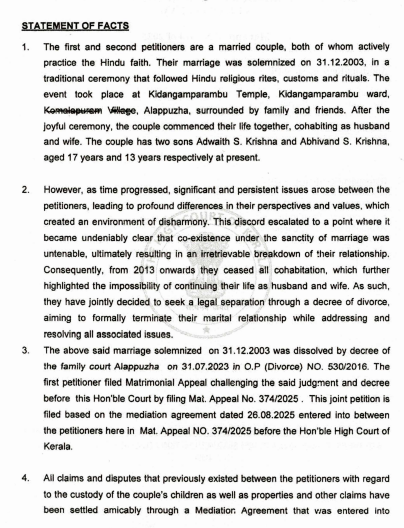
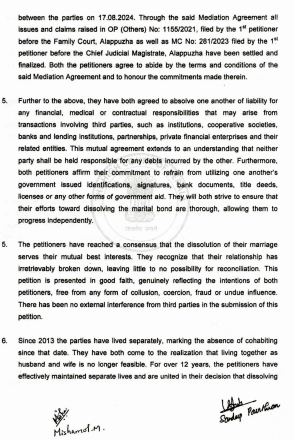
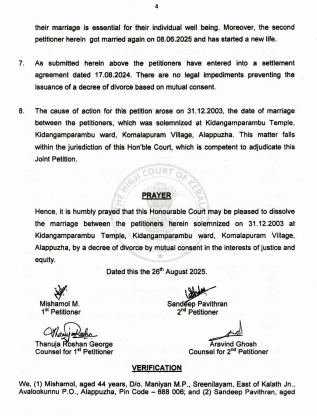
4. In view of the settlement arrived at by the parties, Mat.A No.374 of 2025 3 2025:KER:67724 appellant and respondent have filed a petition under Section 13B of the Hindu Marriage Act, 1955 for dissolution of their marriage by mutual consent, wherein they have stated that they have mutually agreed and decided for dissolution of marriage voluntarily and there is no collusion. Further it is stated that there is no coercion or undue influence from any corner in filing the petition under Section 13B of the Hindu Marriage Act.
6. Both parties have affirmed that the entire disputes between the parties have been settled in terms of the memorandum of agreement filed by the parties.
7. We are convinced that the marriage between the spouses who are Hindus has been irretrievably broken down and there is no possibility of reunion and divorce is the viable option and all the attempts of reunion have been failed. We are also convinced that the parties have voluntarily filed the petition under Section 13B of the Hindu Marriage Act and there is no collusion between the parties and this Court is satisfied that the consent was not obtained through fraud or coercion.
8. We are of the view that this is a fit case to grant divorce by mutual consent on the application filed under Section 13B of the Hindu Marriage Act.
9. Accordingly, Mat.Appeal.No.374/2025 allowed and Mat.A No.374 of 2025 4 2025:KER:67724 judgment and decree in OP( HMA ).No.530/2016 of Family Court, Alappuzha stand set aside.
10. The marriage between the appellant and the respondent is dissolved by a decree of divorce by mutual consent under Section 13B of the Hindu Marriage Act, 1955 with effect from today.
The parties are directed to act implicitly in terms of the memorandum of agreement and the joint memo and shall comply all the terms therein, which do form part of the judgment.