
 Back
Back





IN THE HIGH COURT OF KERALA AT ERNAKULAM
EASWARAN S., J
MUHIYUDHEEN – Appellant
Versus
ABDUL HAQUE – Respondent
RSA NO. 1141 OF 2015|OS NO.29 OF 2010|AS NO.53 OF 2012
| Table of Content |
|---|
| 1. preliminary decree in partition case established. (Para 1 , 2 , 10) |
| 2. arguments on financial contributions and joint ownership rights presented. (Para 3 , 4 , 5) |
| 3. court's analysis of evidence and findings on contributions. (Para 6 , 7 , 8 , 9 , 11 , 12) |
| 4. determining partition rights based on financial contribution. (Para 13) |
| 5. final decision on partition shares issued. (Para 14) |
JUDGMENT
This appeal arises out of the preliminary decree in a suit for partition. O.S. No.29 of 2010 on the files of the Munsiff Magistrate, Perinthalmanna, was instituted by the 1st respondent, who is now no more and his legal representatives, impleaded as additional respondents 4 to 8, are prosecuting the case. As per the averments in the plaint, a property, having an extent of 3.55 Acres, was purchased in the name of the plaintiff and the defendants in the year 1984. While so, in the year 1999, the parties attempted to partition the property by executing a registered partition deed No.2514 of 1999. However, the 1st defendant did not sign the said partition deed, and accordingly, that partition was not effected. Later, the plaintiff filed the present suit, O.S. No.29 of 2010 before the Munsiff Court, Perinthalmanna, on the pretext that the property in question was jointly purchased by all four brothers. The 1st defendant entered appearance and resisted the plea for partition on the ground that he is entitled to hold the property on his own because of the contribution made by him for the purchase of the same. The 1st defendant’s defence was that he was employed in the gulf and was financially sound, and that the defendants 2 and 3, who are the brothers, were students at that time and had no financial capacity to purchase the property. On behalf of the plaintiff Ext.A1 to A6(a) documents were produced and marked, and the plaintiff himself was examined as PW1. The 1st defendant/appellant got himself examined as DW1 and produced Ext.B1. Though the 2nd and 3rd defendants supported the plea of the plaintiff, did not adduce any oral or documentary evidence. The trial court, on appreciation of the oral and documentary evidence, came to the conclusion that the plaint B schedule property was liable to be partitioned into four equal shares and accordingly passed a preliminary decree by directing the plaint schedule property to be partitioned by metes and bounds. Aggrieved, the appellant herein/defendant No.1 preferred A.S. No.53 of 2012 before the Additional District Court-II, Manjeri, which was dismissed by judgment dated 2.7.2019 and hence this appeal.
2. On 27.10.2015, while admitting the appeal, this Court issued notice to the respondents on the questions of law framed in the memorandum of appeal, which read as under:
A. When it is specifically alleged in the plaint that the parties have jointly purchased the plaint schedule property have not the courts below seriously erred in taking the view that the purchase price came from the father of the parties--- a case which none of the parties have?
B. Is it not a case where section 45 of the Transfer of Property Act clearly applies and is not the appellant/1st defendant entitled to a share equal to that of his contribution in the purchase price?
C. Have not bought the courts erred in not even adverting to section 45 of the Transfer of Property Act ?
D. The plaintiff, as PW-1, having clearly admitted that both he and the 1st defendant were abroad at the time of obtaining Exhibit A-1 assignment deed, should not the courts below have accepted and relied upon the entries in Exhibit B-1 pass book to at least prima facie find that the 1st defendant's case is more probable and should they not have held that the burden shifted to the plaintiff to prove otherwise?
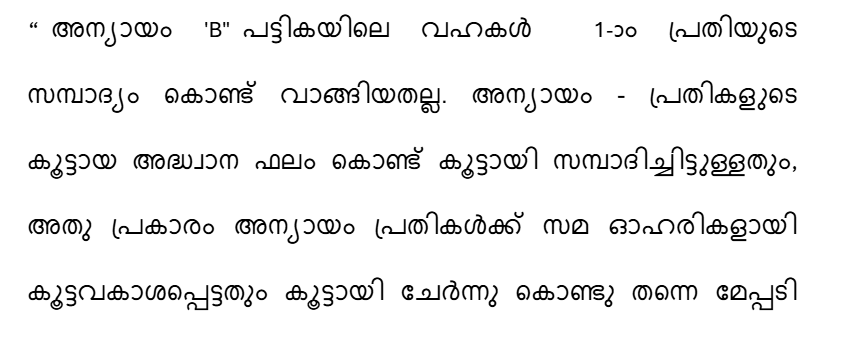
E. Have not the courts below seriously erred in not even attempting to find out the respective contribution of each of the sharers towards the purchase price utilised for purchasing the plaint schedule property as per Exhibit A-1 especially wh




An indispensable Tool for Legal Professionals, Endorsed by Various High Court and Judicial Officers
Please visit our Training & Support
Center or Contact Us for assistance

Scan Me!
India’s Legal research and Law Firm App, Download now!


For Daily Legal Updates, Join us on :



 Back to top


