
 Back
Back





IN THE HIGH COURT OF KERALA AT ERNAKULAM
MRS. SHOBA ANNAMMA EAPEN, J
HAMZA M., SHAJI M.K. – Appellant
Versus
STATE OF KERALA – Respondent
WP(C) NO. 2658 OF 2026
| Table of Content |
|---|
| 1. need for donor due to unsuitability of relatives. (Para 1 , 2) |
| 2. evaluation of donation motivation questioned. (Para 4 , 5) |
| 3. verification of altruism stated by donor. (Para 6) |
| 4. court found no evidence of commercial transaction. (Para 7) |
JUDGMENT
The first petitioner is a person in need of kidney transplantation. Since the kidneys of his close relatives were found unsuitable for transplantation, the second petitioner expressed his willingness to donate his kidney to the first petitioner.
2. The application submitted by the petitioners was initially rejected by the third respondent as per Ext.P7 order. The said order was challenged in appeal; however, the appellate authority also rejected the request as per Ext.P10 order. Aggrieved by Ext.P10, the petitioners approached this Court by filing a writ petition, which was dismissed. The petitioners then preferred an appeal; and as per Ext.P12 judgment, the Division Bench of this Court set aside Exts.P7 and P10, and directed the third respondent to reconsider the matter. Upon reconsideration, the third respondent again rejected the request as per Ext.P13 order. The petitioners once again approached this Court challenging Ext.P13, and by Ext.P16 judgment, this Court directed the third respondent to reconsider the matter. Pursuant to Ext.P16, the third respondent passed Ext.P18 order rejecting the request again. The matter was again brought before this Court, and by Ext.P20 judgment, the third respondent was directed to reconsider the matter afresh and to assign satisfactory reasons. Finally, the third respondent passed Ext.P21 impugned order rejecting the application. It is challenging Ext.P21 that the petitioners have filed the present writ petition.
3. I have heard the learned counsel for the petitioners and the learned Government Pleader.
4. To find a donor for kidney transplantation if close relatives are unavailable, is a cumbersome task. The rules do not prohibit kidney transplantation from donors other than close relatives. As per the Transplantation of Human Organs and Tissues Act , 1994, transplantation from a donor, who is not a near relative, is permissible only if the donor is able to establish that the donation is motivated by altruism towards the recipient or that there exists a strong and genuine link between them. A large number of patients require organ transplantation to save their lives; however, only a few are fortunate enough to find a matching donor. In the present case, the first petitioner is in urgent need of kidney transplantation and is stated to be in a medical emergency. Despite several rounds of litigation, and notwithstanding repeated directions from this Court to pass a reasoned order, the third respondent rejected the request of the petitioners. From Ext.P21, it is seen that the rejection was on the ground that the statements given by the donor, his wife, and the recipient’s wife were found to be unreliable, and that the proposed donation was not motivated by altruism, but allegedly based on commercial transaction. If a commercial transaction is established, the donation would clearly be impermissible under the Act. In order to prove the link, though several questions were put forward to the donor, the recipient and their family members, the committee could not get a clear answer from them. There may be some variations in the reply or answers given by the family members or the donor or the recipient. It is very difficult to prove love and affection towards a person.
5. For proving commercial transactions, the third respondent relied on Ext.P19 police verification report. Some of the findings in Ext.P19 police verification report reads as follows:
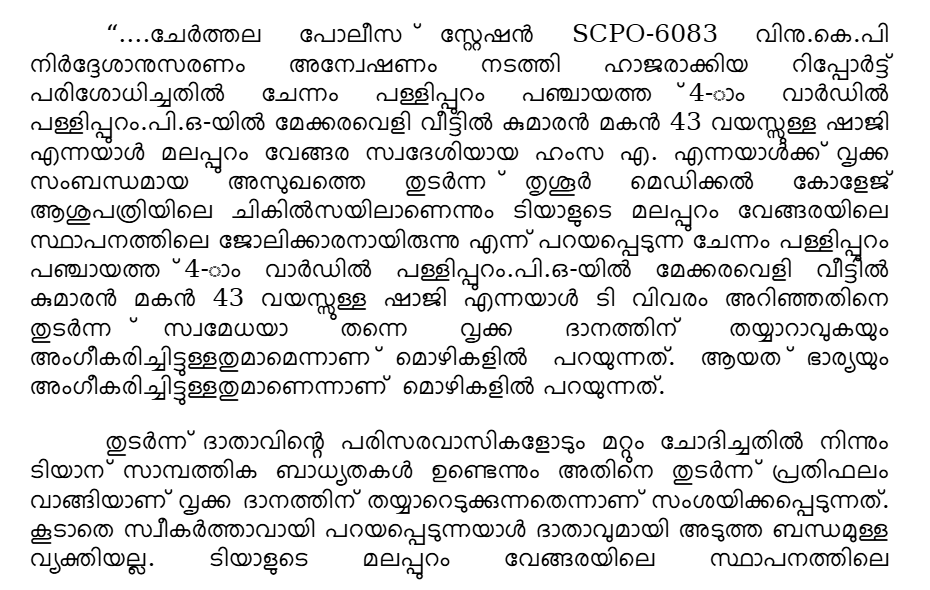
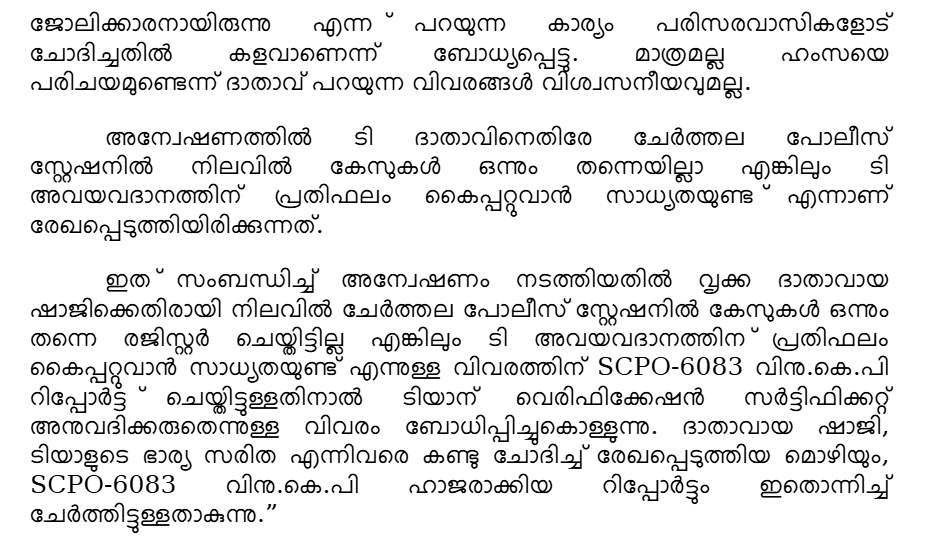
It is revealed from Ext.P19 police verification report that though they have interacted with the donor and his family members, no questions were asked directly to them regarding financial liabilities, if any, of the second petitioner/donor. Upon conducting an enquiry among the neighbours of the do



An indispensable Tool for Legal Professionals, Endorsed by Various High Court and Judicial Officers
Please visit our Training & Support
Center or Contact Us for assistance

Scan Me!
India’s Legal research and Law Firm App, Download now!


For Daily Legal Updates, Join us on :



 Back to top


