
 Back
Back





IN THE HIGH COURT OF KERALA AT ERNAKULAM
EASWARAN S., J
CHANDU,(DIED)(LEGAL HEIRS IMPLEADED) – Appellant
Versus
CHANDRAN , S/O KOTTAPPARAMBIL NAGAN – Respondent
RSA NO. 1063 OF 2011|A.S.NO.510 OF 2003|O.S.NO.524 OF 1997
| Table of Content |
|---|
| 1. factual background of partition dispute (Para 1 , 2) |
| 2. appellate court's admission of substantial question (Para 3 , 4) |
| 3. arguments regarding the evidence and oral partition (Para 5 , 6) |
| 4. court's analysis of oral partition and evidentiary issues (Para 7 , 8 , 9 , 10 , 11 , 13) |
| 5. conclusive judgment maintaining lower court's decision (Para 14) |
JUDGMENT
This appeal is preferred by the 12th defendant in a suit for partition, aggrieved by the reversal of the judgment and decree of the Sub Court, Thrissur in O.S.No.524 of 1997 by the1st Additional District Court, Thrissur in A.S.No.510 of 2003.
2. Brief facts necessary for the disposal of the appeal are as follows:
The plaint schedule property consists of two items having extends of 1.19 acres and 2 cents respectively. It belonged to one Ramai and her three children as per a partition deed. The plaintiff is the son of one Nagan, who is the second son of Ramai. The appellant – 12th defendant is one of the son of Krishnan, who is the third son of Ramai. It is contended by the plaintiff that consequent to the death of the mother in 1987, the property devolved among the plaintiff and the defendants and they are in joint possession. Since the request for separate possession of the plaintiff's right was declined, a notice demanding partition was issued, to which the children of Krishnan, the third son of Ramai, replied stating that there was an oral partition among the three sons of Ramai and as per which, the father of the plaintiff had executed an agreement of sale and pursuant to which they were put in possession and hence the claim for partition cannot be accepted. Thus, the plaintiff instituted the suit. The appellant along with defendants 11 and 13 resisted the suit primarily contending that the suit for partition is not maintainable because of the oral partition among the parties in the year 1970 and that they being put in possession of the portion of the property pursuant to the agreement of sale and thus are entitled to hold the property in exclusive possession against the plaintiff. The defendants also produced various evidence to show that they constructed the building and they were paying the building tax in respect of the building constructed in the properties allotted to them. Based on these evidence, the trial court dismissed the suit. Aggrieved, the plaintiff preferred an appeal as A.S.No.510 of 2003 before the 1st Additional District Court, Thrissur. By judgment dated 16.09.2010 the appeal was allowed by reversing the judgment and decree of the trial court and passing a preliminary decree declaring 1/3 share over the plaint schedule property is that of the plaintiff and the defendants 17 to 19 and also to others. Accordingly, the 12th defendant alone has come up in the present appeal aggrieved by the judgment of the first appellate court.
3. On 28.10.2011 this Court admitted the appeal on the substantial question of law as follows:
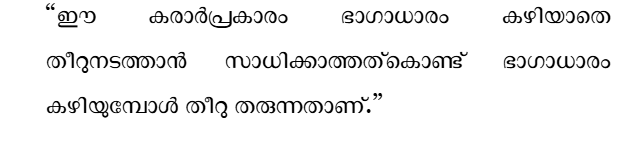
“In the light of the recitals in Ext.B5 a registered document, by Nagan under whom the plaintiffs claim right, that there was an oral partition before 1974, whether first appellate court was justified in holding that there was no oral partition and the plaint schedule property is available for partition.”
4. Heard Sri.G.Sreekumar Chelur, learned counsel appearing for the appellant and Sri.Santhosh Poduval, learned counsel appearing for the first respondent-plaintiff.
5. Sri.G.Sreekumar Chelur, learned counsel appearing for the appellant pointed out that as far as the children of Nagan are concerned, they cannot have any right over the property because during the life time of Nagan, he had accepted the oral partition and had even received the sale consideration fixed under Ext.B5 agreement of sale. The trial court had correctly appreciated the evidence adduced by the defendants. The plaintiff on the other hand did not even choose to step into the box and adduce any oral evidence which would show that they have nothing to contradict



An indispensable Tool for Legal Professionals, Endorsed by Various High Court and Judicial Officers
Please visit our Training & Support
Center or Contact Us for assistance

Scan Me!
India’s Legal research and Law Firm App, Download now!


For Daily Legal Updates, Join us on :



 Back to top


