
 Back
Back





IN THE HIGH COURT OF KERALA AT ERNAKULAM
MR. EASWARAN S., J
SREE BHAGAVATHY VILASAM, N.S.S KARAYOGAM – Appellant
Versus
KANINADU SREE BHAGAVATHY KANINADU KARA – Respondent
RSA NO. 1277 OF 2012 | A.S. NO.23 OF 2011 | OS NO.25 OF 2009 | CO NO. 46 OF 2014 | RSA NO.1280 OF 2012
| Table of Content |
|---|
| 1. factual background of temple management dispute. (Para 1 , 2) |
| 2. substantial questions of law formulated for consideration. (Para 3 , 4) |
| 3. arguments raised by both parties regarding temple administration. (Para 5 , 6 , 7) |
| 4. court's observations on the status and rights of office bearers. (Para 9 , 10 , 12 , 18 , 19 , 20) |
| 5. ratio decidendi on management rights under the settlement deed. (Para 23 , 43) |
| 6. final decision reversing the sub court's judgment. (Para 46) |
JUDGMENT
The defendants 1 to 3 in O.S. No.25 of 2009, a suit filed for declaration that a settlement deed executed in favour of defendants 1 and 2 by the 3rd defendant for management of the Sree Kaninadu Bhagavathi Temple is void and for recovery of possession, have come up in these appeals, aggrieved by the reversal of the judgment and decree rendered by the Munsiff Court, Perumbavoor, by the Sub Court, Perumbavoor in A.S. No.23 of 2011. The plaintiffs, on the other hand, have come up with the Cross Objection, contending that the first appellate court ought to have allowed the appeal in full and not in part.
2. The brief facts necessary for the disposal of the appeals and the cross objection are as follows:
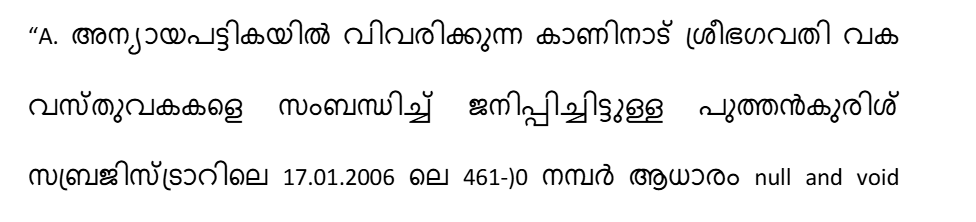
The dispute centers around 18 Ares of land of Kaninadu Sree Bhagavathi Temple. The deity of the temple is made as the 1st plaintiff, represented by plaintiffs 2 and 3, who are the office bearers of a registered society, by name, Kaninadu Sree Bhagavathi Khesthra Bharana Samithy, a society registered under the provisions of the Travancore Cochin Literary, Scientific and Charitable Societies Registration Act, 1955 . The 3rd defendant, through the power of attorney holder, executed a settlement deed in favour of defendants 1 and 2 by which the right of management of the temple was given to the 1st defendant. The plaintiffs impugn the settlement deed on the ground that the 3rd defendant could not have alienated the property of the temple because the property of the temple did not belong to Komana Mana, of which the 3rd defendant claims to be the eldest member, but, on the contrary, to the deity itself. The plaintiffs further claim that the temple is a public temple and therefore the management of the temple vests with the worshipers and thus they formed an association which was registered as a Society under the provisions of the . The plaintiffs further allege that the 1st defendant had trespassed into the property and had taken away the records, and thus they have thrown out the plaintiffs from the management of the society and therefore are constrained to institute the suit for recovery. Additionally, it is pleaded that the 3rd defendant does not have any right to alienate the properties of the temple, which belongs to the deity. In support of their plea, various registers and minute books pertaining to the selection of the office bearers of the society and two tax receipts showing the remittance of tax in respect of the plaint schedule property in the name of the deity were produced. The defendants, on the other hand, contended that the plaintiffs 2 and 3 are usurpers and do not have any right over the management of the temple. The management of the temple was always vested with the Bhramaswom and belonged to the family of Komana Mana, who in turn had derived the right under Ext.B1 partition deed. The 3rd defendant, being the eldest member of the family, had transferred the right of management of the temple to the 1st defendant because the family found it difficult to manage the expenses of the temple. It is further contended that, going by Ext.A2 settlement deed, the 1st defendant had no absolute right over the property but only the right of management, and if it is found that the temple is not being administered properly, the 3rd defendant retains the right to recall Ext.A2 and thereby take back the management of the temple. On behalf of the plaintiffs, Exts.A1 to A12 documents were produced, and PW1 to PW3 were examined. On behalf of the defendants,




An indispensable Tool for Legal Professionals, Endorsed by Various High Court and Judicial Officers
Please visit our Training & Support
Center or Contact Us for assistance

Scan Me!
India’s Legal research and Law Firm App, Download now!


For Daily Legal Updates, Join us on :



 Back to top


